






Sometimes the next big step in one’s career starts with a change in perspective. An Executive MBA gives professionals the chance to rethink what’s possible. They have an opportunity to sharpen their business skills. They also learn alongside people who see the world differently.
For some professionals, that means building the business knowledge they need to move into leadership. For others, it means exploring a new industry, starting a company, or discovering that the career they thought they wanted might look a little different after all.
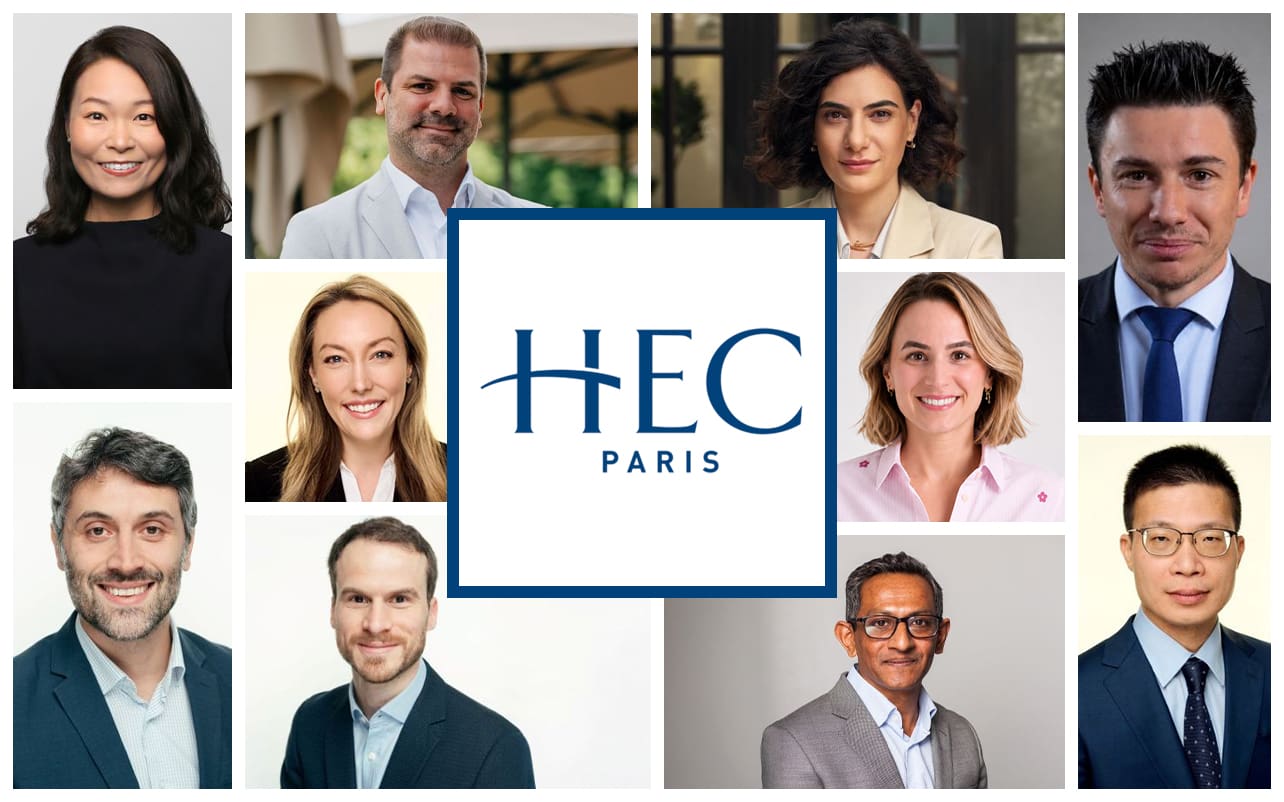
For these 10 HEC Paris EMBA alumni, the experience brought all of that and more. These students found new perspectives on leadership, lasting professional relationships, and in some cases, a completely different way of looking at their futures.
WHY GO FOR AN EMBA?
One recent EMBA alumni is Jui-Hsien Chang, Class of 2025. He’s currently working as the New Business Development Director at Wahlee Industrial Corp. He decided to go for his EMBA came down to filling a gap in his education and preparing for his next career move.
“Throughout my career before the EMBA program I was working in the function of strategy, marketing and new business development,” explains Chang. “However, because my previous studies focused on engineering and science, I felt that I lacked some business and finance knowledge. In order to advance my career, I believed I needed a holistic education in business administration.”
Chang also decided he wanted to explore professional networks and explore opportunities in other regions. HEC Paris stood out because of its location in Europe, its strong international reputation, and the diversity of its student body.
Mario Mero, Class of 2022 and Director of Operations at Joyson Safety Systems, came into the EMBA program with a similar desire to understand business beyond his technical background.
“As an engineer, I always understood the how but not always the why behind business decisions – that curiosity is what pushed me toward an EMBA. I also saw a strong foundation in business administration as the springboard I needed to keep climbing the corporate ladder,” Mero shares.
Choosing HEC Paris also felt like a natural fit to him.
“I live in Paris, and HEC Paris is one of the best business schools in the world – with an alumni network right here on my doorstep,” Mero adds. “Never underestimate that network. And HEC’s values, excellence and daring, are simply my own values, which made the fit obvious.”
Naomi Sasaki, Class of 2024 and Corporate Projects Manager at Fuji Electric Europe GmbH, says the people she encountered helped her make the decision.
Sasaki first became seriously interested in HEC Paris after attending an event in Tokyo where alumni from several business schools gathered. What stood out to her was how the HEC alumni interacted with one another.
HEC Paris EMBA group shot
“The HEC alumni I spoke with were open, collaborative, and genuinely approachable. The overall atmosphere made me feel that HEC could be a place where I would fit in,” she says.
Sasaki researched the program further and was drawn to its leadership focus, entrepreneurship specialization, and access to the entrepreneurial ecosystem.
The diversity of the cohort was also a big draw, along with the opportunity to build meaningful relationships with classmates from different walks of life.
Her conversations with Japanese EMBA alumni and the support she received from the admissions team reinforced that first impression.
BALANCING WORK, LIFE, AND ACADEMICS
An EMBA is designed for people who already have demanding professional lives. But fitting classes, assignments, and group work around an existing career can still require some serious planning, especially when getting to campus means crossing the world.
Sasaki experienced this firsthand while completing the program’s core modules. At the time, she was working in Japan and had to travel to attend five modules in person.
“To attend five modules in person, I took one or two weeks of leave each time,” she says. “To put that into perspective, the average employee in Japan takes only around 11 days of paid leave a year. On top of that, each trip involved about 15 hours of travel each way. Looking back, I sometimes wonder how I managed it.”
Planning ahead and communicating with her employer made a difference. As soon as she was admitted, Sasaki spoke with her manager about why the EMBA mattered to her and how the learning could benefit her work, too.
“I was fortunate to receive strong support, and I remain very grateful to my manager at the time, as well as to the colleagues who covered for me while I was away.”
Program Director at MBDA, Julien Hebert from the Class of 2024 was also navigating a busy year. Alongside a demanding full-time job, family commitments, and his EMBA, he was training for the Diagonale des Fous, an exceptionally demanding ultratrail race on Réunion Island.
It was the year he was turning 40, so Hebert decided to make the most of it. He also took trips he had long dreamed about, including visiting Greenland, seeing mountain gorillas in Uganda, and exploring the pyramids at Giza in Egypt.
“It was probably the most intense year of my life, but also one of the richest,” Hebert says. “Looking back, balancing everything was challenging, but having so many meaningful things happening at the same time made it an incredibly rewarding year.”
His experience is a reminder that pursuing an EMBA doesn’t necessarily mean putting the rest of your life on hold. He made room for several ambitions at once.
UNFORGETTABLE MEMORIES
Ask alumni what they remember most about business school, and many reflect on just how much they can learn from the people around them.
For Hebert, that moment came when he first met his cohort and saw the range of professional backgrounds represented.
“We had people from all over the world and from completely different fields: cardiology, law, finance, oil & gas, marketing, HR, and many others,” he says.
Even classmates with engineering backgrounds brought very different cultural perspectives and ways of approaching problems. That mix made discussions more interesting and challenged students to consider solutions they might never have reached on their own.
“Discovering how differently people could approach the same problem was fascinating, and this diversity became one of the most valuable parts of the HEC experience,” Hebert says.
The relationships built was one of the best experiences for Antoine Colson, Class of 2021. Currently an Industrial Director and Innovation & Digital Transformation Leader, Colson entered the EMBA after nearly a decade of learning primarily on the job.
Having moved into an industrial leadership role while also leading innovation and digital transformation initiatives, he wanted to understand how manufacturing, technology, and innovation could work together as part of a broader business strategy.
“Beyond the technical knowledge and frameworks, I gained a group of friends who continue to help me grow. They challenge me with honesty and kindness, and help me see the blind spots that are often impossible to recognize on our own,” Colson says.
The cohort became a trusted circle he could turn to for professional and sometimes personal advice, even after graduation. He also found himself learning from classmates in unexpected ways, borrowing ideas and approaches he had seen them use months earlier.
“Perhaps the deepest personal transformation was almost unconscious,” Colsom says. “It did not happen during one class and it cannot easily be quantified. It came from the accumulation of conversations, different perspectives, moments of admiration, and honest exchanges with other leaders. Little by little, those experiences changed the way I listened, reflected, and led.”
Class of 2024 and the Director of SME Business at TBC Bank, alumni Natia Pachikashvili says that one of her most memorable experiences was a two-day outdoor leadership seminar.
She explains that she was anxious before the seminar began, worried that some of the physical activities might be difficult or uncomfortable. But what happened was that it actually was one of the most rewarding parts of the EMBA for her.
The activities put students in situations where they had to lead, communicate, collaborate, and make decisions without knowing exactly what would happen next.
“For me, it was also a powerful exercise in self-awareness,” shares Pachikashvili. “I became more conscious of my strengths, but also of where I needed to develop. It reinforced how much communication, trust, and cultural intelligence matter when you are leading people through uncertainty.”
AN EMBA CAN CHANGE YOUR CAREER IN UNEXPECTED WAYS
An EMBA program can open the doors to help professionals change how they see their potential, the opportunities in front of them, and the risks worth taking.
Pachikashvili entered the program with a background predominantly in risk management. After graduating, she was promoted to Deputy Chief Risk Officer before making a bigger transition into the business side of banking. Today, she leads SME Business at TBC Bank, with responsibility for customers, growth, strategy, and commercial opportunities.

EMBA alumni cap throw
“The EMBA played an important role in preparing me for that transition. It gave me a broader understanding of how organizations create value and greater confidence in operating beyond the boundaries of my original functional expertise,” she says.
Julia Riou, Class of 2024, Co-Founder of Deméa Paris, has learned what it means to make a dramatic career change.
She joined the EMBA while working at Rubis. She wanted to learn more, challenge herself intellectually, and meet people outside the professional circles she already knew.
Today, however, she is building Deméa Paris, a womenswear brand she co-founded around the idea that clothing can help women feel confident without sacrificing comfort, elegance, or practicality. Her inspiration came from her own experiences traveling and working in male-dominated environments, where she became increasingly aware of the relationship between clothing, confidence, and presence.
“The EMBA did not teach me how to build a fashion brand and I think that distinction matters. What it gave me was a framework, confidence in my ability to learn, and access to an extraordinary ecosystem of people,” Riou says.
Riou’s story also shows how a program can help people become comfortable taking a risk they might otherwise have avoided.
“Not at all,” she says when asked whether her current role was what she envisioned when she began the EMBA. “If someone had told me when I started the EMBA that a few years later I would leave the energy industry and launch my own fashion brand, I probably would not have believed them.”
LEARNING TO LEAD BEYOND YOUR AREA OF EXPERTISE
Not every career transformation involves changing industries. Sometimes, the biggest shift is learning to approach the work you already do in a different way.
Eventually, Riou reached a point where staying on a familiar career path felt riskier than trying something new.
“I was 35, I had a good position in a company I respected, and I could very easily have continued on that path,” she shares. “But I did not want to wake up at 50yo wondering what might have happened if I had taken the chance.”
Riou didn’t have every answer when she started her business. Instead, she leaned on her professional experience, asked questions, and surrounded herself with people who had expertise she lacked.
“Instead, I started with what I knew, surrounded myself with people who knew what I didn’t, asked a lot of questions, and learned the rest along the way,” she says. “Between my professional experience and the EMBA, I had developed enough confidence to think: I may not know exactly how to do this yet, but I trust myself to figure it out.”
Jillian Toussaint, HEC Paris Class of 2024 and Engineering Improvement Manager at Air Products, decided to pursue her EMBA after nearly 15 years as an engineer. She could often identify a problem and even see a possible solution, but getting the broader organization on board was another matter.
“So for me, the EMBA was never about leaving engineering behind,” she explains. “It was about expanding my perspective. I wanted to build confidence in areas such as finance, strategy, legal risk, and organizational leadership so I could move from identifying problems to helping lead meaningful change.”
When she began the program, Toussaint thought it might lead her away from engineering and toward another business role. What she discovered was that her technical background was one of her greatest strengths.
“The combination of technical experience and broader business knowledge allows me to connect the practical realities of operations and engineering with strategic decisions, financial impact, and organizational change. That has become a powerful place to operate from,” she says.
She’s still working in the same industry, and she still enjoys solving complex problems. That shift also changed how she thinks about leadership. Earlier in her career, she believed that strong technical expertise, hard work, and good problem-solving would naturally create opportunities. As she progressed, she realized that leadership requires more.
“Influence is not politics,” Toussaint says. “Building relationships, earning trust, understanding stakeholders, and helping people see a different perspective are essential leadership capabilities. Good ideas do not move through organizations on their own. People move them,” she says.
EMBA alumni Jayraj Lutchmun from the Class of 2020 and Founder and CEO of LetsBe says the EMBA offered him a shift in perspective.
When he enrolled, Lutchmun was working as a country manager in the oil and gas industry. He wanted to strengthen his strategic and leadership skills, expand into new markets, and prepare for greater responsibility.
Lutchmun says his EMBA experience really challenged what he thought he already knew.
“The program gave me one of the most humbling realizations of my professional life: I had to question much of what I thought I knew and become a learner again,” Lutchmun says.
He learned to look at businesses from multiple perspectives, challenge assumptions, and remain open to unfamiliar ideas. Rather than viewing learning as something that ends after a certain point in your career, he came to appreciate it as an ongoing process.
“Today, I see business differently – and I genuinely enjoy the continuous process of learning and creating,” he says.
WORDS OF WISDOM FOR FUTURE EMBAS
Grads of the HEC Paris EMBA have a few important messages to pass on. Be ready to work hard, make time for the people around you, and don’t assume you need to have your entire career mapped out before you begin.
Lutchmun’s advice is to approach the experience with curiosity and a willingness to question what you think you know.
“Be prepared to work hard. The program demands time, discipline, humility, and genuine commitment,” he says. “If you want to discover your purpose, differentiate yourself, and acquire tools and perspectives that may take you far beyond what you currently imagine, then go for it.”
He also encourages future students to approach the experience like a sponge, absorbing new ideas, reflecting on what they learn, and remaining open to perspectives that challenge their assumptions.
Hendrik Buske, Class of 2024 and Director of Customer Success Management at Serviceware SE says that for him. pursuing an EMBA was about personal and professional growth. He wanted to step outside familiar patterns, and learn alongside people with different backgrounds and experiences.
“If you are genuinely curious and feel that desire to grow, go for it! But go into it with the intention of fully embracing the experience,” Buske says.
Balancing an EMBA with a demanding career isn’t always comfortable. It requires discipline, commitment, and plenty of long evenings – but it is so worth it.
“Be open to the people around you, engage with perspectives that are different from your own, ask questions, participate, and make the most of every opportunity to learn,” he says. “If you are willing to challenge yourself, the HEC Paris EMBA can change much more than your CV. It can change the way you think.”
DON’T MISS THESE PROFILES OF RECENT HEC PARIS ALUMNI
© Copyright 2026 Poets&Quants. All rights reserved. This article may not be republished, rewritten or otherwise distributed without written permission. To reprint or license this article or any content from Poets&Quants, please submit your request HERE.

