




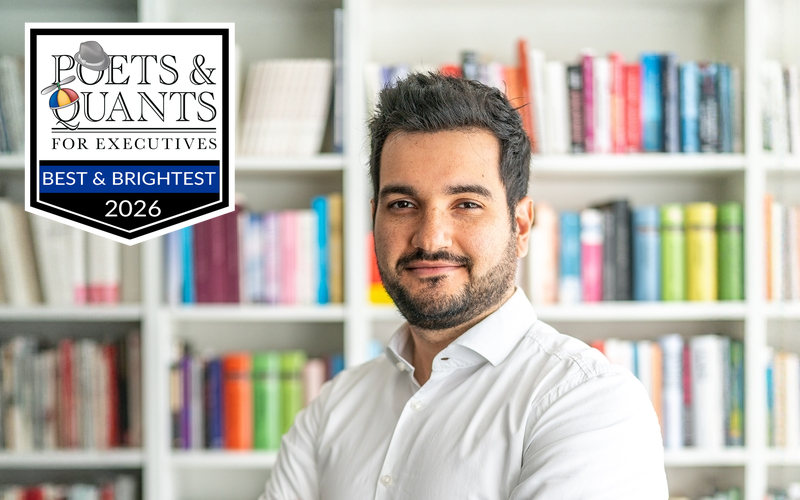
Saulo Santana
IESE Business School
Age: 39
“A Brazilian in Germany, creative by origin, business by conviction. I build where contradictions don’t usually work.”
Hometown: Potsdam, Germany
Family Members: Married with one daughter.
Fun fact about yourself: As a child, I wanted to become a professional tennis player. Very early on, I understood that performance is not only about training the body, but about mastering the mind – including how you deal with pressure, focus and doubt.
In my twenties, I sold everything I had to open a chocolate store in a high-end shopping mall. It failed. It was the first time I experienced full ownership of decisions, consequences, and risk. Looking back, it was my first real MBA.
Becoming a father two years ago changed something more fundamental. I learned what it really means to face critical stakeholders and still advocate for decisions that are not always popular…but necessary.
Undergraduate School and Degree: UNESA University (Brazil), Industrial Design
Where are you currently working? I am the chief creative officer at Axel Springer SE, where I lead a multidisciplinary team of more than 200 professionals across product, brand, design, data, and storytelling.
In parallel, I serve as senior advisor at Kekst CNC (Publicis Groupe), where I founded the Kekst CNC Creative Studio and built its business and operating model, scaling creative and campaigning capabilities across 13 countries and three continents.
Extracurricular Activities, Community Work and Leadership Roles: Throughout my career, I have been recognized with more than 80 international awards, including distinctions from Cannes Lions, the Art Directors Club (ADC), the Society for News Design (SND), and other global competitions. My portfolio has been ranked multiple times among the world’s top creative work.
Early in my career, these recognitions were an important validation. They confirmed that the work was relevant beyond my immediate environment. Over time, their role changed. They became less about personal achievement and more about responsibility, using that credibility to raise the bar, influence decisions, and create space for others to contribute and be recognized.
I have also served as a judge in international competitions such as SND in New York and The Golden Steering Wheel in Europe, evaluating work across markets and disciplines.
At the same time, a significant part of my time goes into supporting people within my teams and industry, often outside formal structures. These are not formal mentoring programs, but direct conversations, helping someone think through a decision, challenge their assumptions, or take ownership of something they would otherwise avoid.
Over time, I’ve come to see that impact is rarely created in visible moments. It happens in how people think, decide, and act when no one is guiding them. If I can influence that, then the work extends far beyond any individual project or recognition.
Which academic or extracurricular achievement are you most proud of during business school? It was recognizing that experience can become a constraint. At a certain level, you rely on pattern recognition. It makes you fast, but it can also make you predictable.
The MBA exposed me to perspectives that did not fit those patterns. The same problem, approached from different industries and contexts, led to completely different conclusions.
The shift for me was to slow down, question more, and resist the instinct to jump to conclusions. That has changed how I approach decisions and how I listen.
What achievement are you most proud of in your professional career? It was building a career that connects creativity with business in a way that creates real outcomes. I started in the creative industry, where the focus is often on ideas and execution. Over time, I became increasingly interested in how those capabilities translate into business impact, how ideas become products, how communication shapes decisions, and how creativity can influence growth, not just perception.
The most meaningful part of my career has been building that bridge. Not only operating as a creative professional, but using that background to build teams, develop business models, and scale capabilities across organizations.
What I’m most proud of is proving that creativity is not just an output function. When integrated early, it becomes a way of thinking that improves how businesses operate, prioritize, and grow.
Who was your favorite MBA professor? The ones who didn’t provide answers, but forced decisions. They created situations where you had to take a position, defend it, and adapt under pressure. That reflects reality much more than theoretical clarity.
Why did you choose this school’s executive MBA program? It was because of how IESE approaches business. What stood out was not only the global structure of the program, but the underlying philosophy: business as a responsibility, not just a performance system.
The combination of general management focus, the case method, and a humanistic approach creates a very special environment. Decisions are not analyzed in isolation, but in context: considering people, long-term consequences, and trade-offs. This aligns with how I see business: not as a purely analytical exercise, but as a system of decisions that affect organizations, people, and society at the same time.
Give us a story during your time as an executive MBA on how you were able to juggle work, family and education. The most difficult part of the MBA was not the workload. It was the accumulation of decisions. There were weeks where everything converged (board-level topics at work, assignment deadlines, travel between modules). At the same time, my daughter was in her first year of life. I would leave home before she woke up and return after she was already asleep, joining calls from airports while trying to stay present in both worlds.
At some point, it became clear that this was not a problem of time management. It was a problem of design. I had to fundamentally change how I operated. Delegation was no longer about efficiency, but about building a system that could function without my constant involvement. That meant developing people to take decisions, not just execute tasks, and accepting that outcomes might differ from how I would have approached them.
At home, it required a different discipline. I was not trying to compensate for absence, but be fully present in the time that was available. The real learning was understanding that you cannot optimize all dimensions at once. You make trade-offs, consciously. And over time, you become more deliberate about where your presence actually creates value and where it doesn’t.
What advice would you give to a student looking to enter an executive MBA program? Be clear about what you want to change. The program will expose different perspectives and frameworks, but it will not create change by itself. That depends on how willing you are to question your own assumptions.
What was your biggest regret in business school? Trying to optimize too early. Some of the most valuable insights came from conversations and perspectives that could not be planned or structured.
What is one way that your business school has integrated AI into your programming? What insights did you gain from using AI? AI was not approached as a standalone technology, but as part of a broader shift in how organizations operate. The key insight is that without rethinking processes, decision-making, and organizational structures, AI does not create meaningful change. It simply accelerates what already exists. If the system is clear, it scales effectiveness. If not, it scales inefficiency.
What was the main reason you chose an executive MBA program over part-time or online alternatives? It was because learning at this level depends on context. The Global Executive MBA format creates depth through interaction with peers operating in complex environments across industries and geographies, something that cannot be replicated through content alone.
And that “G” before EMBA played a real role, not as a label, but in how the program is designed. Having each module in a different country exposes you directly to how business is shaped by local context, as opposed to having theoretical discussions about cultural differences. That combination was decisive for me.
How did you finance your EMBA and what did you do to make tuition and associated costs more affordable? The GEMBA program was financed by my company. In terms of costs, I kept travel and accommodation efficient by aligning with classmates when possible and planning early.
What is your ultimate long-term professional goal? I want to build organizations that perform at a high level without eroding the people who operate them.
Many organizations are designed for short-term efficiency. They optimize output, but often at the cost of clarity, ownership, and long-term capability. Over time, this creates friction, disengagement, and dependency on individuals rather than systems.
What interests me is designing organizations differently, where performance is a result of how the system is built, not how hard individuals have to compensate for it. This means clearer priorities, better-defined decision rights, and environments where people can take ownership without unnecessary complexity. It also means aligning incentives with long-term outcomes, not just immediate results. The goal is not to reduce ambition or performance. It is to make both sustainable.
DON’T MISS: BEST & BRIGHTEST EXECUTIVE MBAS: CLASS OF 2026
© Copyright 2026 Poets & Quants. All rights reserved. This article may not be republished, rewritten or otherwise distributed without written permission. To reprint or license this article or any content from Poets & Quants, please submit your request HERE.

