




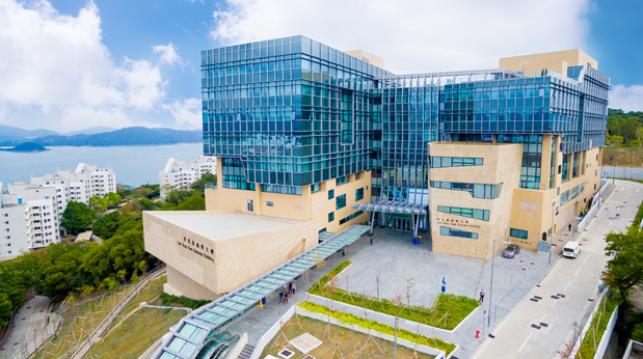
The Kellogg-HKUST Executive MBA, a joint program between Northwestern University’s Kellogg School of Management and Hong Kong University of Science and Technology, claimed the No. 1 spot in the Financial Times 2026 Global EMBA Ranking, rising from fourth place last year.
Kellogg-HKUST Business School has reclaimed the top spot in the Financial Times 2026 Global Executive MBA Ranking, rising three places to No. 1.
The joint program between Northwestern University’s Kellogg School of Management and Hong Kong University of Science and Technology climbed from No. 4 last year, returning to a position it last held in 2023. It replaces Washington University in St. Louis’ Olin-Fudan EMBA, which tumbled seven places from No. 1 to No. 8 after claiming its first-ever top ranking just a year ago.
China Europe International Business School (CEIBS) held steady at No. 2, while Spain’s IESE Business School made one of the ranking’s biggest leaps, surging 11 places from No. 14 to No. 3. France’s SKEMA Business School continued its ascent, moving up one position to No. 4 after jumping from 13th to fifth last year. ESCP Business School, last year’s third-place finisher and the top-ranked European program in 2025, slipped two places to No. 5.
THE FINANCIAL TIMES’ TOP 10 GLOBAL EMBAs IN 2026 |
||||||
2026 FT Rank |
Name |
Location |
2025 Rank |
2024 Rank |
Three-Year Average Rank |
Program |
| 1 | Kellogg/HKUST Business School | Hong Kong | 4 | – | – | Kellogg-HKUST EMBA |
| 2 | Ceibs | China/Switzerland/Ghana | 2 | 1 | 2 | Ceibs Global EMBA |
| 3 | IESE Business School | Spain/US/Germany/Brazil | 14 | 4 | 7 | Global EMBA |
| 4 | Skema Business School | France/US/China/Brazil/UAE | 5 | 13 | 7 | Global EMBA |
| 5 | ESCP Business School | France/UK/Germany/Italy/ Spain/Lebanon/UAE |
3 | 2 | 3 | EMBA |
| 6 | Guanghua-Kellogg | China/US | 10 | 12 | 9 | Guanghua-Kellogg EMBA |
| 7 | EMBA-Global: Columbia/LBS | US/UK | – | 7 | – | EMBA — Global |
| 8 | Washington University: Olin | China | 1 | 3 | 4 | WashU-Fudan EMBA |
| 9 | National University of Singapore Business School | Singapore | 23 | 32 | 21 | The NUS EMBA |
| 10 | University of Cambridge: Judge | UK | 20 | 25 | 18 | Cambridge EMBA |
The changes reflect a significant reshuffling at the top of the FT’s annual ranking of 100 executive MBA programs, which weighs alumni salaries and career advancement alongside international diversity, faculty research, and other measures.
Kellogg-HKUST’s graduates reported average annual salaries of $607,684, adjusted for purchasing power parity three years after graduation, which are among the highest in the ranking. Alumni reported a 69% increase in salary over their pre-program earnings, while 73% said the degree helped them achieve their goals. The program also reported a notably international student body, with 93% of participants coming from outside its home market.
This is the 13th time Kellogg-HKUST has topped the FT EMBA ranking. It also ranked first globally for its alumni network, which connects senior executives, entrepreneurs and business leaders across industries and regions. Alumni gave the program an overall satisfaction score of 9.73 out of 10.
“For more than two decades, Kellogg School of Management and HKUST Business School have fostered a close and fruitful partnership, bringing together outstanding faculty from around the world to deliver a world-class global management education,” says Francesca Cornelli, dean of Kellogg School of Management, in a release. “We will continue to deepen our collaboration to nurture forward-looking and responsible leaders who create long-term value for Hong Kong, Asia, and the global community.”
Frederik Anseel, dean of HKUST Business School, credits the experience participants bring to the classroom, faculty who connect research with real-world leadership challenges, and a global alumni community that continues to support graduates long after completing the program.
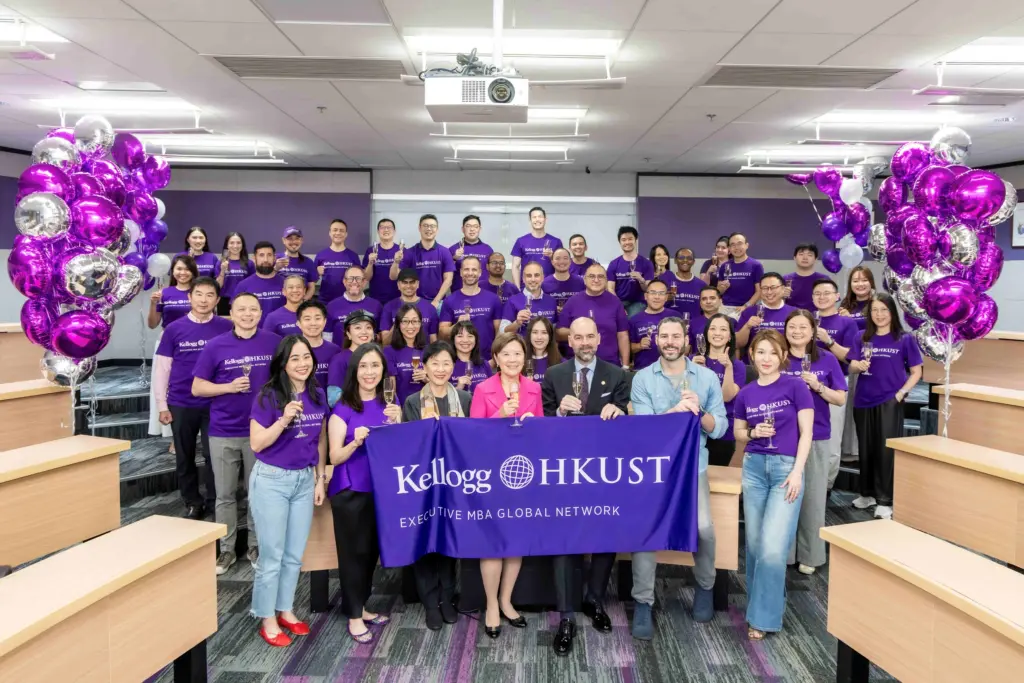
Frederik Anseel (front row, third from right), dean of HKUST Business School, joins Kellogg-HKUST EMBA students and university leaders to celebrate the program’s record-extending 13th No. 1 ranking in the Financial Times Global EMBA Ranking. Courtesy photo
THE BIG MOVERS IN 2026
Perhaps the most striking reversal of fortune belongs to WashU-Fudan. The St. Louis-Shanghai partnership’s seven-place drop comes after its 2025 victory, when it reported the highest alumni salaries and salary gains of any program in the ranking. Its average alumni salary fell from $718,662 to $649,429 this year, while its reported salary increase declined from 134% to 105%. Despite the slide, it remains among the world’s 10 highest-ranked programs.
IESE’s rise was nearly as dramatic in the opposite direction. After finishing fourth in 2024 and slipping to 14th in 2025, the school’s Global EMBA vaulted to third this year. Its alumni reported salaries of $431,065 and an 89% salary increase, while international students accounted for 95% of participants.
Two other schools made particularly impressive moves into the top 10. National University of Singapore Business School jumped 14 places from No. 23 to No. 9, with alumni reporting salaries of $542,224. Cambridge Judge Business School climbed 10 places from No. 20 to No. 10, with reported alumni salaries of $408,540.
Guanghua-Kellogg, another U.S.-China partnership, advanced four places to No. 6. EMBA-Global, the joint program offered by Columbia Business School and London Business School, returned to the ranking at No. 7 after being absent last year.
On the other end of the spectrum, INSEAD slipped from No. 7 to No. 12, dropping out of the top 10, while the TRIUM Global EMBA offered by HEC Paris, the London School of Economics, and NYU Stern fell nine places from No. 6 to No. 15. Fudan University’s standalone EMBA dropped from No. 8 to No. 17.
The Double-Digit Climbers & Fallers In The Financial Times 2026 Global EMBA Ranking |
||||||
Risers |
||||||
|
2026 FT Rank
|
Program name (School) | Location | 2025 Rank | YOY Change | 2024 Rank |
Three-Year Average Rank
|
| 49 | Weekend Executive MBA (Duke Fuqua) | U.S. | 75 | 26 | — | — |
| 55 | EMBA (Iscte Business School) | Portugal/UK/Spain | 81 | 26 | 92 | 76 |
| 68 | EMBA (Rennes School of Business) | France/China | 89 | 21 | 73 | 77 |
| 72 | Aalto EMBA (Aalto University) | Finland | 92 | 20 | 88 | 84 |
| 82 | EMBA (Tennessee Haslam) | U.S. | 100 | 18 | 100 | 94 |
| 33 | Cornell EMBA NYC (Cornell Johnson) | U.S. | 50 | 17 | 64 | 49 |
| 38 | PGPMAX (Indian School of Business) | India | 53 | 15 | 40 | 44 |
| 67 | Audencia EMBA (Audencia) | France/Algeria/ Morocco/China |
82 | 15 | 89 | 79 |
| 9 | NUS EMBA (National University of Singapore) | Singapore | 23 | 14 | 32 | 21 |
| 25 | Global EMBA (Neoma Business School) | France/China | 38 | 13 | 46 | 36 |
| 82 | EMBA (University of Porto – FEP/PBS) | Portugal | 95 | 13 | — | — |
| 59 | PHBS EMBA (Peking University HSBC) | China | 71 | 12 | 90 | 73 |
| 62 | EMBA (Texas A&M Mays) | U.S. | 74 | 12 | 76 | 71 |
| 3 | Global EMBA (IESE Business School) | Spain/U.S./ Germany/Brazil |
14 | 11 | 4 | 7 |
| 44 | EMBA (Bayes Business School) | UK | 55 | 11 | 53 | 51 |
| 69 | Smith EMBA National Program (Queen’s Smith) | Canada | 80 | 11 | 75 | 75 |
| 10 | Cambridge EMBA (Cambridge Judge) | UK | 20 | 10 | 25 | 18 |
| 76 | Smurfit EMBA (University College Dublin) | Ireland | 86 | 10 | 81 | 81 |
| 88 | EMBA (Solvay Brussels) | Belgium | 98 | 10 | — | — |
Fallers |
||||||
|
2026 FT Rank
|
Program name (School) | Location | 2025 Rank | YOY Change | 2024 Rank |
Three-Year Average Rank
|
| 31 | BI-Fudan MBA (BI Norwegian/Fudan) | China | 21 | −10 | 30 | 27 |
| 76 | EMBA (Hult International) | UK/UAE | 66 | −10 | 71 | 71 |
| 58 | EMBA (Toronto Rotman) | Canada | 47 | −11 | 54 | 53 |
| 74 | EMBA (HEC Lausanne) | Switzerland | 62 | −12 | 70 | 69 |
| 89 | EMBA (Polimi School of Management) | Italy | 77 | −12 | 98 | 88 |
| 40 | EMBA (SDA Bocconi) | Italy | 27 | −13 | 23 | 30 |
| 54 | Mannheim EMBA (Mannheim Business School) | Germany | 40 | −14 | 68 | 54 |
| 75 | EMBA (Korea University Business School) | South Korea | 61 | −14 | 62 | 66 |
| 52 | EMBA (Rotterdam School of Management) | Netherlands | 37 | −15 | 58 | 49 |
| 79 | EMBA (National Sun Yat-sen University) | Taiwan | 64 | −15 | 87 | 77 |
| 89 | EMBA (Koç University) | Turkey | 73 | −16 | 44 | 69 |
| 53 | Kellogg-Schulich EMBA (Kellogg/York Schulich) | Canada | 32 | −21 | 36 | 40 |
| 81 | EMBA (INCAE Business School) | Costa Rica/ Panama |
60 | −21 | 68 | 70 |
| 70 | Sabanci EMBA (Sabanci Business School) | Turkey | 48 | −22 | — | — |
| 91 | EMBA (UC Irvine Merage) | U.S. | 67 | −24 | 91 | 83 |
| 87 | CBS EMBA (Copenhagen Business School) | Denmark | 59 | −28 | 58 | 68 |
| Source: Financial Times Global Executive MBA Ranking 2026. | ||||||
EMBA SALARIES: 2025 vs. 2026
Alumni salaries tell a more complicated story than the ranking positions alone. Among the 87 programs appearing in both the 2025 and 2026 Financial Times rankings, average reported salaries rose about 4.5%, with 51 schools posting increases and 36 reporting declines.
Some of the biggest gains came from programs making major moves up the ranking: National University of Singapore reported a nearly $170,000 increase in average alumni salaries, while Cambridge Judge gained more than $123,000 and IESE more than $102,000.
Yet several of the highest-ranked programs moved in the opposite direction. New No. 1 Kellogg-HKUST reported a $40,166 decline, while last year’s winner, WashU-Fudan, saw the largest dollar decrease among continuing programs, falling $69,233 to $649,429. The figures, adjusted for purchasing power parity, reflect different alumni cohorts rather than salary changes experienced by the same graduates.
Of the nine programs in the 2026 top 10 that were also ranked in 2025, five reported lower salaries and four reported higher salaries.
Financial Times 2026 Global EMBA Ranking: Top 10 Alumni Salary Comparison |
|||||
2026 Rank |
Program (School) |
2026 Salary |
2025 Salary |
Dollar Change |
% Change |
| 1 | Kellogg-HKUST EMBA | $607,684 | $647,850 | −$40,166 | −6.2% |
| 2 | CEIBS Global EMBA | $567,019 | $568,696 | −$1,677 | −0.3% |
| 3 | IESE Global EMBA | $431,065 | $328,494 | $102,571 | 31.2% |
| 4 | SKEMA Global EMBA | $361,941 | $394,151 | −$32,210 | −8.2% |
| 5 | ESCP EMBA | $341,326 | $382,156 | −$40,830 | −10.7% |
| 6 | Guanghua-Kellogg EMBA | $588,889 | $492,006 | $96,883 | 19.7% |
| 7 | EMBA-Global (Columbia/LBS) | $353,076 | — | — | — |
| 8 | WashU-Fudan EMBA | $649,429 | $718,662 | −$69,233 | −9.6% |
| 9 | NUS EMBA | $542,224 | $372,278 | $169,946 | 45.7% |
| 10 | Cambridge EMBA | $408,540 | $285,179 | $123,361 | 43.3% |
| Source: Financial Times 2025 and 2026 Global Executive MBA Rankings. | |||||
EUROPEAN SCHOOLS DOMINATE ESG RANKS
European business schools continued to dominate the Financial Times’ ranking for environmental, social and governance (ESG) teaching in 2026, claiming nine of the top 10 positions. ESCP Business School retained the No. 1 ESG spot for the second consecutive year, even as its overall EMBA ranking slipped from third to fifth.
The French business school embeds sustainability and ethics throughout its curriculum, requiring professors to identify between two and four United Nations Sustainable Development Goals addressed by each course. The program also ranked second globally for international course experience, with 95% international students and 94% international faculty. Participants can take courses across seven locations — Berlin, London, Madrid, Paris, Turin, Beirut and Dubai — or online, and select from more than 50 electives.
“Once again ranking among the world’s leading Executive MBA programmes is a powerful recognition of ESCP’s mission,” says Thomas Jeanjean, executive president and dean of ESCP. “We are committed to developing leaders who can connect performance with purpose and navigate complexity with responsibility. Our European identity, international reach and commitment to positive impact remain central to that ambition.”
IE Business School took second place in ESG, returning to the overall EMBA ranking at No. 13 after being absent in 2025. SKEMA Business School climbed from fifth to third in ESG, while IESE Business School made an even bigger jump, rising from 14th to fourth. Portugal’s Iscte Business School rounded out the ESG top five, improving from 24th a year earlier.
Several other European programs also made significant gains. France’s Neoma Business School rose from 13th to sixth in ESG, while EDHEC climbed from 20th to seventh. Switzerland’s University of St. Gallen improved from 23rd to eighth, and Sweden’s Stockholm School of Economics held steady at No. 10.
Arizona State University’s W. P. Carey School of Business, whose joint EMBA program with the Shanghai National Accounting Institute ranked ninth in ESG, was the only U.S.-affiliated program among the category’s top 10. It slipped slightly from seventh in 2025. Meanwhile, HEC Paris improved from 38th to 14th, and Guanghua-Kellogg rose from 28th to 16th.
Among U.S. standalone programs, Yale School of Management stood out at No. 15 in ESG, improving from 16th last year. UCLA Anderson climbed from 32nd to 27th, while Georgetown McDonough advanced from 52nd to 31st. Other prominent American schools ranked considerably lower: Northwestern Kellogg was 69th, Wharton 79th, Cornell Johnson 81st, NYU Stern 89th, Michigan Ross 90th and MIT Sloan 91st.
The ESG measure is one component of the FT’s broader EMBA ranking, which places substantial weight on alumni salaries, career progression and international experience. The differences show that the programs leading in sustainability-related teaching are not necessarily those at the top of the overall ranking.
NEXT PAGE: Stand alone U.S. EMBA + The FT’s top 100 Global EMBAs
© Copyright 2026 Poets & Quants. All rights reserved. This article may not be republished, rewritten or otherwise distributed without written permission. To reprint or license this article or any content from Poets & Quants, please submit your request HERE.

