




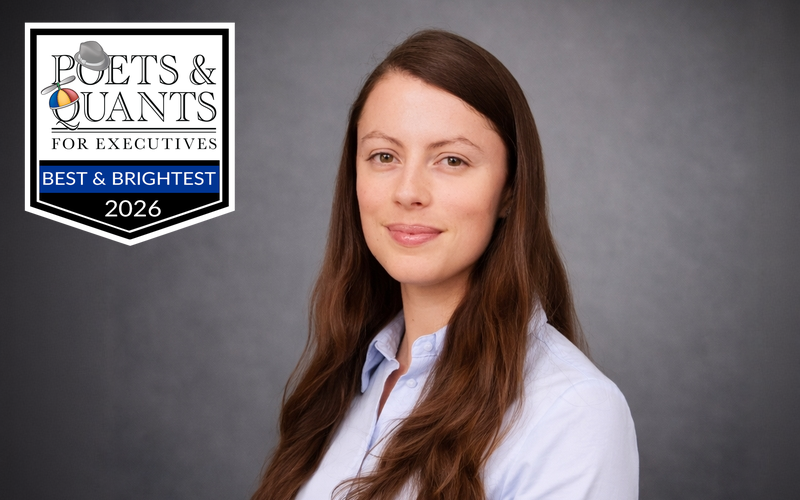
Katelyn Garcia
The Wharton School, University of Pennsylvania
Age: 33
“Structured thinker with a wandering streak – drawn to unfamiliar places, big questions, and ambiguous problems.”
Hometown: Annapolis, Maryland
Family Members: My incredibly supportive husband and I have one daughter. I am also deeply grateful for my parents and younger brother.
Fun fact about yourself: In addition to professional necessity, my traveling around the world is fueled by a quest to find the city with the best croissant. Currently, Copenhagen is in the number one position, overtaking the previous title holder, Dushanbe.
Undergraduate School and Degree: BA in Politics and International Relations, Wake Forest University
Where are you currently working? While studying at Wharton I worked at the U.S. Embassy in Tbilisi, Georgia. Our family has just moved back to the U.S. (less than a month ago!) and I am looking forward to transitioning to my first private sector role this fall.
Extracurricular Activities, Community Work and Leadership Roles: I enjoy traveling with my family, virtual house hunting, and boutique fitness classes (especially when they have a smoothie bar). I am involved in multiple organizations supporting veterans, people with disabilities, and children from low-income communities.
Which academic or extracurricular achievement are you most proud of during business school? Business school coincided with one of the most defining transitions of my life: becoming a mom. Navigating that experience, more than anything else, is what I am most proud of.
Balancing the demands of the MBA, returning to work full-time, and learning how to continue to show up for my family and community was at once both humbling and clarifying. It propelled me to be more disciplined with my time, thoughtful in how I communicate, and more compassionate in how I lead without any concessions on excellence.
My fellow classmates who also became parents during the program were a constant source of inspiration and support.
What achievement are you most proud of in your professional career? I am most proud of the times in my career when I was able to continue to exercise calm, disciplined judgment, despite extreme pressures. One example is when I led my Blackhawk helicopter crew back to base safely while experiencing an emergency procedure. We went ‘inadvertent’, which means that all of a sudden all visual reference was lost and I had to rely entirely on my instruments. Despite being the junior of two pilots, I coached my friend (the senior pilot on the controls), who I admire greatly, through necessary inputs to get us back to a stable flight profile.
Who was your favorite MBA professor? It is impossible to narrow it to one professor or list all those who deserve mention, but I will do my best to highlight those who impacted me the most. Dr. Luzi Hail is incredible. Being that I was a self-described “poet” prior to business school, he was able to make Financial Accounting not only engaging but also one of my favorite classes. His genuine, deep desire for each and every student to fully understand the subject matter will never be forgotten. Dr. Nazlı Bhatia flawlessly built a class that is based in research, filled with practical exercises and applicable to everyday on the job. She gave invaluable personal feedback that has made me a better team member, negotiator and leader. Dr. Gad Allon’s Scaling Operations changed the way I view operational planning and running office hours with him and my other classmates along the Schuylkill was another highlight of the whole program.
Why did you choose this school’s executive MBA program? Wharton is not only the world’s number one business school, but it also has the best global network. Wharton gave me an opportunity that many would think impossible – the ability to pursue a prestigious, Ivy League business degree while serving as a diplomat in Eastern Europe. Furthermore, I wanted to ensure there was no compromise, that I was challenging myself to learn and grow to the fullest extent possible in a rigorous program.
What is the biggest lesson you gained during your MBA and how did you apply it at work? The biggest lesson I learned during the program is that, historically, my personal method of exerting influence has relied more on formal versus informal means. This was not at all something I was expecting. In fact, if you had asked me prior to the evaluation where my strong suit lies, I would have been very confident that I index toward softer, informal influence. And yet, it was in fact the opposite. Gaining this insight was immediately applicable at work. I became more creative and more curious, practicing implementing other influence styles and deducing which were most effective with my team.
Give us a story during your time as an executive MBA on how you were able to juggle work, family and education? The day after giving birth to my daughter, I logged in from the hospital to attend my weekend of online synchronous sessions in term one. Just two weeks later, I was taking my final exams while learning how to mother a newborn on minimal sleep. A few months later, I was living in Tbilisi, Georgia logging in to class at 3 am. It was tough, but with radical prioritization and early mornings I was able to juggle work, family and education. Not perfectly, but well enough.
It was a wild journey, but I wouldn’t trade it for the world. My husband, my parents, and my learning team rallied around me.
What advice would you give to a student looking to enter an executive MBA program? Go for it. Opportunity awaits, but you will never know what is on the other side of the door if you don’t open it. The time is now. Be smart about your commitments, but if you are considering applying, you have already shown the desire to improve yourself. There will never be a “perfect” time to pursue an MBA as an executive. Trust that, with dedication and the willingness to ask for help, you will succeed.
What was your biggest regret in business school? I don’t have any regrets from my time in business school. My only wish is that I had more time or more hours in a day. I feel confident that I stretched myself farther than I ever have before during this time, and yet I still wish I were able to give more.
What is one way that your business school has integrated AI into your programming? What insights did you gain from using AI? Wharton is at the forefront of integrating AI into programming – they even offer an AI major. I thoroughly enjoyed taking Dr. Lynn Wu’s Enabling Technologies class. Here we really gained a foundational base of knowledge on AI, how it is evolving, and its impact on industry.
What was the main reason you chose an executive MBA program over part-time or online alternatives? An executive MBA was the only option I considered. When pursuing my MBA I did not want to compromise on the rigor of the course load in any way. I wanted the full (challenging) experience. I also of course recognized the immense value of my fellow classmates. Especially at Wharton, it is an immense privilege to be in the room with the brilliant (and remarkably humble!) minds sitting to your left and right. They bring immense value to the educational experience.
How did you finance your EMBA and what did you do to make tuition and associated costs more affordable? I financed my degree through Veterans Readiness and Employment (VR&E) Chapter 31 benefits. I am immensely grateful to Lynn Manuel in the financial services office and Maria Livelsberger, my VR&E counselor. They expertly and kindly guided me through the process of using my veteran benefits.
What is your ultimate long-term professional goal? I want to lead a global mission-driven organization. One that is not hampered by inefficiency or bureaucracy, but is able to identify and solve hard problems in real time.
DON’T MISS: BEST & BRIGHTEST EXECUTIVE MBAS: CLASS OF 2026
© Copyright 2026 Poets&Quants. All rights reserved. This article may not be republished, rewritten or otherwise distributed without written permission. To reprint or license this article or any content from Poets&Quants, please submit your request HERE.

