





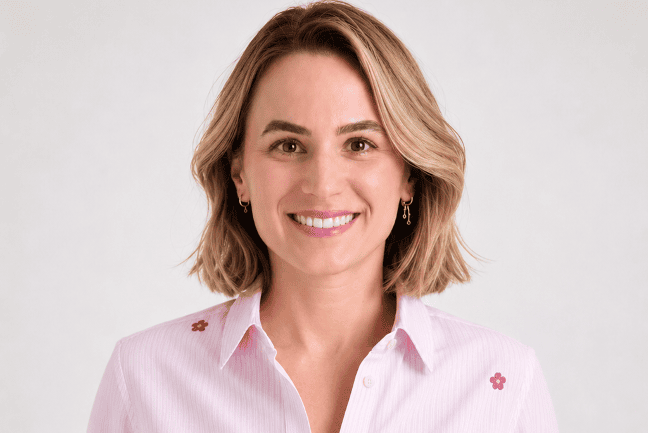
Julia Riou
“Driven by curiosity, human connection and the desire to keep learning and challenging myself, with a tendency to follow my intuition and figure things out along the way”
Graduation Year: HEC Paris Class of 2024
Current Role: Co-Founder at Deméa Paris
Why did you decide to pursue an Executive MBA?
I joined the EMBA while working at Rubis, after a particularly formative chapter of my career in Kenya. It had been an incredibly dynamic, hands-on experience, with a strong managerial dimension, and it left me wanting to explore some of those subjects more deeply. But my motivation was actually quite simple: I missed learning.
I have always had a strong appetite for learning and self-development, and at that point in my career I felt a real need to challenge myself intellectually again. I wanted to be exposed to new subjects, new ways of thinking and, perhaps most importantly, people I would not necessarily have encountered in my professional life.
Having started my career in Australia and worked internationally, I was also very conscious of the value of building a strong network in France. The diversity of the EMBA was particularly attractive to me: different nationalities, industries, generations and life experiences, all sitting in the same room. I thought that combination would challenge my assumptions and broaden my perspective.
What lead you to the HEC Paris EMBA, and how did you know this school and this program was the right fit for you?
There was a rational answer and a more personal one.
As a French person, HEC has a very particular aura. Its reputation extends far beyond France, and I knew I would find an exceptional environment in terms of perspectives, specializations and people.
There was also a personal connection: my father studied at HEC. I liked the idea of creating that link across generations, while having a completely different HEC experience of my own.
I did look at other programs, but ultimately, I followed my intuition. HEC felt right. Looking back, I think some of the most important career decisions are made with a combination of analysis and instinct and this was one of them.
How did you customize your learning experience?
I think everyone experiences an EMBA through a slightly different lens. We arrive with our own experiences, questions and ambitions, and consciously or unconsciously, we start connecting the dots through them.
That is very much how I approached mine. Whenever possible, I used assignments and group projects as an opportunity to explore questions that genuinely interested me rather than simply completing the exercise.
I chose the Energy specialization, despite already working in the industry. Some might have expected me to use the EMBA to move away from what I already knew, but I found there was enormous value in doing the opposite: going deeper. The professor was exceptional, and being surrounded by people who also had extensive experience in the sector created incredibly rich discussions. The sessions in Doha and London remain some of the highlights of the program for me.
How did you balance the demands of work, family, and the program while studying?
I never found the balance particularly difficult. I did not to have children at the time, and seeing classmates combine a demanding career, the EMBA and several children certainly put my own workload into perspective! I organized myself around the program and genuinely enjoyed making space for it.
I think that also says something about the experience: when something is intellectually stimulating and you genuinely want to be there, it doesn’t always feel like an additional obligation.
What’s a standout memory from your time at HEC Paris?
It is difficult to choose just one.
Some of my strongest memories are actually of group assignments. Not necessarily because of the assignment itself, but because I found it fascinating to observe how other people approached the same problem. Someone from another country, another industry or another generation could look at exactly the same information and reason completely differently. I learned a lot from those conversations.
The Energy specialization (Doha and London) was another highlight, as was the Commando weekend. I had missed the weekend organized with my own cohort, so I joined another group where I knew absolutely no one. Through a series of challenges and leadership exercises, complete strangers became a team remarkably quickly. By the end of the weekend, we felt as though we had known each other far longer. It was fun, intense, and a fascinating lesson in how quickly trust and relationships can be built through shared experiences.
But ultimately, the people are probably what stay with me most. Some classmates have become genuine friends, people I admire, call for advice, and am lucky to still have in my life.
How has the program helped you grow personally or professionally since graduating?
Today, I am building Deméa Paris, a womenswear brand I co-founded.
The idea came from something very personal. I have always been drawn to aesthetics and beautiful things, but throughout my career I also travelled extensively and often worked in male-dominated environments. I became very aware of the relationship between clothing, confidence and presence.
I strongly believe in power dressing, but I often struggled to find clothes that reflected how I wanted to feel: elegant without being rigid, comfortable, timeless, made from beautiful materials, and designed to stay in a wardrobe for years rather than a season.
Deméa grew from that idea, and from meeting my co-founder, with whom I connected very quickly.
The EMBA did not teach me how to build a fashion brand and I think that distinction matters. What it gave me was a framework, confidence in my ability to learn, and access to an extraordinary ecosystem of people.
Entrepreneurship can be surprisingly lonely. Having a network where I can say, “I don’t know this, who does?” has been invaluable. I have found partners and experts through the HEC community, but just as importantly, I have found people willing to share their experience and help me think through problems. I try to do exactly the same whenever I can help someone else.
Perhaps that is the most valuable network: not a collection of contacts, but a community where knowledge circulates.
Is this the industry and role you envisioned yourself when you entered the program?
Not at all. If someone had told me when I started the EMBA that a few years later I would leave the energy industry and launch my own fashion brand, I probably would not have believed them.
I had always been attracted to entrepreneurship, though. Eventually I reached a point where the bigger risk was no longer trying and failing, it was never trying at all.
I was 35, I had a good position in a company I respected, and I could very easily have continued on that path. But I did not want to wake up at 50yo wondering what might have happened if I had taken the chance.
There is this funny saying: “everything you need not to know in order to succeed.” I understand that expression much better today. Had I known every difficulty involved in launching a fashion brand before starting, perhaps I would have been more hesitant or delayed it?
Instead, I started with what I knew, surrounded myself with people who knew what I didn’t, asked a lot of questions, and learned the rest along the way. Between my professional experience and the EMBA, I had developed enough confidence to think: I may not know exactly how to do this yet, but I trust myself to figure it out.
What are some of the biggest takeaways you gained from the EMBA experience?
One of the biggest lessons for me was becoming comfortable not having all the answers. An environment like HEC constantly reminds you that everyone has an area where they know far more than you do, and that this is an opportunity rather than a weakness.
It taught me to ask questions more freely, seek out the right expertise, and use the collective intelligence around me. That has become particularly important as an entrepreneur.
It also reinforced something I have been working on personally: letting go of perfection. There is a point where trying to make something perfect stops improving it and simply prevents you from moving forward.
I have become much more comfortable testing, taking thoughtful risks, learning from what works and what doesn’t, and refining from there. I don’t really believe in failure in the traditional sense. If you make a considered decision and it doesn’t work, you have gained information. The important thing is what you do with it next.
For those thinking about applying to the HEC Paris EMBA, what advice would you share with them?
Make the most of it, because it goes incredibly fast.
The academics matter, of course, but don’t experience the EMBA only through the classroom. Be curious about the person sitting next to you. Ask what they are building, what they have learned, what they see differently from you. Some of the most valuable lessons will come from conversations you could never have planned.
And make the program yours. We all arrive with a reason for being there, even if that reason evolves along the way. Whenever you can, connect an assignment, a project or a conversation to something you genuinely want to understand or accomplish.
Finally, don’t wait until you know enough to participate, contribute or ask for help. Share what you know generously, and be equally comfortable saying, “I don’t know, can you help me?” That exchange is, for me, one of the greatest strengths of the HEC community.
DON’T MISS: 10 profiles of HEC Paris EMBA Alumni
© Copyright 2026 Poets&Quants. All rights reserved. This article may not be republished, rewritten or otherwise distributed without written permission. To reprint or license this article or any content from Poets&Quants, please submit your request HERE.

