




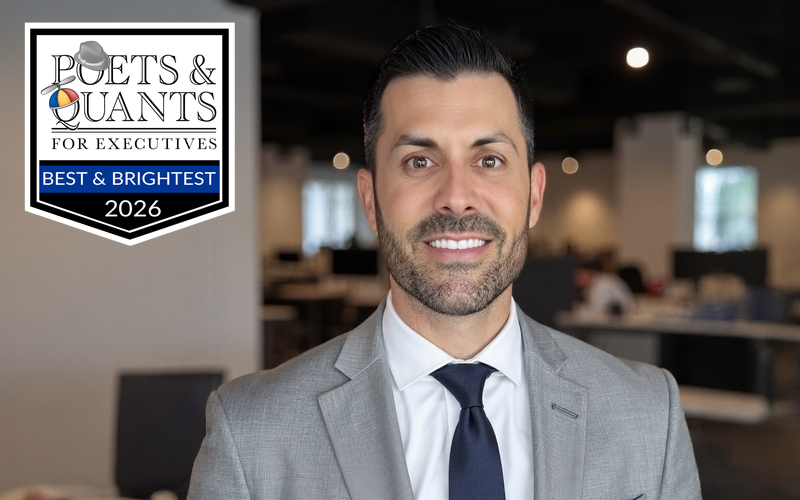
Mike Valdes
Samuel Curtis Johnson Graduate School of Management, Cornell SC Johnson College of Business
Degree: Cornell Executive MBA Americas
Age: 38
“Builder at heart, grounded in discipline, and driven to create meaningful impact beyond myself.”
Hometown: Newport Beach, CA
Family Members: My mother (Karla) has always been the voice in my corner, encouraging me to aim higher and keep going. As a retired professor, she instilled in me a lifelong commitment to learning and personal growth.
My father (Max) has been a foundational influence in shaping my work ethic and competitive drive. A retired Fortune 500 CFO and current board member, he continues to inspire me every day through his discipline, dedication, and relentless work ethic.
My brother (Andrew) has always been someone I can count on, no matter the circumstance. His loyalty, perspective, and toughness have played a major role in who I’ve become, and I know he will always be in my corner. He’s incredibly creative and driven, and the way he pours his energy into both his passions and the people around him is something I’ve always admired.
Together, my family has shaped not just how I work, but who I am.
Fun fact about yourself: I started playing baseball at age five and was fortunate to continue through the collegiate level. Being part of a close-knit team had a lasting impact on me, shaping my competitive mindset and instilling a strong sense of discipline early on. The experience taught me the importance of preparation, consistency, and performing under pressure, while also reinforcing accountability to something bigger than myself.
Those lessons have stayed with me and continue to influence how I approach my career, lead teams, and push myself to improve.
Undergraduate School and Degree: Bachelor of Arts in Business Administration – Accounting Concentration: California State University, Fullerton
Where are you currently working? I am a Senior Managing Director of Finance at BKM Capital Partners, an institutional private equity fund manager, specializing in value-add light industrial multi-tenant properties.
Extracurricular Activities, Community Work and Leadership Roles: I’ve always pushed myself to contribute beyond my day-to-day role, whether that’s taking on leadership opportunities, staying actively engaged in my industry, or giving back to the community. Below are a few activities, awards, and experiences that I’m especially proud of doing.
* Certified Public Accountant (CPA) – Licensed in California
* American Institute of Certified Public Accountants (AICPA) – Active member
* Cornell University – Executive MBA class of 2026, Dean’s List
* PwC – Former Career Coach, mentoring junior professionals on career development, performance, and progression within the firm
* Deloitte – Future CFO Leadership Selection, recognizing emerging finance leaders
* U.S. Department of Defense – Patriot Award Recipient for employer support of the Guard and Reserve
* U.S. Bank – Board Member, Commercial Real Estate Client Advisory
* Project Hope Alliance and United Way – Active volunteer supporting education and anti-poverty initiatives
* Boys & Girls Clubs of America – Active volunteer promoting development, teamwork, and confidence
Which academic or extracurricular achievement are you most proud of during business school? The academic achievement I’m most proud of is my capstone individual project, where I built a new venture from the ground up around something I’ve always been passionate about. I developed a full business plan and pressure-tested it in a real-world context, working through actual business dynamics, engaging with potential clients and vendors, and thinking through how it would truly operate.
The project culminated in a live pitch, where I presented the business as if launching it in the real world. The presentation was recognized as one of the best pitch presentations they had ever seen, something that meant a great deal to me – not just for recognition, but because it validated what I’d been passionately building toward.
More than anything, the experience shifted how I think, pushing me to approach ideas with an ownership mindset and execute like a builder. It reinforced my drive to take concepts from ideas to reality and create something meaningful.
What achievement are you most proud of in your professional career? The achievement I am most proud of in my professional career is helping transform my firm’s finance function into a strategic driver of the business during a period of significant growth, an evolution that took place alongside my MBA experience. As the platform scaled to support over $5 billion in transaction volume, I focused on embedding finance more directly into decision-making, evolving it from a traditional reporting function into one that actively influences capital allocation, operational strategy, and long-term planning. During this time, we grew the finance team by over 30% and helped drive a 3x increase in the firm’s bottom line.
What makes this especially meaningful is not just the scale of the outcomes, but the role finance played in enabling them. Applying what I was learning in real time through my MBA, I was able to help shape decisions and drive results, rather than simply measure them, which has been the most rewarding part of my career.
Who was your favorite MBA professor? This is a tough question, the professors at Cornell were all incredible. That said, a couple who really stood out to me were Professor Justin Johnson (Business Strategy) and Professor Ori Heffetz (Global Macroeconomics), both of whom continue to shape how I think.
Professor Johnson was engaging, creative, and an exceptional teacher who brought real energy into every class. He made complex strategic concepts feel practical and relevant, consistently tying them back to real-world decisions. More importantly, he challenged us to think differently, questioning assumptions, looking at problems from multiple angles, and approaching strategy with a more thoughtful, structured mindset.
Professor Heffetz brought a completely unique approach to macroeconomics. He had a way of synthesizing theories and concepts into real-world applications, making the subject not just understandable, but highly practical. His classes were engaging, dynamic, and genuinely exciting. He presented macroeconomics in a way that was both intuitive and deeply insightful.
Together, their classes reshaped how I approach both strategy and the broader economic landscape and have had a meaningful impact on how I think and operate professionally.
Why did you choose this school’s executive MBA program? I chose Cornell University’s Executive MBA program because I was looking for a program that combined strong academic rigor with immediate real-world applicability. From research and conversations with alumni, it was clear that Cornell’s approach was highly practical, bringing together experienced professionals and creating a learning environment grounded in real-world decision-making.
What stood out most to me was the quality and diversity of the cohort. I wanted to learn alongside peers who brought different perspectives and experiences, where classroom discussions would be as valuable as the coursework itself. Cornell’s Executive MBA program felt uniquely designed to foster that kind of dynamic.
It was a clear first choice for me because it offered the right balance of structure, challenge, and collaboration, an environment where I could sharpen my thinking while continuing to grow in my career and immediately apply what I was learning.
What is the biggest lesson you gained during your MBA and how did you apply it at work? The biggest lesson I learned was that perspective is a real competitive advantage. Being surrounded by a diverse group of experienced professionals showed me how differently thoughtful, capable people can approach the same problem – and how much stronger decisions become when you bring those perspectives together. I’ve applied that at work by being more intentional about seeking out and weighing different perspectives, especially on complex or high-impact decisions. It’s reinforced the value of stepping back, challenging assumptions, and ensuring we’re looking at opportunities from multiple angles before moving forward.
More than anything, it underscored that strong judgment isn’t just about expertise. It’s about perspective, and the ability to bring together the right inputs to make better, more informed decisions.
Give us a story during your time as an executive MBA on how you were able to juggle work, family and education? There were weeks during the program where the demands from work alone could have filled every available hour. During those periods, I had to become extremely intentional with my time, structuring early mornings, late nights, and weekends with a level of discipline I hadn’t previously needed to sustain.
What made it sustainable, though, was the people. I built strong relationships within my cohort, including someone I’m proud to call one of my closest friends, who is now building an innovative company in the defense technology space. What stood out most was how he approached his work. He worked relentlessly, never complained, and always found time to support others, including me. That combination of drive and generosity was genuinely inspiring.
Watching that up close pushed me to think bigger about my own path. It shifted my mindset toward ownership, creativity, and long-term value creation, one of the most meaningful takeaways from my MBA experience.
In the end, it was that combination of discipline, purpose, and community that made it possible not just to manage competing priorities, but to grow through them.
What advice would you give to a student looking to enter an executive MBA program? Be clear on your “why” before you start. An executive MBA will demand more of your time and energy than you expect, and having a strong sense of purpose is what carries you through the most challenging stretches.
My advice is to fully commit to the experience. Don’t treat it as something to fit around your life as conveniently as possible. Treat it as an opportunity to raise your standards, create lasting relationships and become a part of a truly special community. What you put into the experience will define what you take away, and ultimately shape how you think, operate, and lead long after the program ends. At the same time, don’t let the two years fly by, take the time to be present. Build relationships and genuinely enjoy the experience along the way.
What was your biggest regret in business school? My biggest regret was not slowing down enough to truly take in some of the moments along the way. The pace of an executive MBA, coupled with full-time work in the private equity industry, is intense, and it is easy to stay focused on the next “deliverable” or obligation.
Looking back, there were conversations, relationships, and experiences I wish I had slowed down enough to fully appreciate. It taught me an invaluable lesson: being present is just as important as performing at a high level.
What is one way that your business school has integrated AI into your programming? What insights did you gain from using AI? AI was integrated into the program both as a practical tool and as a strategic topic. It was used to enhance analysis while also challenging how we think about decision-making. We incorporated it into case work, research, and problem-solving, which made it clear how quickly it can accelerate insight generation.
The most important takeaway for me is that AI doesn’t replace judgment; it amplifies it. The real advantage comes from knowing how to ask better questions, apply context, and critically evaluate outputs. For me, it reinforced that technology could improve speed and efficiency, but thoughtful decision-making remains a distinctly human responsibility.
What was the main reason you chose an executive MBA program over part-time or online alternatives? The executive format created a level of dialogue and peer learning that is uniquely difficult to replicate in a purely part-time or online setting. Just as important, it provided the opportunity to build a lasting network of exceptional individuals across my cohort, faculty, and the broader alumni community, relationships that will continue to shape how I think, lead, and grow long after the program.
It’s truly an honor to now be part of the Cornell alumni community, and I’m excited to stay actively involved and continue building on those relationships in the years ahead.
How did you finance your EMBA and what did you do to make tuition and associated costs more affordable? I financed my EMBA primarily through personal investment, approaching it the same way I would evaluate any meaningful capital allocation decision. I viewed the program not just as an educational expense, but as an investment in my long-term growth and leadership trajectory.
To make the cost more manageable, I focused on disciplined financial planning and maximizing the return on that investment by applying what I learned in real time. That approach ensured the value of the program extended well beyond the classroom and directly impacted my professional performance.
What is your ultimate long-term professional goal? My long-term goal is to become a strategic CFO who goes beyond finance, helping shape, scale, and strengthen businesses from the inside out, and ensuring they create lasting impact beyond the bottom line.
I’m drawn to opportunities where finance operates at the core of decision-making, shaping strategy, allocating capital with discipline, and helping organizations grow in a thoughtful, sustainable way.
What motivates me most is the ability to help turn vision into execution. I want to work alongside strong leadership teams to solve complex problems, navigate growth, and build platforms that are not only successful but also resilient over time.
More broadly, I want my career to reflect more than advancement in title. I want to be remembered for how I lead, the teams I help build, and the impact I create. Building something meaningful, developing high-performing teams, and creating long-term value are what matters most to me. Ultimately, success for me will be defined by the quality of what I help build, the people I help along the way, and the impact it leaves behind.
DON’T MISS: BEST & BRIGHTEST EXECUTIVE MBAS: CLASS OF 2026
© Copyright 2026 Poets & Quants. All rights reserved. This article may not be republished, rewritten or otherwise distributed without written permission. To reprint or license this article or any content from Poets & Quants, please submit your request HERE.

