




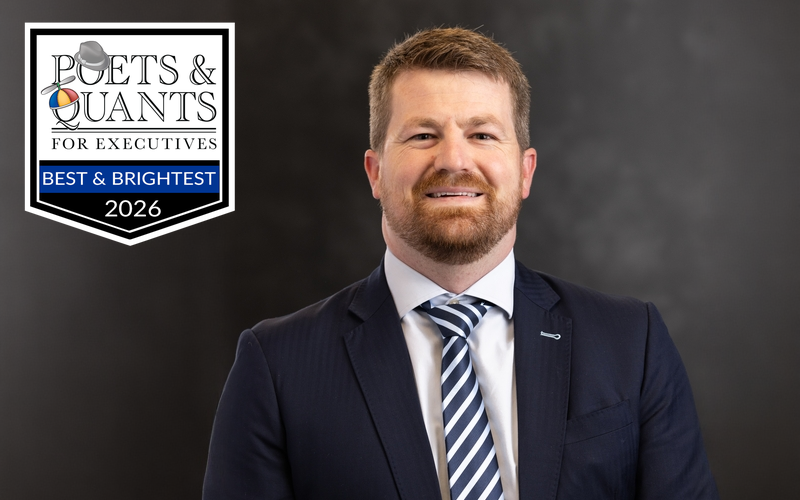
Mitchell Dabling
University of Utah, David Eccles School of Business
Age: 36
“Curious builder, husband, dad, engineer, technology executive — supporting teams and people to implement meaningful change.”
Hometown: Salt Lake City, Utah
Family Members: Wife, Julie; daughter, Charlotte (4); and son, Wesley (2).
Fun fact about yourself:
I’m a certified regional volleyball referee. It turns out the best way to learn how to make fast, fair decisions under pressure happens on a court — with a whistle, not a slide deck.
Undergraduate School and Degree:
B.S. with Honors, Civil Engineering — Utah State University
M.S., Civil Engineering — Utah State University
Executive M.B.A. — University of Utah, David Eccles School of Business (May 2026)
Where are you currently working? HDR Engineering Inc. — Associate Vice President and Water Business Group Technology Director.
Extracurricular Activities, Community Work and Leadership Roles:
Top of Class, Executive MBA — University of Utah (2026)
Chair, Industry Advisory Board — Utah State University, Department of Civil and Environmental Engineering
Volunteer, Information Technology Disaster Resource Center (ITDRC) — Deploying emergency IT and communications during natural disasters
Featured guest, MIT Technology Review podcast on AI, infrastructure, and human-centered transformation (November 2025)
Goldwater Scholar in Civil Engineering — Sole national recipient
College of Engineering Senior of the Year, Utah State University — Sole recipient
Undergraduate Researcher of the Year, Utah State University — Sole recipient
Which academic or extracurricular achievement are you most proud of during business school? My proudest academic moment was a moment of humility during our AI Business Strategy course. Even though I serve as an AI leader for a 2,000-person global business group, the class forced me to confront a significant blind spot. While I had been very successful using AI as a support mechanism, I had not focused enough on true automation and offloading the right kinds of work to automated flows. That mindset shift was powerful. It made me realize that my team and I were only scratching the surface of what the technology could do. Many of the ideas I developed in that class have since been implemented across my organization: supporting knowledge transfer from senior staff to early-career engineers, improving project delivery quality, and automating repetitive workflows. It also taught me that AI is a personal journey, not just an organizational one. Each of us must learn — through real and dedicated practice — how to use, and not use, the tools at our disposal.
What achievement are you most proud of in your professional career? It was architecting and launching the first enterprise technology strategy for HDR’s Water Business Group, supporting more than 2,000 engineers and water professionals across multiple geographies. The work has been impactful enough that HDR has now replicated the Technology Director role and the model across every business unit in our firm. To me, that is the highest compliment — it means our team proved a way for an engineering organization to genuinely bridge IT, business operations, and the project teams who deliver the work. The same body of work led to being featured on the MIT Technology Review and Infosys Knowledge Institute podcast on AI, infrastructure, and human-centered transformation, which gave me the chance to advocate publicly for an idea I deeply believe: technology only matters if it makes the people doing the work better.
Who was your favorite MBA professor? Dr. Jennifer Cummings. Her class focused on the idea that you grow your team’s effectiveness by growing yourself, and it reframed how I think about leadership. It made me realize that leadership does not start with bravado or influence — it starts with being genuine and creating a supportive space for the people around you to bring their best and whole selves to work. That has become the lens through which I lead every day.
Why did you choose this school’s executive MBA program? The University of Utah’s David Eccles School of Business was the perfect fit. It is local to my family and highly respected, but what really sold me was that the program is the perfect blend of engineering, business, and technology – just like me. I felt seen by the curriculum, staff, cohort, and professors from the very first conversation.
What is the biggest lesson you gained during your MBA, and how did you apply it at work? Negotiation. The class fundamentally changed how I approach high-stakes conversations — moving me away from positional bargaining and toward designing for shared maximum value. I have not only applied it constantly in the multi-million-dollar external negotiations that come with managing an enterprise technology portfolio, but also in the quieter internal conversations about strategy, scope, and resourcing within our teams. The mindset shift was learning to look for an outcome that protects my interests while creating value for every party at the table, rather than optimizing only for my own side. It has made me a better partner inside and outside the firm — and frankly, a better person outside of the office as well.
Give us a story during your time as an executive MBA on how you were able to juggle work, family and education? One key moment that captures the whole program’s juggling act comes to mind. I finished my Corporate Strategy final exam in-flight to Nashville after an EMBA class weekend, with my wife and kids in the row next to me, on a trip that was half family vacation and half work travel. It was the truest example of how the EMBA pushed me — but I am proud to say everyone (and the grade) came out the other side intact. The kids got their trip, the strategy write-up got delivered, and I learned that with the right plan (and a very patient family), you really can do it all — just not always in the order you expect.
What advice would you give to a student looking to enter an executive MBA program? You only get to go through this process once — make it count. Spend the time, do the work, and make sure the moment in your life genuinely aligns with your family and your career goals. An EMBA is a major investment of money, time, and energy, and the return is directly proportional to how present you are willing to be. Half-in does not get you there.
What was your biggest regret in business school? Not spending enough time fully processing the content before class. There is a huge amount of material, and I always walked into the room wishing I had another couple of hours of absorbing it under my belt. Honestly, though, that is also the reality of executive leadership — you rarely get to be the most prepared person in the room. I learned to lean on my teammates and my cohort. Collaboratively, we always brought the classroom discussion to a point where class was effective and informative. The ‘regret’ turned out to be one of the most valuable lessons of the program.
What is one way that your business school has integrated AI into your programming? What insights did you gain from using AI? Eccles built an entire AI course into the curriculum, and it was one of the most valuable experiences of the program for me. I walked in expecting to be ahead of the material — I lead AI and technology for a global business unit — and instead the class pushed me to confront a real gap. The insight that has stayed with me is that AI is a personal journey as much as an organizational one. Every leader and every individual must learn — through actual practice — how to use, and not use, these tools. At some points, AI seems like the solution to all problems, at others, it’s just a hype mechanism. It can be a powerful tool in personal and professional work, but requires practice, dedication, and continuous learning to be successful.
What was the main reason you chose an executive MBA program over part-time or online alternatives? The executive format worked with my family and work-travel schedule in a way the alternatives simply did not. Just as importantly, the in-person executive cohort gave me something neither part-time nor online could replicate: two years in the same room with senior leaders from completely different industries. That experience helped me build a holistic, organization-wide view of leadership that I do not think I could have developed any other way.
How did you finance your EMBA and what did you do to make tuition and associated costs more affordable? HDR supported roughly 30% of the tuition, and I self-funded the remaining 70%. I made it work by being intentional about timing, committing to the program at a moment when my career and family were stable enough to absorb the cost, and by being transparent with HDR about how the investment would pay back into my role and the firm. Treating it like a strategic project, rather than a personal expense, helped me build the case with everyone involved, including myself.
What is your ultimate long-term professional goal? I want to keep operating at the intersection of technology, application, and business. I would love to step into an SVP or CTO role someday — but the work I find most meaningful is helping the broader engineering industry figure out how to successfully adopt the tools being built for it. That conversation, about how engineers and technologists work together to deliver better outcomes for clients and communities, is the one I want to spend my career leading.
DON’T MISS: BEST & BRIGHTEST EXECUTIVE MBAS: CLASS OF 2026
© Copyright 2026 Poets & Quants. All rights reserved. This article may not be republished, rewritten or otherwise distributed without written permission. To reprint or license this article or any content from Poets & Quants, please submit your request HERE.

