






Rachel Manning, from CU Denver’s first EMBA in Aviation cohort
When the University of Colorado Denver launched its Executive MBA in Aviation in January 2026, they were hoping to answer one big question. Could a graduate business program built specifically around the complexities of aviation produce leaders ready to shape an industry in transformation?
Now, several terms into the inaugural cohort, David Chandler, the program’s director is getting that answer. The program is the first of its kind, focused specifically on aviation leadership and is now moving from its third term into its fourth. So far, he says, the transition from concept to classroom has been better than he could have imagined.
“I don’t know that it’s possible to have brought together a better quality product,” Chandler explains. “We aren’t perfect. We’ve still got ideas that we want to keep innovating,” he says. Yet so far, it seems like success is in their cards.
MEET THE INAUGURAL COHORT
Before you can understand what the program is becoming, you have to understand who is sitting in the classroom.
CU Denver’s inaugural Aviation EMBA cohort consists of 18 students averaging around 40 years old. Six are veterans. Thirty-eight percent are women, and half come from outside Colorado. Some have spent their careers inside aviation. Others entered the program without any aviation experience at all.
That mix is exactly what the program’s inviting.

David Chandler, Program Director of the Executive MBA in Aviation at CU Denver
“We’re still learning the identity of the program – determining whether it’s more attractive for people outside the industry who want to break in,” Chandler says. “It’s seeming like this cohort is mostly people inside the industry looking to move up, or moving within organizations within the greater aviation ecosystem,” he shares.
That distinction matters. The goal was never simply to train students for one particular job in one particular corner of aviation. It was to pull back the curtain on an industry in which airlines, airports, regulators, government agencies, consultants and countless other players are constantly operating alongside one another.
“There’s so much value in taking a macro-level perspective and introducing people to everything else in the ecosystem,” Chandler says.
That broader perspective is something that Chandler has brought into the program by way of industry professionals. Its advisory board includes former United Airlines CEO Oscar Munoz, among other aviation leaders, while industry veterans who have heard about the program continue to reach out with offers to contribute.
“A lot of people who have immense experience in this industry are hearing about our program and reaching out to learn how they can get involved,” Chandler says. “They tell us that what we are doing here in the program, bringing together a variety of industry experts who might not often be in the same room, is really important,” he says.
For a program still defining itself, that kind of outside validation really matters.
THE CLASSROOM AND INDUSTRY AS ONE
As the inaugural cohort has progressed, the distinction between “classroom” and “industry” has begun to disappear.
For example, former United Airlines CEO Oscar Munoz approached Chandler about meeting individually with each student—offering the cohort an unusually direct opportunity to learn from a leader who has spent decades at the highest levels of the industry.
The airport itself has also officially become part of the classroom, as originally envisioned. Denver International Airport recently completed a 65,000-square-foot renovation of its Center for Equity and Excellence in Aviation, and the program was able to use the space for the first time during Term 3.
“It’s an amazing space,” Chandler says.
Already, the first cohort had to learn an important lesson. When you take a brand new program and combine that with a major company, plans can change quickly.
The intended classroom was not ready when the program began, so the team improvised. “We borrowed airline space at the airport in place of our intended classroom,” Chandler says. “In Term 1, Southwest Airlines gave us their conference room for their classes, and in Term 2, United Airlines gave us some meeting space.”
SEEING AVIATION IN ACTION
The experiential component of the program is a large chunk of that the EMBA program offers. Students just completed their first residency in Washington, D.C., in partnership with Georgetown University. They’ll soon have three additional residencies in Munich, Ontario and Pittsburgh.
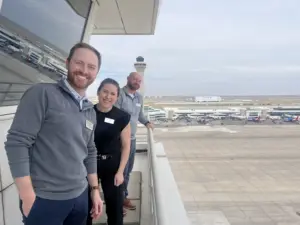
CU Denver Aviation MBA students
The airport visits are a great complement to what students are learning in class. “The three airport residencies are designed to be the practical application, the experiential learning,” he says. What they learn in his course, they’re gonna see in practice at three very different airports.
During their Washington residency, students met with NTSB safety experts, visited the Air Traffic Control Command Center, heard from an aviation lobbyist about how regulation gets passed and spoke with an aviation lawyer about the industry’s regulatory history.
Airline and airport lobbyists also offered competing perspectives. Shortly after they returned, a Wall Street Journal story about aviation safety brought those disparate perspectives together. “We were seeing all the bits, the pieces, and then two weeks later the story showed how a safety improvement could be widely supported yet still remain stalled because of competing interests,” he says.
For Chandler, though, the most convincing evidence that the program is working is what he heard from one student in Washington.
“He was explaining how much of an impact it’s had on him, and the connections that he’s made, and the confidence that he’s gotten as a result,” Chandler says. “Hearing that, that was a moment which crystallized why we made this program. It was wonderful to hear that our effort and hard work and creativity was paying off and making an impact for our students.”
The inaugural cohort is helping shape what comes next, and it may yet evolve based on the students’ needs.
“It feels like we’re still, to some degree, building the airplane as we’re running down the runway,” he laughs.
That it can grow and change forms is in the design. Chandler says the unexpected challenges along the way thus far allow the program to remain flexible and responsive. As a first of its kind program, it is evolving and changing, and that’s completely accepted by leadership.
THE BIGGER PICTURE
For Rachel Maelyn Manning, one of the inaugural students, that broader view is exactly what she came looking for.
As Terminal Airside Operations Manager at Propeller Airports, Manning joined the Executive MBA in Aviation looking to understand the industry outside from what she knows.
“I joined this program first and foremost because I wanted to learn about aviation as a whole industry from a broad perspective,” she says.
Manning applied because she felt like she wasn’t advancing as much as she wanted to, and she wanted to strengthen her qualifications. Being in the program has already changed things fundamentally, especially how she sees her own place within the industry.
“I felt like my part in aviation was kind of small, and like I was beginner level as far as my experience was,” she says.
Her classmates quickly helped to challenge her perspectives.
“My classmates are the glue that makes this program worth it for me,” Manning says.
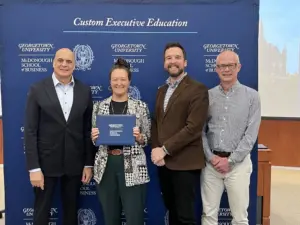
Rachel Manning and others at the EMBA program’s first residency in Washington, D.C.
The cohort has brought together professionals with different backgrounds and areas of expertise, giving students the chance to learn from one another while building relationships that extend beyond the classroom. For Manning, that has meant both professional connections. She’s already been able to make potentially lifelong friendships.
A WIDER VIEW OF AVIATION
Manning says the residencies have been a game changer. Especially getting the opportunity to travel together, then hearing directly from industry experts. During her cohort’s week in Washington, D.C., one presentation from a current FAA investigator and former NTSB investigator really stood out to her. “She was so easy to talk to and I feel like we got a few hours with a real expert,” she shares.
The program has helped Manning to better understand the many pieces that make up aviation. “I have learned a lot about airline operations – route planning, crew scheduling, and how airports incentivize airlines,” she says. “Bringing the whole picture together has just made my vision of my position clearer and has given me confidence in my knowledge.”
Her biggest takeaway so far has been seeing how different pieces of the industry connect, which was exactly the program’s intention for students. “I really think my biggest takeaways so far are simply understanding how all the different parts of aviation merge with each other,” she says.
Manning may not have a single dream job mapped out just yet, but that’s part of what makes the experience so valuable. As for attending, “It is one of the best decisions I have made in my adult life so far,” Manning says.
DON’T MISS CU DENVER LAUNCHES WORLD’S FIRST EXECUTIVE MBA IN AVIATION
© Copyright 2026 Poets&Quants. All rights reserved. This article may not be republished, rewritten or otherwise distributed without written permission. To reprint or license this article or any content from Poets&Quants, please submit your request HERE.

