




Timo Korkeamäki, dean of Aalto University School of Business, is leading the Finnish school’s push to expand its global profile while leaning into its strengths in multidisciplinarity, entrepreneurship, and sustainability,
Aalto University School of Business is already the big fish in the Finnish pond.
It is the country’s No. 1 application target across all disciplines and universities, and among the most selective. If it wanted to, it could grow enrollment by 30% just on top tier domestic students, dean Timo Korkeamäki tells Poets&Quants.
It was the first Nordic business school to earn Triple Crown accreditation, and is one of only two in Finland to have done so.
It is expanding research output and growing both enrollments and faculty at such a clip that it has outgrown the building it moved into just six years earlier. It is recruiting professors without a desk to give them, and is expanding to an adjacent campus building just outside the dean’s office window.
But, even in country where modesty dictates that actions speak louder than words, Aalto aspires to be more than a big Finnish fish. That means spreading its successes and attributes to a wider international audience, even if it feels antithetical to The Finnish Way.
A UNIVERSITY BORN BY INNOVATION
Founded in 2010, Aalto University is an innovation in and of itself, especially when compared to Europe’s stricter, more traditional siloing of academic disciplines. It was the government’s flagship project for Finnish university reform, merging three of Helsinki’s highest-ranked and prestigious universities: the Helsinki School of Economics, Helsinki University of Technology, and the University of Art and Design Helsinki. The first working title for the new institution was “Innovation University.”
Its unique expertise mix of business, design, technology, and engineering has fueled a culture of entrepreneurship that gave rise to Slush – one of the world’s biggest startup and technology events, connecting founders with venture capitalists, investors, and tech journalists. Some 100 startups spin out of Aalto’s entrepreneurial ecosystem each year.
The School of Business has grown 20.4% since 2021, from 3,904 enrolled students to 4,700 in the latest intake. Its faculty and staff grew 28.7%, from 348 to 448, over the same period. Attracting more international representation for both groups is a major school priority.
“We’re working so hard to be a reasonable-sized fish in the global context,” Korkeamäki says.
“That’s why internationalization is one of our three key initiatives in our strategy, and we’re pushing hard to become a little bit better known.”
Q&A WITH TIMO KORKEAMÄKI
Korkeamäki earned his Ph.D. in international finance from the University of South Carolina and spent the first eight years of his academic career at Gonzaga University in Spokane, Washington. He loved the teaching, Gonzaga basketball, and the tight knit community and wasn’t necessarily looking to return to Finland. Then, Hanken School of Economics called early in the morning. The chance to move home with his young family and focus more deeply on research appealed to Korkeamäki.
He spent 11 years at Hanken, first as a professor, then as depart head and then as Dean of Research. Just when he decided to return to his research and step away from administration, Aalto called. It was too big an opportunity to pass up. He was named dean in December 2019.
“I loved Aalto’s multidisciplinarity. That’s the whole raison d’être of our young university, and I love the opportunities that it opens. You get to look at things from a bit different angle,” he says.
“We also are networked globally. To be a player in those clubs was something I was very interested in.”
In the interview below, Korkeamäki talks with Poets&Quants about Aalto’s international aspirations and strategy, deep entrepreneurship roots, and the risks of training students for specific jobs in the age of AI. Our conversation has been edited for length and clarity.

Students move through the light-filled atrium of Aalto University School of Business in Espoo, Finland. The school has grown more than 20% since 2021 and is expanding into an adjacent campus building to accommodate its rising enrollment and faculty. Aalto University photo
Aalto University was founded in 2010 through the merger of three of Finland’s top universities. It has been said that the merger was partly a response to the 2008 financial crisis. Is that true?
The working title of Aalto, before the name Aalto was adopted, was Innovation University. So there was a very specific goal of creating something new in the university sector to promote innovation. I think there was a heavy focus to impact Finland’s economy.
The combination is actually quite unique in Europe: tech, design, creativity and business to generate value for society. But of course, even the predecessor universities were globally quite engaged. So it was not like we were trying become a strictly Finnish university.
I think in Finland at the time, there was quite strong political will to actually generate something bigger. I don’t think this would have ever happened if there was also not a strong commitment from the government.
Now we are in another very tumultuous time. Many schools we are talking to in the U.S. and Europe are seeing a different mix of international students, and the normal pathways for business grads may be changing. What is your international mix, and what trends are you seeing?
Traditionally, we’re very Finnish. This is true for many European business schools and universities in general: Your bachelor’s degree is very much in the local language. We have had an English bachelor’s program since 1989, but it has been quite small compared to our big Finnish bachelor’s program.
You’ve probably heard this already, but in Finland, the typical path is you come to the bachelor’s program, and with that, you gain the automatic right to continue to the master’s.
I think it’s a shame, but in Finland, we don’t have a job market for bachelors. The job market expects you to have a master’s of science, preferably with some relevant work experience as well, before you get to your real job.
Our annual intake for our entire school is about 1,000. Of those, 450 come to our Finnish bachelor’s program. Our direct intake to our Master of Science is about 350. A pretty good chunk of that is also Finnish. If you look at the overall international, so non-Finnish passport holders among School of Business students, I think it’s about 15% or 16%.
We are changing our mix on the bachelor level as we speak. For instance, in this traditional bachelor’s program, finance is by far the most attractive discipline. We’re separating that to its own program. So we’re taking the finance major out of our Finnish bachelor’s and starting an English bachelor’s in economics and finance. The goal with that is to be attractive to the international audience.
We’ve done some benchmarking, and in Europe, the MSc market is highly competitive. BSc is not. So we’re hoping to fit a niche there, too.
One of the challenges is that we’re the No. 1 application target in Finland across all disciplines and all universities with our Finnish bachelor’s program.
This year, we got about 8,000 applicants. In this good school system, we get the cream. The question is, how do we get to the same level on international attraction?
If you are getting the top students, and it is already so competitive, what is the value add for Aalto to be more international at the bachelor’s level?
That’s a good question. I think we just want to be an international business school. I’m somehow quite bothered by the fact that we’re all clones of each other here, and it’s not a very rich learning environment.
It’s even a little bit worse than that. I discovered this quickly when I started. Finance is the big attraction point. I think it’s also the big reason why we have become quite male-dominant in our bachelor’s program. It used to be 50-50. Now it’s more like 30-70.
I did my bachelor’s in Sweden, I did my MBA and Ph.D. in the U.S., and I’ve pretty much always been the only Finn. I’ve often also been the only white, the only Christian, the only whatever. It’s not an easy way to do group work, but it’s a very enriching study.
What is the international mix at the master’s level?
Our master’s level is more balanced. We are, I’d say, 20% to 25% international
There’s a separate MBA market in Finland, and there is a regulatory reason for that. In Finland, by law, university degrees are free. We are not allowed to charge any tuition. We’re not even allowed to charge application fees. If you come from outside the EU, we now have tuition for bachelor’s and master’s programs.
Our MBA program is run pretty much with the Anglo-American model for a fee, but it has to be run outside the university. We have a company called Aalto Executive Education. It’s fully owned by Aalto University, but it is within arm’s length of us. We actually have to prove that we’re not using taxpayer money to substitute their operation.
We actually have an associate dean who oversees that program, and I’m also sitting on the board. I mean, we get this question a lot from accreditors.
What is the international mix of the MBA?
It has been expanding. There has been a growing number of people who actually come to Finland to do their MBA studies here. Traditionally, it has been very much Finnish executive-focused, but it has become more international.
You mentioned earlier the learning environment of an international cohort. Is there also a strategy there for Aalto as education changes, demographics become a challenge, and geopolitics and AI reshape business education? Is having an international feeding pool something you are actively and strategically looking at?
We are. I guess our blessing is that we don’t have a shortage of Finnish applicants. We could grow our school by 30% just like that.
But I think, at least for me personally, internationalization is very important. We don’t want to be here just hidden.
We did our strategy work about a year and a half ago and listened carefully to our faculty’s view on what we want to be. I was happy that there were three things that came pretty much in concert: One, academic excellence. I was very happy to hear from our crowd, “Let’s raise the bar,” instead of me saying it.
Second, internationalization, and third, sustainability. There were not very big arguments on any of those.
In regard to Aalto looking to spin finance into its own bachelor’s degree, how do you see that fitting in with predictions that AI will replace more white-collar junior and entry-level jobs? I’m interested in whether business schools are still training people for jobs that may not be there. What are your thoughts?
That’s a good question. I’m a finance professor myself, but I try not to be biased by it. I think finance skills actually give you a wide ability to tackle problems on a daily basis and a strong methodological base.
In a way, I think in business in general, the difference between European business schools and many U.S. schools is that we are quite a bit more research-oriented, less academically oriented. I don’t know if that’s the right word to use. But our master’s programs include pretty heavy final theses. Traditionally, that’s been like six months working on your own, producing an academic contribution.
We’re rethinking that a little bit now in the age of AI, but that’s a separate story.
When I came from the U.S. to Finland, I was questioning this thing. I was like, why aren’t we doing more cases, more applied work, instead of having these students learn academic literature in some corner, learning research methods that they probably don’t use in their future job unless they turn out to be Ph.D. students? Why are we doing this?
Then I had one of my former students. He was an investment banker, probably still is, in Singapore. He came to visit my office, and he said that he really loved the time he spent during his thesis, which I supervised. He said that he often works on these investment deals in a team where the other people might have Harvard MBAs, but he’s the only one who knows the theoretical underpinnings of what they’re doing.
That had me rethink that maybe this theory-based thing is not that bad after all.
I don’t know if I want to come out and say, “We don’t teach them for a job,” but teaching for a job is a risk right now, because the jobs are changing so fast. When I talked to our stakeholders, corporate people, three years ago, everybody wanted people who can code.
What if I had just jumped on that? I would have had a School of Business and Coding. Now, AI can largely do the coding.
What is Aalto doing in the AI space?
AI is a tough one. There are a lot of expectations on us, for good reason.
Two years ago, we had a faculty retreat, and we have a very close relationship with our business student union. They had a session there, or they participated in a session on AI and what we should do. Again, this was two years ago, and their big message was, “Why don’t you quit trying to catch us and instead support us?”
Fair enough. I think the big challenge with AI is that the goalposts are changing every week.
Five years ago, business schools didn’t really have any AI experts. Now they’re popping up all over the place. They’re all self-proclaimed, and I cannot separate who to listen to this week.
This year, we started a working group where we have one member from each of our six departments along with student representation. They share best practices amongst themselves. I placed an order also for thought leadership on what we could, should and would do.
I know that these tools are very widely used. I would be surprised if there was one student among our 4,000 students who is not using it. AI is not just a tool, but a completely new way of thinking about business management.
It’s also a little bit depressing going to the conferences and seeing what other schools do, because you see they’re basing their flash product on just a little corner of AI.
It is almost an arms race now.
It is. Then again, going back to what I said earlier, what part is hype? What part is truly transformational? It’s very hard for me, with my background, to even tell the difference. I have huge appreciation for some of our faculty who are really on the cutting edge. They are building tools and very widely sharing their expertise as well. But it will be tough, at least with my capabilities, to come up with top-down policy.
We have some really, really deep AI expertise on this campus. I was told that the technical school’s first AI article was published in 1969. In that sense, it’s not a brand-new thing. Aalto is also part of the Finnish Center for AI.
But again, we didn’t go 100% on coding three years ago, which I think was beneficial.

Aalto University School of Business has grown from 3,904 enrolled students in 2021 to 4,700 in 2025, while its faculty and staff increased from 348 to 448. The rapid expansion has pushed the school beyond the capacity of the building it moved into in 2019 and prompted plans to expand into adjacent campus space. Aalto photo
Let’s talk more about your strategy. What were some of the big things you were interested in doing when you first started?
When I started, of course, COVID hit very quickly. I had about two and a half months of non-COVID, but within that two and a half months, I managed to be at two dean’s conferences.
It dawned on me very quickly that I had made a good decision. Business deans around the world were talking about two things: one, design; two, analytics. I thought that this combination Aalto has is not bad.
The university system in Finland has a very, very strong basis of academic freedom. I can’t go to Professor X and say, “You need to study this.”
Part of it is there are funding structures, both European, national, Aalto and school-specific, that give some carrots into working together with people from different fields. Then we do these things we call coalitions, so colliding people from different fields of Aalto.
Sometimes, there are projects that have formed by two people accidentally sitting at the same lunch table. I think we’re doing quite well on that.
Do you have any examples?
We have had this circular economy project where our people from our management department have been working together with people from the School of Engineering and the School of Design on circular economies, using the clothing industry, going from design to materials to reuse. I think it’s a great story in that you really have all three aspects of Aalto involved.
One thing that’s fairly recent is that we have our economists working together with electrical engineers on the energy markets in Europe. It’s also kind of like, why hasn’t this been done before? Of course, energy markets have been a very, very acute issue, also impact-wise, in Europe in the last few years.
In general, I think the multidisciplinarity, I mean, we have a lot of universities out in the world that have different schools. I think for us, because it’s kind of our raison d’être, it’s more natural to seek these connections.
This is something I’ve been saying ever since I started: Multidisciplinarity can also be done the wrong way. That would be many finance professors starting to dabble in marketing, maybe design. I would never be able to do that.
As business schools respond to shifting political pressures, changing accreditation standards and evolving language around sustainability, diversity and inclusion, how do you think European schools are positioning themselves differently from U.S. schools?
You might know that AACSB changed its guidance on its standards last year. The words “diversity and inclusion” disappeared. We actually had a group of Nordic AACSB school deans who wrote an open letter to the leadership. If this is a membership organization, why was this changed without member input?
Diversity and inclusion has been the centerfold of what we have been about. So it was a pretty significant change. I think there was a good discussion, but I think it was a point where Europe kind of separated a little bit mentally from the Global North. This is not an easy transition, because the U.S. still has the best business schools in the world, and U.S. schools have kind of been the North Star for us. So that is a challenge.
I think that, even with sustainability, there is a tendency to think of them as fads because they change their label every once in a while. Same thing with analytics. First we were talking about big data, then about analytics. Sustainability moved into CSR, and so on.
But I think again, from our school’s perspective, we have a sustainability research group that was founded 32 years ago. Sustainability was part of our identity before it became cool.
You have described Aalto as something of a hidden gem. Given the school’s long history in sustainability and responsible management, is part of the strategy now to tell that story more clearly to the outside world?
We had a business school sustainability expert here a couple years ago. I met her when she was leaving, and she said, “You guys have all of this. You have the whole package. Why don’t you tell anybody?”
I said, “Well, that’s the Finnish way.”
But then also, maybe we should tell it more. Partly due to that discussion, we filed for a Financial Times responsible management award, which we won in 2024. We are now a UN PRME Champion school for two years in a row.
Especially with UN PRME, we’ve gotten a lot of positive feedback. As a champion, you not only focus on your own doing, but you also spread your message. So we have been getting a lot of positive feedback on the work that we do.
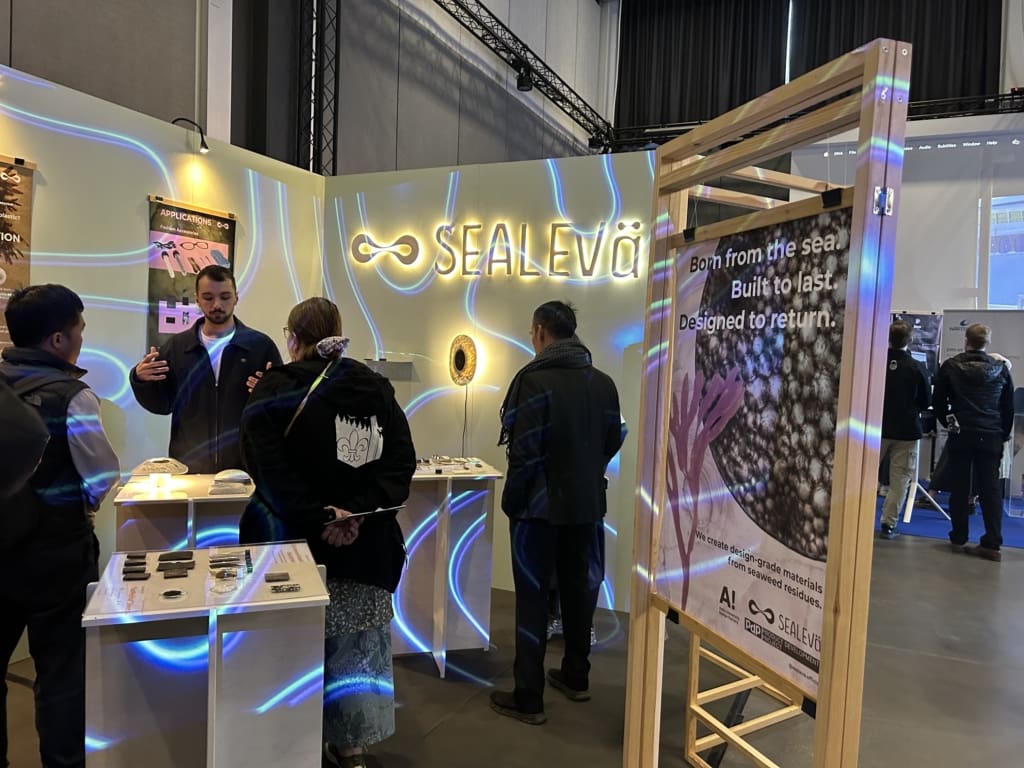
An Aalto student explains his team’s prototype during Aalto University’s Product Development Project Gala in May at the Design Factory. Celebrating its 30th anniversary, the annual gala showcases prototypes developed by multidisciplinary student teams working with companies and other partners to solve real-world world challenges.
During my campus tour, I visited the Aalto Design Factory to learn more about the entrepreneurship ecosystem here. I’ve been thinking about entrepreneurship as a possible response to the changing graduate job pipeline. Do you see entrepreneurial thinking and the broader ecosystem here as a way to help employment as jobs change so quickly?
Absolutely. I think, partially to test that market and idea, we started a new master’s program two years ago called Sustainable Entrepreneurship.
Entrepreneurship is kind of what’s special about Aalto as a whole. There are 100 companies born on this campus every year. Traditionally, this entrepreneurial activity has had a very strong tech focus. It still has, and there are a lot of deep-tech startups that thrive.
In the last few years, and it has been kind of one of my initiatives, we have taken a little bit more ownership. I’m actually very fortunate to have a really good team in our entrepreneurship unit.
How do you think this generation of students is thinking differently about careers and entrepreneurship, and how is Aalto trying to give them the tools to pursue that?
I think the big thing is, when my generation graduated out of college, we wanted to go to a large corporation and eventually retire. This younger generation, they want to start their own startup and save the world.
Of course, not everybody will do that or even be willing to do that. But we want to provide them with tools to go in that direction.
Luckily, in Finland, we’ve had some really good success stories of actually making it big in the startup world, born on this campus. And again, when I talk to my international colleagues, the startup community is actually something they recognize, those who know a little bit about us.
I don’t know if you’ve talked with other people about this thing called Slush. Slush was actually born by a student group out of Aalto, and it still has a lot of this youthful, raw spirit.
A few years ago, right before COVID, in their own opinion, Slush grew too big. They had 20,000 to 25,000 visitors, and they said that we don’t want hangers-on. We want VCs. We want startups. So they actually cut the size of Slush.
What a problem to have.
And it is quite a name in the startup circle. They fly a charter flight from Silicon Valley just with investors, and they have taken a good foothold.
I like the fact that this youthful entrepreneurial spirit is so strong on this campus.
I hear on one hand that you don’t necessarily celebrate or tell everybody about your strengths because that is the Finnish way. And yet, on the other hand, you have this strong culture of entrepreneurship. How do those two things fit together?
It’s a really good question, and I think we’re kind of struggling with that a little bit. We had a visiting crew from Copenhagen Business School a few weeks ago, and we talked about Nordicness, what it is.
Part of it is being doers instead of talkers. In a way, we got into a discussion about, if we become talkers, are we losing Nordicness? Is this part of it?
For us to explain to ourselves what we have that is so special, maybe it takes international visitors for us to learn what’s special about us, too.
Anything else you’d like to add?
If you looked at our school 15 years ago, we would be extremely Finnish, both faculty and students. There were very few people who had gone through the whole track to full professor who would be non-Finns.
This issue was raised in an interesting conversation. I was talking with one of our international assistant professors, and he was like, “So, is it impossible to become full professor if you’re not Finnish?” I thought, this guy is smart, but that’s a stupid question. Then I looked at our ranks.
So that kind of reflects how big a shift we have done. If you look at our academic headcount now, it’s 35% non-Finnish professors. A big part of that has happened within the last few years.
I don’t think of our school as a big fish in a small Finnish pond. We’re working so hard to be a reasonable-sized fish in the global context.
That’s why internationalization is one of our three key initiatives in our strategy, and we’re pushing hard to become a little bit better known.
DON’T MISS: HIGH & LOW MBA SALARIES & BONUSES AT THE TOP 100 U.S. B-SCHOOLS AND HARVARD CALLS ON ITS B-SCHOOL TO HELP PLUG UNIVERSITY’S BUDGET GAP
© Copyright 2026 Poets & Quants. All rights reserved. This article may not be republished, rewritten or otherwise distributed without written permission. To reprint or license this article or any content from Poets & Quants, please submit your request HERE.

