




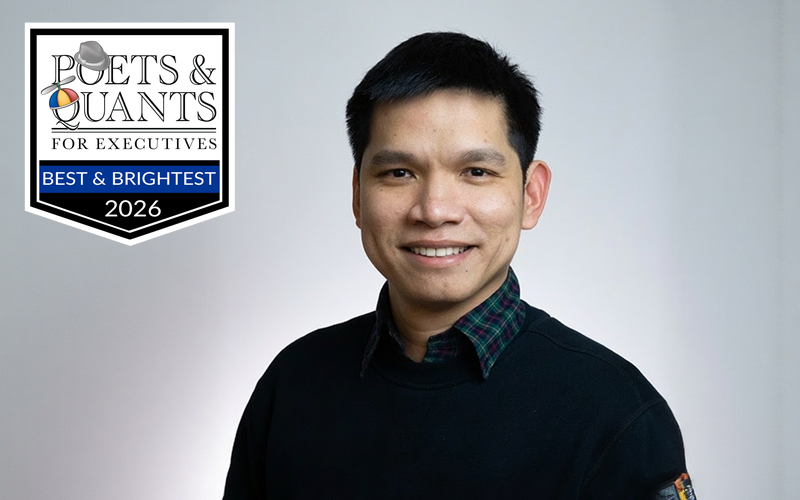
Thuy Nguyen
University of California Berkeley, Haas School of Business
Age: 41
“From Vietnam to Silicon Valley: working in startups, building autonomous machines, and connecting people.”
Hometown: Albany, CA (I grew up in Ho Chi Minh City, Vietnam)
Family Members: Thao Tran (spouse), An Nguyen (daughter)
Fun fact about yourself: I lived in South Korea for seven years while earning my master’s and PhD — yet I never learned to speak Korean. I also have a massive PDF-based manga collection that I read to decompress after long days of debugging autonomous vehicle code.
Undergraduate School and Degree: Nong Lam University, Vietnam, Bachelor’s in Computer Science; Sungkyunkwan University, South Korea, master’s and PhD in Computer Engineering
Where are you currently working? Motional as a Staff Engineer in Machine Learning for Autonomous Vehicles
Extracurricular Activities, Community Work and Leadership Roles: Associate Editor of the Journal of Autonomous Vehicles and Systems (American Society of Mechanical Engineers); Informal advisor to early-stage startups from UC Berkeley and Y Combinator, providing technical guidance on autonomous systems and AI; Published 40+ research papers (1,374 citations, h-index: 18) and hold six U.S. patents in computer vision and autonomous vehicle technology.
Which academic or extracurricular achievement are you most proud of during business school? Becoming the bridge between cutting-edge AI and business strategy at Haas. Drawing on over a decade of experience in machine learning and computer vision, I partnered with MBA classmates and alumni to develop AI-driven solutions for real-world business challenges — from machine learning-based operation management to AI-based content-search workflow. I translated deep technical concepts into frameworks that nontechnical leaders could act on. In the process, I strengthened my own conviction that the most impactful innovations emerge at the intersection of engineering expertise and business acumen.
What achievement are you most proud of in your professional career? As the first employee at Bear Flag Robotics, I built the entire autonomous tractor software stack from scratch — sensor selection, system integration, algorithm design, and deep-learning-based obstacle avoidance. John Deere acquired the company for $250 million, bringing autonomous farming technology to one of the world’s largest agricultural equipment manufacturers. I then joined DoorDash as a founding engineer of DoorDash Labs, where I developed the first autonomous delivery robot software stack and grew a perception engineering team that deployed 20 robots serving hundreds of customers and stores. DoorDash went public in 2020 in one of that year’s largest tech IPOs. Today, at Motional, I develop world models for autonomous vehicles that will power shared self-driving rides — continuing my mission to build intelligent machines that safely advance how people live and work.
Who was your favorite MBA professor? Toby Stuart. His entrepreneurship course transformed how I think about building ventures. Professor Stuart made the startup world not just exciting, but methodical — he showed us that entrepreneurial success is rooted in relentless preparation, pattern recognition, and the discipline to iterate. His teachings validated my own experience working at Bear Flag Robotics and deepened my commitment to building technology companies that create lasting value.
Why did you choose this school’s executive MBA program? The MBA for Executives Program at Haas had everything I was seeking. It is consistently ranked among the top Executive MBA programs in the world, with world-class faculty who bring cutting-edge research into the classroom. My classmates are accomplished leaders across industries — exactly the caliber of peers who challenge and inspire you to think differently. The curriculum is uniquely oriented toward entrepreneurship and the Silicon Valley ecosystem, which aligns perfectly with my career in autonomous vehicle startups. The intensive format also matched my schedule as a full-time engineer, allowing me to maintain professional momentum while gaining the business acumen I sought.
What is the biggest lesson you gained during your MBA and how did you apply it at work? The most transformative lesson was learning to think as a business leader first and a technologist second. Before Haas, I would dive into building solutions without fully interrogating the problem. Now, I start every project by asking: What resources do we have? What problem are we truly solving? Who is the customer? This business-first lens has changed how I operate at work. I regularly challenge my team’s assumptions by asking, “Do we really need to build this?” before committing engineering resources. From there, I iterate between business strategy and technical execution to ensure we invest effort only where it creates the most value.
Give us a story during your time as an executive MBA on how you were able to juggle work, family and education? During my time at Applied Intuition, I was working 12-hour days with a three-hour round-trip commute, attending MBA classes on weekends, and studying late into the night — often sleeping fewer than six hours. I would come home just as my daughter was going to bed. The toll on my family became impossible to ignore; my wife and I reached a point where we both knew something had to change. I had an honest conversation with my manager about flexibility, but ultimately realized the situation was unsustainable. I left that company after my first year at Haas and joined one that offered fully remote work, reclaiming three hours a day. I restructured my life: more present with my daughter in the evenings, more efficient in my coursework by collaborating closely with classmates who taught and supported each other, and more intentional about focusing on what truly mattered. That experience taught me that juggling is not about doing everything — it is about having the courage to redesign your life when the balance breaks.
What advice would you give to a student looking to enter an executive MBA program? Have a clear vision, as much as you can, of what you want to accomplish during and after the MBA. From there, build a realistic plan to get there. Optimize ruthlessly for the highest-impact activities, but never optimize away the human connections. The classmates you learn alongside will become lifelong friends and collaborators, and the informal conversations between classes are often as valuable as the lectures themselves.
What was your biggest regret in business school? I wish I had carved out more time to explore topics beyond my core curriculum — particularly financial engineering and M&A, which are increasingly relevant to my long-term goal of becoming an investment partner. I also regret not engaging more with the broader UC Berkeley community outside of Haas, where cross-disciplinary connections happen organically.
What is one way that your business school has integrated AI into your programming? What insights did you gain from using AI? Haas provided generous AI credits, sandbox environments, and a culture that actively encouraged experimentation with emerging AI tools. As someone who has spent over a decade building machine learning systems, I brought a practitioner’s perspective to these discussions. The most valuable insight I gained is that AI is best used as an amplifier, not a replacement. By delegating routine analytical tasks to AI, I freed up time to focus on building deep knowledge frameworks, forming meaningful relationships with classmates, and developing the strategic judgment that no algorithm can replicate.
What was the main reason you chose an executive MBA program over part-time or online alternatives? Three factors were decisive. First, the immersive format — three consecutive days every three weeks — created deep, sustained engagement that part-time evening classes cannot match. I had the chance to connect with the incoming cohort before committing, and the caliber of my future classmates confirmed this was the right community. Second, I wanted face-to-face interaction, not the isolation of an online program; the most important learning happens in the hallways, over meals, and during late-night study sessions. Third, the Executive MBA’s two-year timeline was far more aligned with my career pace than a three-year part-time alternative, allowing me to return to full professional intensity sooner.
How did you finance your EMBA and what did you do to make tuition and associated costs more affordable? I financed the program entirely out of pocket, drawing on savings from successful company exits — including Bear Flag Robotics’ acquisition and DoorDash’s IPO. These outcomes were the direct result of years of building technology from the ground up, and reinvesting that financial return into my education felt like the natural next step.
What is your ultimate long-term professional goal? My ultimate goal is to give back to the UC Berkeley community that has given me so much. Beyond my primary career as an engineer and technology leader, I aspire to become a teaching partner at Haas — sharing practical lessons from building autonomous systems startups — and an investment partner, backing the next generation of deep-tech founders emerging from Berkeley’s extraordinary ecosystem.
DON’T MISS: BEST & BRIGHTEST EXECUTIVE MBAS: CLASS OF 2026
© Copyright 2026 Poets & Quants. All rights reserved. This article may not be republished, rewritten or otherwise distributed without written permission. To reprint or license this article or any content from Poets & Quants, please submit your request HERE.

