




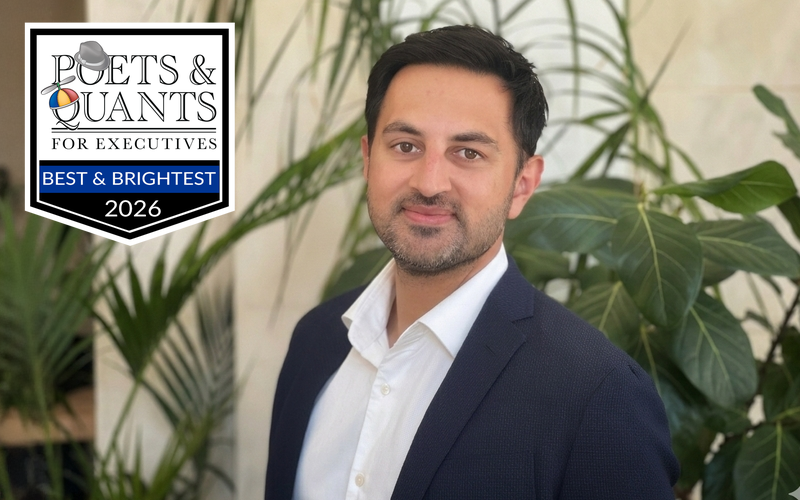
Sharan Chawla
University of Chicago, Booth School of Business
Age: 36
“Curious, spiritual, always on the move, chasing new ideas, good food, and fun conversations.”
Hometown: Currently Co-located between Frankfurt and New York
Family Members:
Preet Chawla (Brother): Managing Director, Investments, Carnegie Corporation of New York
Harleen Chawla (Mother): Counselor @ Insight, Board of Directors at United Way of Baroda (NGO), Board of Directors at Arpan (NGO)
Shivinder Chawla (Father): Co-Founder and Chair, Reinhardt Roto Machines, India
Fun fact about yourself: I traveled to Lisbon in the pandemic for a month and ended up staying for four years!
Undergraduate School and Degree:
UC San Diego – BS, Management Science
Stanford University – MS, Management Science & Engineering
Where are you currently working? Director, Zenco Consulting (Independent)
Currently consulting for Boehringer Ingelheim’s US Human Pharma division to build the AI Transformation Center and drive innovation by building new AI capabilities within the commercial org.
Extracurricular Activities, Community Work and Leadership Roles: (Include school awards and honors)
Graduating with Honors
Elected to Student Partnership Council (SPC)
Best Negotiator Award
Booth Cohort trip host – I organized and led a trip to Lisbon, Portugal for 20 of my classmates, and I’m in the process of putting one together for Cape Town, South Africa!
Which academic or extracurricular achievement are you most proud of during business school? My peers elected me as one of the top negotiators in class after multiple live negotiations. I have always been someone who prefers alignment over confrontation, so this was a core muscle I was looking to develop. The recognition was about the outcomes, and also about how those outcomes were achieved.
Being recognized by such a diverse and highly accomplished cohort made it really rewarding. My peers have negotiated several billion-dollar deals, and this signaled to me that I did not just improve technically but also shifted how I showed up in difficult conversations.
What achievement are you most proud of in your professional career? Paradoxically, my greatest professional failure is also the accomplishment I’m most proud of achieving.
In 2019, I Cofounded a travel company called The Out Of Office Club to help busy professionals find connection and time to enjoy life.
When the pandemic hit in 2020, it derailed our expansion plans, put us in debt, and forced us to pivot to a B2B model to host offsites for remote organizations. Although we stabilized and recovered financially by 2023, the physical and emotional toll made us pull the plug in 2024.
At that time, it felt like a failure. But when we announced we were closing, our customers started sending in heartful messages and stories of how the community and experience had impacted their lives.
I only fully appreciated the impact of our little endeavor after I stepped away from the business – whether it was helping someone regain their confidence, recover from a difficult chapter in their life, find a genuine set of friends and a real community, or find meaning and purpose outside of work. I had never anticipated those kinds of outcomes.
While we didn’t reach the scale we had hoped for, I’ve started thinking about success in more than financial terms. Specifically, I’m thinking about whether I’ve built something that genuinely mattered to anyone.
Funny enough, two customers even got tattoos of our company logo! That more than anything made me feel like we must have left a little positive impact on people, even if only a few.
Who was your favorite MBA professor? There were many professors I really enjoyed spending time with. I perhaps had the best time learning from and debating with Professor Erik Hurst on macro topics. Though it’s not a topic that will immediately impact my work, I think it’s a deeply relevant topic today and one that has significant ramifications on how we elect people in power and how we live our lives. I came into his class with fairly strong views on fiscal and monetary policy, regulation, immigration, and the future of work – and his class consistently challenged and refined my thinking.
You can see and feel his passion for his research, his commitment to us, and his ability to make complex topics feel accessible.
In the last hour of the final class, he opened it up for questions on real world macro issues, and we must have gone at least two hours over, discussing and debating with him on current debt levels, income inequality, immigration policies, housing market, AI, and more. It was incredible.
Why did you choose this school’s executive MBA program? Booth makes you work hard for your MBA. The program is very analytical and rigorous – we’re on campus almost every night finishing group assignments. Even though that sounds painful, that’s what I loved about the program. You feel like you actually earned your degree, not just getting it on paper. The deal was sealed with the opportunity to take classes in London, Hong Kong, and Chicago alongside a very global, down-to-earth community.
What is the biggest lesson you gained during your MBA and how did you apply it at work? My biggest lesson was how to leave your emotions out of high-stakes negotiations. It is a constant part of your day-to-day life, whether negotiating with clients, teams, vendors, sellers, your partner, or family and friends. And realizing that it is not a zero-sum game has helped me drive better outcomes.
It sounds intuitive, but it’s difficult to execute when emotions are running high, especially for someone like me who naturally avoids conflict. This was one practice I really wanted to master during my MBA. Through live practice sessions in multiple different courses, I’ve learned how to be calm and intentional; when to make the first offer and when to hold back; how to unearth underlying interests; how to establish common ground; and how to create alignment so all parties feel ownership of the outcome.
I’ve applied these techniques almost immediately at work – structuring partnerships, negotiating price, or bringing difficult stakeholder teams to work together to solve a common problem with different underlying interests. The biggest change I notice is moving from avoiding tension to using it productively, and it’s been helping me drive consistently better and sustainable outcomes.
Give us a story during your time as an executive MBA on how you were able to juggle work, family and education? When I started the Executive MBA at Booth, my life was spread across four countries.
I was living in Lisbon, my partner had just moved to Frankfurt, my primary client was in New York, and Booth classes were in…London.
At many points, a two-week stretch looked like this:
Sunday – Lisbon (home base)
Monday/Tuesday – New York (work)
Wednesday/Thursday/Friday – Frankfurt (relationship)
Saturday–Saturday – London (for classes)
Sunday – New York (work)
Tuesday – Lisbon (home base)
I’d wake up in a hotel room and genuinely have to think – where am I today?
It was chaotic, exhausting. But it was also kind of incredible. You figure it out through tight schedules, being efficient at the airport, and being very intentional about the moments you do get with the people who matter in your life. And strangely, you build a rhythm in the chaos. I don’t think you can “balance” everything. You have to sort of embrace the intensity for a short period of time and make it all work.
I have to say though – my partner (and all of our significant others) played an absolute critical role. Without her support, patience, and the ability to take on even more responsibilities while I was gone for classes, I’m not sure I’d be here finishing my MBA.
What advice would you give to a student looking to enter an executive MBA program? If you are looking to apply and enter, I’d suggest – narrow down 3 schools, speak with 3-5 current students, alumni or professors to get a sense for the people and the program, and apply based on the best fit. Look in detail how the school runs classes, exams, and international weeks and make sure you have the time and resources to commit fully.
Once you’ve accepted, go all in while you’re in the program!
It’s late at night and others are grabbing a drink? Go for it!
Some folks are planning a small weekend trip to Lisbon? Join them!
There’s an elective that sounds fascinating but looks intense? Do it!
There’s a networking event, but you’re tired? Put on your boots and go for it!
The people, conversations, late nights, the random trips…that’s where the real long-term value will stay with you. So don’t optimize for comfort and cost. Squeeze every bit of juice out of it.
What was your biggest regret in business school? Not doing the Chicago Booth Global New Venture Challenge. It’s an amazing opportunity at Booth to experiment and build a startup with your peers at school. If I could go back, I’d definitely enroll in this program.
What is one way that your business school has integrated AI into your programming? What insights did you gain from using AI? Booth has been intentional about where to use AI and where not to. In areas like Business Analytics, AI will fundamentally reshape how work gets done, and it’s fully embedded into the learning experience at Booth. While in other areas like Ethics, there is a clear emphasis on preserving independent critical thinking.
In Professor Gunter’s Business Analytics course, we were required to use AI to perform advanced regression and predictive modeling, which would have required a multi-person consulting team over several months in the past. Having done similar work before, I was surprised by how far these capabilities have advanced.
We’ve now used AI to conduct advanced analytics, create a startup business plan, build applications with no prior CS experience, conduct negotiations, build agentic models to help track critical business functions, and pressure-test our thinking on various problem statements.
What was the main reason you chose an executive MBA program over part-time or online alternatives? In my mid-30s, I was very intentional about the kind of learning environment I wanted.
I wasn’t looking to pivot careers, but I was looking to sharpen my thinking with people who had already built strong experience and were operating as leaders in their respective industries. The Executive MBA naturally brings together that kind of cohort.
The format was also important. I was working full-time, so a traditional full-time program didn’t fit. I liked the ability to fully immerse myself for a concentrated week each month, step away from the day-to-day, go deep with my classmates, and then bring that energy straight back into work.
It was the best of both worlds – no pause on my career, but a meaningful reset every month to learn and grow.
How did you finance your EMBA and what did you do to make tuition and associated costs more affordable? I was paying out of pocket, but I looked at it as an investment for my consulting practice and for my future. I took on multiple clients at one point to increase my earnings and couldn’t afford many breaks outside of the school weeks. Apart from that, my philosophy was really to go all in on the program.
What is your ultimate long-term professional goal? My goal is to build something that lasts. To lead an organization or platform that improves how patients experience care at scale. I’ve spent my career at the intersection of strategy and emerging technology, and I want to continue turning that into tangible impact. I think we are just at the cusp of exploring the impact of AI in Healthcare, and I want to be at the forefront of that helping to shape how the technology can usefully be deployed for patients and clinicals.
Over time, I also hope to contribute at the board level of NGOs (following in my Mother’s footsteps). Seva (service) is a big part of my cultural upbringing and I’ve always been involved in volunteering and sponsoring kids. However, my life thus far has been largely focused on personal exploration and building up my own career, and I’d like to start thinking about bigger ways to impact my community at large. Both my parents have influenced that thinking since I was a kid, and I know it’s something I will do, once given a chance.
And when I’m much older, I’ll probably open a coffee shop by the beach!
DON’T MISS: BEST & BRIGHTEST EXECUTIVE MBAS: CLASS OF 2026
© Copyright 2026 Poets & Quants. All rights reserved. This article may not be republished, rewritten or otherwise distributed without written permission. To reprint or license this article or any content from Poets & Quants, please submit your request HERE.

