




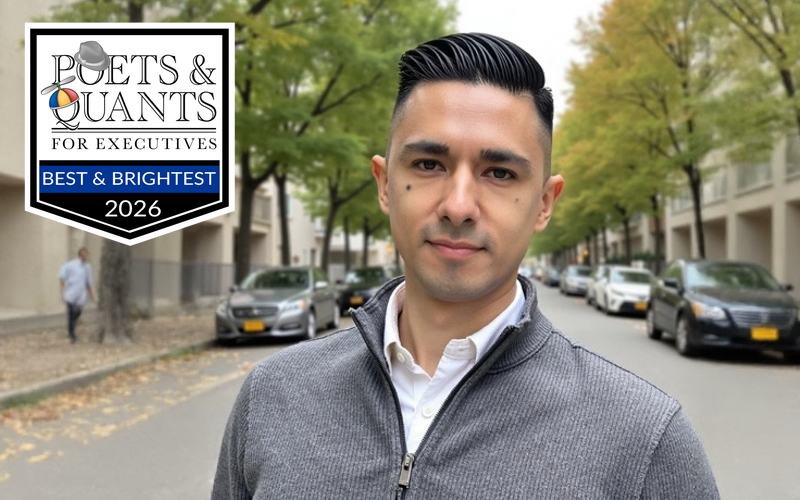
Carlos Ortega
Northwestern University, Kellogg School of Management
Age: 38
“People-driven analytics leader in banking, Latin American, LGBTQ+ advocate, and proud family man.”
Hometown: Mexico City, Mexico
Family Members: Partner, brother and niece, aunts, and Lola (my dog)
Fun fact about yourself: I love dancing salsa.
Undergraduate School and Degree: Universidad Anáhuac — Actuarial Science
Where are you currently working? HSBC — Head of Business Reconciliations for the Americas
Extracurricular Activities, Community Work and Leadership Roles
Co-Founder and Member, EMBA Pride — Kellogg’s LGBTQ+ student group, fostering an inclusive and supportive community for executive students.
Member, Diversity Committee — Actively contributing to building a diverse and inclusive cohort culture aligned with Kellogg’s values.
Recipient, Dean’s Scholarship — Awarded by Kellogg School of Management in recognition of academic merit and leadership potential.
Which academic or extracurricular achievement are you most proud of during business school? The achievement I am most proud of during business school is co-founding EMBA Pride, Kellogg’s LGBTQ+ group for executive students. Launching this group was about more than visibility — it was about creating a space where people could show up fully as themselves during one of the most demanding journeys of their professional lives. What moved me most was seeing how it resonated not just within the LGBTQ+ community, but across the entire cohort. It sparked conversations about inclusion and authenticity that enriched our classroom experience and strengthened our sense of community. Kellogg already has an extraordinary culture of warmth and belonging — EMBA Pride, I hope, made it just a little more complete.
What achievement are you most proud of in your professional career? What I’m most proud of professionally is that HSBC has always given me the freedom to explore new paths and turn ideas into impact — and two moments define that for me. The first is founding the Pride Network at HSBC Mexico, the first-of-its-kind in the region. What began as a drive to create visibility and inclusion grew into leading the network across all of Latin America, and eventually into my nomination as one of three Global Pride Co-Chairs, helping shape inclusion policies across the 35+ markets where HSBC operates.
The second is my current role as Head of Reconciliations for the Americas, where we are in the middle of a full redesign of how the team operates across the region — a transformation that, once complete, will be a game-changer. Kellogg played a direct role in preparing me for this — through strategic frameworks in the classroom, mentorship from world-class professors, and the perspective of peers who pushed me to think at an entirely new level. Both achievements share the same root: a company that trusted me and a willingness to build something where nothing existed before.
Who was your favorite MBA professor? My favorite professor was David Schonthal, Professor of Strategy, Innovation and Entrepreneurship at Kellogg — and one of those rare educators who doesn’t just teach you new things, but fundamentally changes how you think. I first encountered his work in a design thinking class, and then again in my elective in Austin. Both times, he achieved the same remarkable thing: he made a room full of experienced executives question assumptions they didn’t even know they were making. His approach is rooted in the idea that the biggest obstacle to innovation isn’t a lack of good ideas — it’s the human resistance that stands in the way of them. That concept alone reframed how I think about leading change at work. As someone who operates in a large, complex global organization, understanding why people resist new ideas — and how to work with that resistance rather than against it — has been one of the most practically useful things I have taken from my entire EMBA. Professor Schonthal has a gift for making you see the world differently. And once you do, you can’t unsee it.
Why did you choose this school’s executive MBA program? I chose Kellogg after attending an on-campus session to learn about the program — and that’s the moment everything clicked. Walking in, I expected to be evaluated on my professional credentials and career trajectory. What I didn’t expect was to be asked about my hobbies, my family, and my hometown. The people I met that day were extraordinarily accomplished, yet what they wanted to know was who I was as a person — what shaped me, what I loved, and what I carried with me beyond my job title. That told me everything. Kellogg wasn’t just looking for executives; it was looking for human beings with something to contribute from every dimension of their lives. I left that campus visit knowing this wasn’t just a business school — it was home.
What is the biggest lesson you gained during your MBA and how did you apply it at work? The biggest lesson my MBA gave me is one that sounds simple but takes real courage to embrace: leadership is not about having all the answers — it’s about creating the conditions for others to thrive. Coming from an analytics background, I was trained to solve problems myself, to find the answer in the data. Kellogg challenged that instinct. Through my coursework, my professors, and perhaps most powerfully through my peers, I discovered that the greatest impact a leader can have comes not from what they know. Instead, it comes from how well they empower the people around them.
The second lesson — deeply connected to the first — is the transformative power of collaboration. When people feel genuinely supported and trusted, they bring their best thinking to the table, and the collective result far exceeds anything one person could achieve alone. I carry both lessons into my work at HSBC every day. As I lead the redesign of the reconciliations function across the Americas, my approach is built on exactly these principles: empowering my team to own their work, fostering a collaborative culture across markets and functions, and trusting that when people feel valued, they deliver exceptional results.
Give us a story during your time as an executive MBA on how you were able to juggle work, family and education? Toward the end of last year, everything seemed to converge at once. At work, we were navigating an unprecedented period of change — restructuring how our team operates across the Americas, with all the pressure and complexity that brings. At the same time, I was dealing with some personal health challenges, and academically, I was facing some of the most rigorous coursework and deliverables of the entire program.
There were moments where I genuinely didn’t know how I was going to get through all of it. What carried me through was my study group — the small team of classmates at Kellogg who became my academic partners, sounding board, and, luckily enough, my friends. I was honest with them about what I was going through, and without hesitation they stepped up. I contributed what I could, and they covered the rest. That experience taught me something I will never forget: the Kellogg community is not just a network — it is a genuine support system. And sometimes, the most important lesson a leader can learn is how to ask for help and trust the people around them.
What advice would you give to a student looking to enter an executive MBA program? My advice is simple: do your research. Choosing an Executive MBA is one of the most significant investments you will make — not just financially, but in time, energy, and personal growth. Look beyond rankings and focus on finding a program that aligns with both your professional goals and your personal values. Visit campus, sit in on a class, and talk to current students and alumni. Pay attention to how people treat each other, what the culture feels like, and whether you can picture yourself growing there. Because at the end of the day, an EMBA is not just an academic credential — it is a transformational experience. The right program will challenge how you think, expand how you lead, and change who you are. Make sure you choose one that is worthy of all three.
What was your biggest regret in business school? My biggest regret is not having had enough time to take full advantage of everything Kellogg has to offer. From access to world-class publications and research tools, to the incredible range of student clubs and events, the resources available are truly extraordinary. I threw myself into the experience wholeheartedly — but the honest truth is that the more engaged you become, the more you realize how much more there is to explore. If I could do it again, I would be even more intentional from day one about mapping out everything available and making a plan to experience as much of it as possible. Kellogg gives you so much — the only regret is that there aren’t enough hours in the day to absorb it all.
What is one way that your business school has integrated AI into your programming? What insights did you gain from using AI? Kellogg has woven AI into its programming in a way that goes far beyond theory — and no experience made that clearer than TechVenture India, a global immersion designed by Professor Mohanbir Sawhney, one of the world’s foremost authorities on AI and marketing. Through the program, I was immersed in India’s most forward-thinking companies — from AI-powered healthcare platforms to fintech disruptors — seeing firsthand how organizations are building and scaling AI at speed. Watching Professor Sawhney bring these concepts to life in real time, moving fluidly between theory and live demonstration, was one of the most eye-opening moments of my entire EMBA. The insight I brought back was this: AI is not just a technology challenge — it is a leadership and organizational challenge. The companies winning with AI are not necessarily the ones with the best models; they are the ones with the clearest strategy, the strongest culture of trust, and leaders who understand both the opportunity and the limits.
What was the main reason you chose an executive MBA program over part-time or online alternatives? For me, the decision was clear from the start. My next career move is an international one, and I needed a program that would help me grow a global network — not virtually, but face-to-face, in rooms with experienced professionals from around the world. A part-time or online program simply couldn’t offer that. The Executive MBA format gave me exactly what I was looking for: the ability to continue working and applying my learning in real time, while also immersing myself in a truly global experience. But beyond the curriculum, it was the people. Being in the room with accomplished executives from diverse industries, geographies, and backgrounds — learning from their experience as much as from the professors — is something no online program can replicate. That peer network is one of the most valuable things I am taking with me from Kellogg.
How did you finance your EMBA and what did you do to make tuition and associated costs more affordable? I financed my EMBA through a combination of personal savings, student loans, and a Kellogg scholarship. Being selected for the scholarship was not only a financial help, but also a meaningful recognition that reinforced my commitment to making the most of the experience. Careful financial planning before and during the program helped me manage the associated costs and kept me focused on what mattered most — getting the best out of every moment at Kellogg.
What is your ultimate long-term professional goal? My ultimate goal is to become a better leader every day — one who creates genuine impact in the lives of the people around them. I am deeply aware of how fortunate I am to have had the opportunity to study at an institution like Kellogg, and that awareness comes with a responsibility I take seriously. Not everyone from Latin America gets a seat at this table, and I never want to take that for granted. My long-term commitment is to use every skill, connection, and lesson this experience has given me to give back — to my community, to the next generation of Latin American and LGBTQ+ professionals who are finding their way, and to the organizations I have the privilege of leading. Impact, for me, is not a destination. It is how I want to show up every single day.
DON’T MISS: BEST & BRIGHTEST EXECUTIVE MBAS: CLASS OF 2026
© Copyright 2026 Poets&Quants. All rights reserved. This article may not be republished, rewritten or otherwise distributed without written permission. To reprint or license this article or any content from Poets&Quants, please submit your request HERE.

