





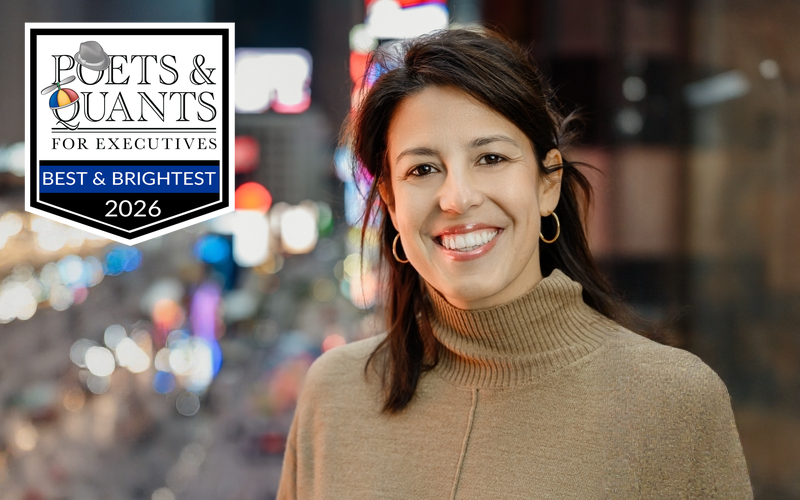
Abigail (Abby) Anderson
University of Notre Dame, Mendoza College of Business
Age: 45
“Daughter, Wife, Mother, Friend, Values-driven leader redefining business through empathy, curiosity, and “power with” leadership.”
Hometown: Farmington, WV (currently reside in Sewickley, PA)
Family Members: Todd (husband), Domenic (son), Maryan (daughter), Tyce (son), and Nelly (goldendoodle “dog daughter”)
Fun fact about yourself: I’m a lifelong Notre Dame superfan across all sports (far beyond football) and bring that same energy to cheering for my three children at every academic and athletic event…while still being the “geek” mom who loves homework time and daily reading. I believe meaningful questions matter more than quick answers, and I bring that mindset everywhere, from boardrooms to family dinners.
Undergraduate School and Degree: James Madison University, B.S. Integrated Science and Technology
Where are you currently working?
Company: Viatris
Role: Global Transformation Office: Head of Initiatives and Transaction Management
Extracurricular Activities, Community Work and Leadership Roles: Mentor to early-career professionals and women leaders; active supporter of school- and community-based leadership initiatives; engaged in service- and faith-based family activities focused on developing character, empathy, and responsibility.
Which academic or extracurricular achievement are you most proud of during business school? Developing clarity and confidence to lead with purpose, not just authority. The EMBA program challenged me to integrate strategy, finance, and operations without losing sight of people, values, and long-term impact. I’m most proud of how I showed up as a leader throughout the program while balancing demanding professional and personal responsibilities.
What achievement are you most proud of in your professional career? Building and leading cross-functional teams through complex, high‑stakes change, while intentionally shifting leadership from “power over” to “power with.” Creating environments built on trust, vulnerability, and accountability has resulted in stronger execution…and more human, sustainable outcomes.
Who was your favorite MBA professor? This is difficult to choose because several professors stood out for different reasons, particularly for their ability to connect theory to real‑world application. Their teaching consistently challenged me to think differently, ask better questions, and apply concepts immediately in my professional role. That said, I would land on Sam Miller, largely because of the impact his course had on deepening my understanding of innovation that affects revenue transformation. Gaining greater fluency in this space is critical for my growth as a leader, especially in transformation-focused work, and his approach helped translate complex concepts into practical tools I now use directly in driving change and enterprise-wide decision-making.
Why did you choose this school’s executive MBA program? The University of Notre Dame’s Executive MBA stood apart for its clear commitment to Grow the Good in Business – a philosophy that positions leadership as both a strategic and moral endeavor, where success is measured not only by results, but by the positive, lasting impact leaders create for people and communities. That values-based foundation resonated deeply with my belief that business outcomes are strongest when they are created with, by, and for people.
Equally compelling was the program’s global design. Over the 22‑month journey, the EMBA blends rigorous, on‑campus coursework with immersive experiences across four continents, exposing leaders to diverse business cultures, economic systems, and societal contexts. These global immersions are not observational…they are hands-on, purpose-driven experiences that challenge assumptions, sharpen judgment, and broaden perspective.
Together, Notre Dame’s emphasis on principled leadership and its intentionally global structure offered a rare opportunity to grow not just as an executive, but as a leader prepared to navigate complexity, lead across cultures, and create meaningful impact at scale.
What is the biggest lesson you gained during your MBA and how did you apply it at work? The biggest lesson I gained was the importance of leading with both data and empathy. The program reinforced that the strongest decisions come from integrated thinking (bringing strategy, finance, operations, and people together rather than treating them as silos). I’ve applied this by approaching decisions more holistically, balancing analytics with a deep understanding of people and organizational dynamics to drive more durable outcomes.
Equally impactful were the learnings from Design Thinking and Future‑Back thinking, which emphasized working alongside partners to identify unmet needs and reimagine what is possible. Applying these frameworks in my current transformation role has shifted how we explore growth opportunities…moving from incremental improvement to intentionally designing new value. As a result, the work underway is focused on unlocking new revenue streams with the potential to deliver meaningful double-digit percentage EBITDA growth, while staying aligned with our core business model, long‑term enterprise strategy and purpose.
Give us a story during your time as an executive MBA on how you were able to juggle work, family and education? One week during the program stands out as a real test of balance and commitment. I was traveling internationally for work, focused on securing my portion of a complex M&A transaction critical to the company. At the same time, I was actively pulling together a major paper for one of my EMBA courses…working across time zones, hotel rooms, and airport lounges to keep momentum moving forward.
That same week, I was determined to make it home in time to host a birthday party for one of my children and be present at sporting events for the other two. It was the kind of week where there was no margin, only choice and intention.
Making it work required losing sleep, staying intensely focused on the end game, and leaning
heavily on the support around me. My learning team stepped in with flexibility and partnership, my family provided unwavering encouragement, and I learned to prioritize with precision. I trusted my instincts of knowing when to push, when to pause, and when presence mattered more than perfection.
That experience mirrored the reality executive leaders face every day. It reinforced that success does not come from doing everything alone, but from trusting others, staying grounded in purpose, and remaining clear on what truly matters—both professionally and personally.
What advice would you give to a student looking to enter an executive MBA program? Choose a program that aligns with your values, not just your résumé goals. Stay curious, ask thoughtful questions, and fully invest in your cohort. The relationships you build will matter long after graduation.
Be intentional about what you want to gain from the experience and fully commit to it. An executive MBA is demanding, but the more you invest (in relationships, discussions, and challenges that stretch you) the more transformative the program will be. When you approach it with clarity of purpose and a willingness to engage deeply, the value extends far beyond the classroom and will continue well after the degree is complete.
What was your biggest regret in business school? If anything, I would have pushed myself even further outside my comfort zone earlier in the program. The experience truly rewards those who take full advantage of every opportunity: academically, professionally, and personally. At the same time, I wish I had slowed down sooner to fully appreciate the depth of the relationships being formed. In hindsight, the connections and shared experiences with my cohort were just as transformative as the curriculum itself.
What is one way that your business school has integrated AI into your programming? What insights did you gain from using AI? AI was deeply embedded across the curriculum, with meaningful subject matter integrated into many courses and four dedicated courses focused on applying AI across different business functions and organizational contexts. Rather than treating AI as a standalone topic, the program emphasized practical application… using AI to inform decision‑making, improve operational efficiency, and support strategic judgment.
Most importantly, the experience reinforced that AI enhances, but does not replace, human judgment. It was introduced as both a strategic capability and a leadership responsibility. The program consistently emphasized pairing innovation with empathy, ethics, and strong governance, underscoring that technology only strengthens leadership when it is guided by clear values and thoughtful oversight, particularly in complex business environments.
What was the main reason you chose an executive MBA program over part-time or online alternatives? The executive MBA offered an immersive, high‑impact, global experience alongside peers at a similar career stage, which was critical for how I learn and lead. I knew early on that an online format would not suit my learning style. I value in‑person collaboration, real‑time dialogue, and the intensity that comes from being fully present with a cohort.
The immersive, cohort‑based EMBA experience created deeper learning, immediate application, and lasting relationships that would be difficult to replicate in other formats. That level of engagement, working through complex challenges together, felt essential for leaders navigating high‑impact, transformational roles, where learning is best done shoulder-to- shoulder rather than in isolation.
How did you finance your EMBA and what did you do to make tuition and associated costs more affordable? I am truly one of the fortunate ones. My organization fully sponsored my executive MBA, recognizing both the value of the education and the impact it could have on my leadership and the business. That level of investment was a tremendous gift, and a responsibility I do not take lightly.
I approached the opportunity with intentionality, ensuring that what I gained from the program translated directly into meaningful outcomes for the organization. My goal has always been to repay that investment many times over by applying what I learned to drive transformation, create value, and deliver sustained impact well beyond the duration of the program.
What is your ultimate long-term professional goal? As I tell my children often, I’m still not 100% sure what I want to be when I grow up. Now, I’ve come to see that as a strength rather than a limitation.
What I do know with certainty is that I want to continue growing as a leader who drives meaningful impact. My long‑term goal is to keep leading complex, purpose‑driven organizations while shaping strategy, developing people, and contributing to sustainable business outcomes.
I’m particularly motivated by expanding how business creates value…not just financially, but through outcomes that are created with, by, and for people. Along the way, I hope to mentor and develop future leaders, helping them lead with both courage and empathy, and to ensure that the organizations I serve are stronger, more human, and more enduring because of the leadership applied.
DON’T MISS: BEST & BRIGHTEST EXECUTIVE MBAS: CLASS OF 2026
© Copyright 2026 Poets & Quants. All rights reserved. This article may not be republished, rewritten or otherwise distributed without written permission. To reprint or license this article or any content from Poets & Quants, please submit your request HERE.

