





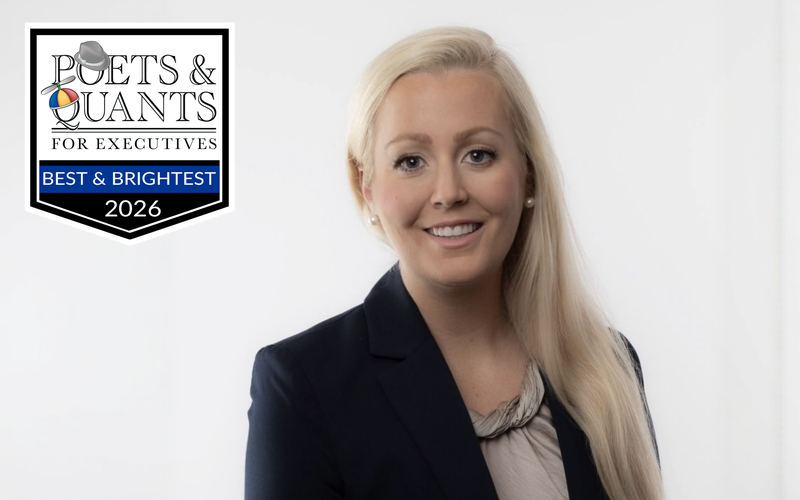
Lindsay Thompson
Imperial Business School
Age: 36
“Global, resilient leader and connector, building high-performing teams and creating opportunities across cultures.”
Hometown: I grew up in Gloucester, Massachusetts, United States and have been living in London, United Kingdom since 2017.
Family Members: My husband, James Megarity, and dog, Brady (both in London); a sister who is Boston-based and my mother and father who are in Florida.
Fun fact about yourself: I am both a singer and an athlete. At university, I sang the U.S. National Anthem before lacrosse and field hockey games I competed in, and I continue to sing today as part of a gospel choir.
Undergraduate School and Degree: Bachelor of Arts, Bates College in Economics and Environmental Studies.
Where are you currently working? Bank of New York, Head of EMEA & APAC Client Services, Growth Ventures
Extracurricular Activities, Community Work and Leadership Roles:
Imperial Executive MBA Honors & Awards
- Dean’s List (Top 10% of cohort)
- Graduated with Distinction, Executive MBA
- Executive MBA Best End of Year Report Prize
- Joan Woodward Postgraduate Memorial Prize for excellence in Organisational Behaviour
- Recipient of both the Inspiring Women’s Scholarship and Imperial Excellence Scholarship
Vice President & Social Chair, Executive MBA Cohort
Elected to leadership role within a diverse global cohort; organized initiatives that strengthened community, collaboration and peer engagement.
Contributing Author, Bold Brilliance (2025)
Contributor to a published book featuring 14 women sharing perspectives on leadership, resilience and redefining success across global careers.
Women’s Leadership, Mentorship & Industry Engagement
Mentor, The Girls’ Network | London
Mentor young women from underserved communities, providing career guidance, confidence-building and access to opportunities in financial services.
Women’s Network Leader & Mentor – Bank of New York and SS&C
Former Head of the Women’s Network and Culture Committee at SS&C, leading initiatives to strengthen inclusion and the advancement of women; currently active in the Women’s Network and Culture Committee at BNY. Mentor junior colleagues and support the progression and representation of women in financial services.
Industry Speaker, Panel Host & Community Builder
Frequent speaker and panel host at industry forums, including the CX in Financial Services Forum and Customer Contact Week UK. Regularly represent BNY at events and lead discussions focused on client experience and leadership. Most recently hosted and moderated a panel, “Building Networks That Advance Women’s Careers,” bringing together senior women to share insights and foster community.
Member, 100 Women in Finance & Women in Asset Servicing
Engaged in global communities advancing female leadership in finance through mentorship, events and industry collaboration.
Global Perspective & Personal Interests
Global Travel & Cultural Engagement
Have travelled to 56 countries and circumnavigated the world, developing a deep appreciation for cultural diversity, global perspectives, and inclusive leadership. These experiences have shaped a more open-minded, adaptable approach to working across international teams.
Singer & Musical Leadership
Active singer with a lifelong passion for music and performance. Currently sing in a London-based gospel choir (London Live Community Choir) and previously served as Vice President of an a cappella group at Bates College. Regularly performed at university events, including singing the U.S. National Anthem at athletic games. Continue to use music as a way to build community and connection.
Athletics
Current: Field Hockey – Wapping Hockey Club; Golf & Tennis
Active competitive and recreational athlete, maintaining a strong commitment to teamwork, discipline and performance.
University Athletics – Bates College
Two-sport varsity athlete (Lacrosse & Field Hockey); NESCAC All-Academic Honors.
Which academic or extracurricular achievement are you most proud of during business school? The achievement I am most proud of during my Executive MBA at Imperial Business School was receiving the Best End of Year Report Prize for my final project, “Bridging the Gender Network Gap in Fintech.” This work was deeply personal, shaped by my own experience navigating a male-dominated industry and my desire to create more inclusive pathways for women.
Through a survey of 350 professionals and 35 in-depth interviews, I explored the structural and cultural barriers women face in building high-value networks, as well as the environments and strategies that enable access, visibility and opportunity.
What made this especially meaningful was the opportunity to connect with and learn from so many women who shared their experiences so openly, and to translate those insights into practical, actionable recommendations that could help others navigate and succeed.
I brought the work to life by hosting and moderating a panel, “Building Networks That Advance Women’s Careers,” creating a space for those insights to be shared and discussed in practice. I have continued to present the findings at Oxford Saïd Business School’s Executive MBA Women’s Day, as well as at Bank of New York, Northern Trust, and other organizations. I’m now working to publish the research more broadly to extend its reach and impact, and to continue supporting women in building the networks that shape their careers.
What achievement are you most proud of in your professional career? The professional achievement I am most proud of is building and leading global client service organizations across EMEA and APAC, a journey that began when I made the decision to move from the United States to London early in my career.
Relocating meant stepping into an entirely new environment, adapting to a different culture and working across diverse teams and clients throughout Europe, the Middle East, Africa, and later Asia-Pacific. That experience became the foundation of my leadership journey.
Over time, I have built and scaled five service teams across multiple firms, including leading EMEA and APAC Client Success and Account Management teams at SS&C Eze and Advent, where I oversaw $260M in annual recurring revenue and supported 680 clients. Most recently, at Bank of New York, I built and scaled a global Client Services organization for the Growth Ventures business from the ground up, establishing a client-first operating model focused on retention, growth, and long-term value.
What I am most proud of is not just the scale, but the ability to bring together diverse teams, navigate different cultural contexts and build high-performing, client-centric organizations that deliver meaningful business impact. This experience shaped my leadership style, strengthened my resilience and adaptability, and remains the defining decision that has enabled me to grow as a global leader and build a career I am deeply proud of.
Who was your favorite MBA professor? My favorite MBA professor was Anne ter Wal, who is Professor of Technology and Innovation Management in the Department of Management and Entrepreneurship and taught the Strategic Networking elective. His module fundamentally changed how I think about networks and their role in leadership, highlighting how they drive access to information, influence and opportunity, as well as innovation through diverse perspectives and connections.
What stood out most was how he encouraged us to critically reflect on our own networks and approach them with intention. Through his teaching, I recognized my natural role as a connector and gained a deeper understanding of how diversity, reach, depth, and reciprocity shape the value of relationships. He also inspired and supported my decision to focus my final research project on networking, particularly the gender dynamics within fintech, an area where there is still limited research.
His encouragement gave me the confidence to explore a topic that was both academically rigorous and personally meaningful and ultimately led to my award-winning project. His module not only shaped my thinking during the MBA, but continues to influence how I build networks and create opportunities for others.
Why did you choose this school’s executive MBA program? I chose the Executive MBA at Imperial Business School because of its unique strength at the intersection of business, technology, and innovation, which directly aligns with my career in fintech.
Imperial has a reputation as a world-leading institution in science, engineering, and technology. That, combined with its entrepreneurial ecosystem at the White City campus and its location in the heart of London, a global business and innovation hub, made it an ideal environment to broaden my perspective and leadership approach.
A key factor in my decision was also the diversity of the cohort. I was intentional about choosing a programme that would expose me to leaders from a wide range of industries and backgrounds, not just finance or technology. Imperial’s cohort composition reflected that, bringing together professionals across sectors, which created a rich learning environment and allowed me to gain new perspectives and better understand different leadership styles.
The programme’s focus on innovation and the integration of AI and emerging technologies across the curriculum was especially compelling. I was also drawn to the global learning experience, including study opportunities with MIT Sloan and Stanford Graduate School of Business. Through these experiences, I engaged directly with startups, venture capitalists and innovation leaders in ecosystems like Silicon Valley, gaining firsthand insight into how technology-driven businesses scale and evolve.
Overall, Imperial offered a forward-looking, globally connected programme that has been instrumental in shaping how I think about leadership, technology, and transformation in business.
What is the biggest lesson you gained during your MBA and how did you apply it at work? The biggest lesson I gained during my Executive MBA was the importance of taking calculated risks and backing myself with confidence. After nearly 13 years at the same firm, where I had progressed to a Senior Director, I had built a strong and stable career but had also become increasingly risk-averse.
With its focus on leadership, innovation, and entrepreneurial position, the Executive MBA challenged my mindset, helping me to recognise how often I hesitate and question that next step. I applied this lesson by making the decision to transition to a new organization during the programme, stepping into a senior leadership role at Bank of New York.
The opportunity involved building and leading a client services organization for the Growth Ventures business across EMEA and APAC, a significant expansion in scope and responsibility. Instead of holding back, I chose to trust my experience and take the risk. Since then, I have successfully built and scaled the function, established a clear operating model and led the team through growth and transformation.
This experience reinforced that confidence is not about certainty, but about the willingness to step forward and create opportunity. Imperial’s MBA experience gave me the perspective and conviction to do that, and it continues to shape how I approach leadership and pursue new challenges.
Give us a story during your time as an executive MBA on how you were able to juggle work, family and education? Balancing work, family and my Executive MBA required a high level of discipline, prioritization, and support. One example that stands out happened during the first-year exam period, which was one of the most demanding times of the programme. I approached it by planning well in advance, spreading out my study schedule and being very intentional with my time to avoid last-minute pressure and unnecessary stress.
A key part of managing this period successfully was clear communication with my support system. I was upfront with my husband and family about when I would be busiest and how I needed to structure my time. This allowed them to support me and helped remove any sense of guilt around shifting priorities temporarily.
At the same time, I made a conscious effort to maintain balance by protecting time to rest and recharge, which ultimately made me more effective both at work and in my studies. I was also supported by my cohort, where we leaned on each other during more intense periods of the programme. These relationships were invaluable, both academically and personally.
This experience reinforced that successful balance is not about sacrificing one area, but about being intentional with your time, communicating openly, and surrounding yourself with people who support your goals.
What advice would you give to a student looking to enter an executive MBA program? My advice would be to fully invest in the experience, both inside and outside the classroom. Some of the most valuable parts of the MBA came from my cohort. I formed friendships that will last a lifetime. As Social Chair, I made it a priority to bring people together and create opportunities to connect. The network you build is one of the most important outcomes of the programme, so take the time to engage, ask questions, and learn from those around you. This includes your professors, who bring deep expertise and real-world perspective.
I would also encourage candidates not to be discouraged by the financial commitment. There are often more options than you initially expect, including scholarships and employer sponsorship, and it is important to advocate for yourself and clearly articulate the value the MBA will bring.
Finally, be intentional with your time. It is a demanding programme, and the more you plan ahead and stay disciplined, the more you will absorb and get out of the experience. If you truly invest in it, the return goes far beyond the degree itself.
What was your biggest regret in business school? My biggest regret is that I did not pursue the MBA sooner. For a long time, I hesitated due to concerns around the financial commitment and whether it was the right time to step away from the stability I had built in my career. In hindsight, those concerns held me back from an experience that has been incredibly valuable, both personally and professionally.
The MBA pushed me to think differently, broadened my perspective, and gave me the confidence to take meaningful steps in my career, including transitioning to a new organization and taking on a larger leadership role. It also introduced me to an exceptional and diverse group of peers who have had a lasting impact on how I think and lead. Looking back, I would have benefited from that experience earlier, and it reinforced the importance of not letting uncertainty or perceived barriers delay opportunities for growth.
What is one way that your business school has integrated AI into your programming? What insights did you gain from using AI? At Imperial Business School, AI was integrated throughout the programme, both formally through the curriculum and practically in how we approached our work. Specific modules and electives introduced the strategic implications of AI and emerging technologies and provided deeper insight into how they are shaping industries. This was complemented by global exposure through the Global Immersions, where we engaged with startups and venture capitalists and explored how AI is driving innovation and shaping the future of business.
AI was also embedded in the broader learning experience, with clear guidance on how to use it responsibly to enhance efficiency while maintaining academic integrity. One of the most valuable insights I gained was how to apply AI in a practical, business context. For example, I used AI tools to support the analysis of data in my final research project, helping to extract insights more efficiently from a large dataset.
More broadly, the programme reinforced my perspective that AI is most powerful when used to augment, not replace, human capability. In my role in fintech, this translates to using AI to reduce time spent on repetitive, reactive tasks, enabling teams to focus on higher-value, relationship-driven work where the human element is critical.
What was the main reason you chose an executive MBA program over part-time or online alternatives? I chose an Executive MBA over part-time or online alternatives because I wanted a highly immersive, in-person experience that would allow me to learn directly from a diverse group of experienced leaders.
A key priority for me was being in the classroom and engaging in discussion. Even more, I wanted to be learning not just from professors, but from peers across a wide range of industries and backgrounds. The smaller, interactive format at Imperial Business School created an environment where we could actively contribute, challenge each other, and build meaningful, long-term relationships.
Equally important was the ability to continue working while studying. At this stage in my career, I did not want to step away from professional momentum, and the Executive MBA allowed me to apply what I was learning in real time. Being part of a cohort with 10+ years of experience also meant that discussions were grounded in real-world leadership challenges, making the learning immediately relevant. Overall, the Executive MBA at Imperial offered the right balance of depth, flexibility, and peer learning that I was looking for.
How did you finance your EMBA and what did you do to make tuition and associated costs more affordable? I financed my Executive MBA through a combination of scholarships and employer sponsorship. I was awarded both the Inspiring Women Scholarship, supported by the 30% Club, and the Imperial Excellence Scholarship, which together covered a significant portion of my first-year tuition.
For the remaining costs, I worked closely with my employer to secure sponsorship, positioning the MBA as a strategic investment in my leadership development and the value I could bring back to the organization. When I later transitioned roles, I proactively negotiated continued support as part of my move to Bank of New York, which ultimately fully funded my second year. This collective approach meant I financed the MBA with intention and persistence, combining merit-based funding with employer support to make the programme financially viable.
What is your ultimate long-term professional goal? My ultimate long-term professional goal is to become a CEO, leading and scaling a global organization, with the path through a Chief Operating Officer role. I am most energized by building and transforming teams, driving operational excellence and creating environments where both people and businesses can thrive. As a leader, I want to build organizations that are not only high-performing, but also purpose-driven, where individuals feel empowered, supported and connected to a shared vision. I care deeply about developing others, fostering inclusive and collaborative cultures, and helping people succeed while delivering meaningful business outcomes.
Ultimately, I want to look back on my career knowing I led in alignment with my values and made a meaningful, positive impact on the world.
DON’T MISS: BEST & BRIGHTEST EXECUTIVE MBAS: CLASS OF 2026
© Copyright 2026 Poets & Quants. All rights reserved. This article may not be republished, rewritten or otherwise distributed without written permission. To reprint or license this article or any content from Poets & Quants, please submit your request HERE.

