




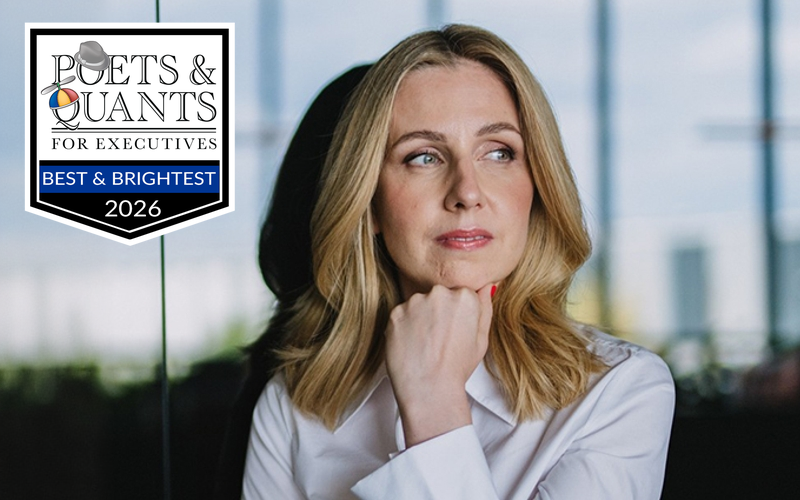
Adriana Kiedzierska-Mencfeld
IMD (International Institute for Management Development)
Age: 45
“Purpose-driven biotech leader who believes people and animals always come first.”
Hometown: Namyslow, Poland
Family Members: Husband Paweł, cat Plimka, and a big, beloved family — siblings, their families, my father, and Paweł’s family too.
Fun fact about yourself: My best friend is my husband. We have known each other for 27 years and have been married for 18. He is also my most trusted coach, the person who always tells me the truth, gives constructive feedback, and puts wind in my sails. My friends often joke that he is the best manager I could ever have. It is very important, especially now being in a CEO role, where getting real feedback is rare.
Undergraduate School and Degree:
IMD – Lausanne, Switzerland, Executive Master of Business Administration (EMBA)
University of Wroclaw – Wroclaw, Poland, PhD in Molecular Biology and Biotechnology
Wroclaw University of Science and Technology and Technische Universität Dresden, Germany (scholarship Herbert Quandt Altana AG-Master Thesis) – MSc in Molecular Biotechnology and Biocatalyst
Where are you currently working? Rezon Bio (CDMO brand of Polpharma Biologics), CEO, President of Management Board
Extracurricular Activities, Community Work and Leadership Roles: From an early age, I found great fulfilment in sharing knowledge and helping others grow. This passion was one of the reasons I decided to pursue a PhD and work closely with students and doctoral researchers at the university level. Supporting others in their development has always been an important part of who I am.
Throughout my professional career, people development has remained one of the most meaningful aspects of my work. I find genuine joy in seeing individuals achieve important milestones, build confidence, and grow into new roles, whether within the organisation or beyond it. Helping people realise their potential is something I care deeply about.
I am particularly passionate about supporting young women and encouraging them to have the courage to speak up, pursue opportunities, and advance in their careers. I strongly believe that leadership does not require perfection, but authenticity, resilience and curiosity. Creating space for others to grow, especially women at earlier stages of their careers, is something I see as both a responsibility and a privilege.
Alongside my executive responsibilities, I have contributed to the broader professional community through interviews, conference participation, knowledge sharing and mentoring. In 2025, I was honoured to receive the CPHI Pharma Awards Woman of the Year recognition, which I see not only as a personal distinction, but also as a reflection of the values I try to live by through leadership, development of others and contribution to the industry.
Which academic or extracurricular achievement are you most proud of during business school? Two moments stand out.
First, there is the academic one: I completed the IMD EMBA program during one of the most demanding periods of my career. Rather than treating coursework as separate from my day job, I made them inseparable. Every assignment was grounded in real challenges from my company, and every framework I learned went straight into practice. That discipline, doing both at full intensity simultaneously, is something I’m genuinely proud of.
Second, my peers selected me as their ambassador. Representing them at the diploma ceremony was an unexpected honour and a reminder that presence isn’t only about time. It’s about the quality of the moments you show up for.
Together, they reflect what I value most: delivering under pressure and earning trust through substance.
What achievement are you most proud of in your professional career? I chose medical biotechnology out of a genuine passion for helping people. Delivering therapies to patients who would otherwise have no access to them has driven every decision across my entire career, from my master’s thesis and PhD through every role I’ve held since.
What I’m most proud of goes beyond my own trajectory. I played a key role in building the foundations of the industrial biotechnology industry in Poland. I created something that, just a few years ago, sounded almost impossible. Even more, I gave talented Polish biotechnologists a reason to come back to their country or to stay. That impact on an entire ecosystem, on careers, on a field, that matters to me more than any single milestone.
And the journey itself carries a message I didn’t set out to send but now embrace, starting from the lowest managerial position and becoming CEO of a biologics CDMO (Contract Development and Manufacturing Organization). It is a path gives confidence to others, especially to young women entering this industry. If my story makes someone believe it’s possible for them too, that’s an achievement I can’t put a number on.
Purpose, people, and building something that lasts. That’s what I’m most proud of.
Who was your favourite EMBA professor? Every professor at IMD brought genuine value to my journey. Each module and conversation left something behind. But three stood out as truly outstanding.
Professor Vanina Faber had the most personal impact. During our immersion module in Peru, I arrived at a turning point. I had just been appointed CEO and was under pressure from a group-level colleague to appoint someone to my executive team who I didn’t believe in as a leader. I knew it was wrong, but I was afraid — being the youngest person on the executive team and the only woman.
Then I met José Ugaz. Listening to his stories about risking his life and his family’s safety for truth and justice made my dilemma feel small — and at the same time, clarified it completely. And finally, Francisco Sagasti, whose words stayed with me: “Crisis does not create a leader’s character. Crisis reveals it.” Add to that: “You can be firm without being aggressive. You can be calm and still be unyielding.”
I came back with those three people as my inner compass. On Monday morning, I told my colleagues: that person will not join my executive team. There was tension, pushback, emotional pressure. I stood firm. Eventually, my decision was accepted and respected. Vanina showed me what real leaders look like. That changed everything.
I met Professor Nicolo Pisani at exactly the right professional moment. Rezon Bio was in the middle of a fundamental transformation from biosimilars developer to CDMO. I needed to understand not just the direction, but to own it with conviction. His frameworks pushed me to think about strategy not as a plan carved in stone, but as a hypothesis constantly tested against reality. That reframe mattered enormously. Being able to build my own analysis, not just absorb someone else’s, gave me the confidence to articulate our strategic direction clearly to my board, my team, and myself. In the process, I was able to inspire them, not just inform them.
Professor Anand Narasimhan gave me the most lasting shift. Through his leadership stream, I was confronted with something I had been telling myself for years: resilience means effort and strength means carrying the load yourself. He challenged me to question that narrative. I started to see that before you can lead others, you must first lead yourself. Vulnerability is not weakness and real authority comes from integrity – not position. That leadership is not revealed in stability. It is revealed when pressure rises, when uncertainty thickens and silence feels safer than speaking. Those weren’t abstract lessons. They landed in the real moments of my CEO journey.
Why did you choose this school’s EMBA program? IMD stood out for several reasons. First, it was the format. I was in a demanding operational leadership role and couldn’t commit to being on campus every month, as many programs require. IMD understood that the people it attracts have serious jobs and serious responsibilities. The program was designed around that reality.
What drew me most was the philosophy: theory grounded in practice. Every assignment was an opportunity to bring a real challenge from my company into the classroom and take a sharper answer back. That continuous loop of learning and application is what made the difference. Not one big project at the end, but genuine growth built week-by-week, module by module.
The timing also aligned with where I was in my career. I was growing through increasingly complex operational roles, and I needed frameworks that matched that complexity in strategy, leadership, and organizational dynamics. IMD gave me exactly that, without asking me to step out of my life to receive it.
In the end, it wasn’t just the school’s reputation that convinced me. It was the conviction that this program was built for leaders who are already in the arena and want to lead better from within it.
What is the biggest lesson you gained during your EMBA and how did you apply it at work? If I had to name the greatest lesson, it came from two places: the leadership stream and the global immersion modules.
Professor Anand Narasimhan’s leadership course gave me the most profound and lasting shift not in what I know, but in how I see myself as a leader. It invited me to look inward, sometimes uncomfortably so. It required me to examine my values, blind spots, fears, and patterns and question the narrative I had built about myself over decades — the strong one, the fixer, the person who carries the load. I learned that before you can lead others, you must first lead yourself. That vulnerability is not weakness. That real authority comes from integrity, not position. That resilience is not endurance; it is the ability to create space between stimulus and response.
In a world of accelerating change, geopolitical instability, and AI disruption, this is where leadership matters most. Not in the stable moments but in the uncertain ones. Leaders today are called to keep organizations steady, to anchor clarity when fear spreads faster than facts and, above all, to stay human. That is what people need from those at the top right now. Not just performance. Presence.
The global immersion modules were equally transformative though in a different way. We did not visit China, Peru, Kenya, and Silicon Valley as tourists. We went as leaders willing to be challenged. We arrived in each place carrying assumptions about how things work in different parts of the world. What we encountered was something far more complex and far more human. Across every continent, one truth became clear: culture is not something you judge. It is something you listen to. Stereotypes collapse the moment you truly engage. Judgment dissolves when curiosity takes its place.
I brought that directly back to how I lead at Rezon Bio, a company with people from diverse backgrounds, functions, and ways of thinking. I became more deliberate about listening before reacting; noticing what is avoided as much as what is said; and building a culture where diverse perspectives are not just tolerated but genuinely sought.
The EMBA gave me frameworks. However, the leadership course and the immersions gave me something harder to teach: self-awareness, humility, and a much wider view of what leadership can look like.
Give us a story during your time as an EMBA on how you were able to juggle work, family and education? There was no magic formula. It was intense, demanding, and (at times) genuinely hard.
I was leading one of the most significant transformations in the company’s history, while simultaneously completing assignments, preparing for modules, and trying to be present for the people I love. Something had to give, and I had to make peace with that.
The biggest shift for me was learning to let go of perfection. That does not come naturally to me. The EMBA forced me to make a choice, not between good and bad, but between what is most important and what can be good enough. Prioritisation as a genuine discipline, not just a concept. That lesson, if I am honest, has made me a better leader too.
What made it possible was the people around me. My family and friends were understanding in ways I am still grateful for. And my colleagues and leaders at work gave me the trust and flexibility to pursue this without guilt.
Looking back, I wouldn’t change a thing. But I carry a deep respect for everyone who takes this path. It asks a lot of you, and of the people who love you.
What was your biggest regret in business school? Honestly? That it ended.
If I have one regret, it is simply that the program is finite. The immersions, the conversations, the depth of reflection, the cohort: all of it created something rare. It was a space where experienced leaders could be genuinely curious, challenged, and vulnerable together. That does not exist in many places in professional life.
Every module, every assignment, every late night was valuable. I would not trade any of it. The only thing I truly regret is not being able to do it all over again.
What is one way that your business school has integrated AI into your programming? What insights did you gain from using AI? IMD takes AI seriously, not as a trend to acknowledge, but as a leadership imperative to engage with directly. It was woven into the program in a way that felt urgent and practical, not theoretical.
We explored GenAI and data analytics not just as tools, but as forces reshaping how organizations make decisions, how leaders stay relevant, and how companies create and destroy value. The question was never simply “What can AI do?”. Instead, it was “what does AI mean for you, your organization, and your responsibility as a leader?”
The insights I gained were both practical and philosophical.
On the practical side, I left with a much sharper understanding of how data-driven decision making can and should inform strategy. The ability to ask the right questions of data, to challenge outputs rather than accept them and build organizations that are genuinely AI-literate. Those are now core leadership competencies, not optional extras.
But the deeper insight was more human. AI can accelerate decisions, but it cannot replace judgment. Data can inform, but it cannot define values. Technology can scale impact but only humans decide which direction that impact takes. In a world where it is increasingly tempting to delegate difficult choices to algorithms and systems, leaders must remain present, visible, and accountable.
That tension between the power of AI and the irreplaceability of human leadership is something I carry into every strategic conversation at Rezon Bio. The executives who will lead well in the next decade are not those who fear AI or blindly embrace it. They are the ones who understand it well enough to stay in charge of it.
What was the main reason you chose an EMBA program over part-time or online alternatives? The learning that stays with you longest does not come from slides or textbooks. It comes from people.
That was the core of my decision. An EMBA with a real cohort, real immersions, and real shared experience offered something that part-time or online alternatives simply cannot replicate: the depth of interaction. It was the friction of diverse perspectives in the same room. It was the relationships built not just in classrooms but over coffee, but on long bus rides and ski slopes…and across four continents.
Online programs can deliver knowledge. But they cannot deliver the moment when someone from a completely different industry and culture challenges an assumption you have held for twenty years and turns out to be right. That requires presence. It requires proximity. It requires being genuinely in it together.
The immersion modules were a defining part of that choice. Going to China, Peru, Kenya, and Silicon Valley as a cohort meant we processed those experiences together in real time. We arrived with assumptions and left with something far more valuable: the habit of questioning them. That is not something you can replicate in a virtual classroom.
In the end, I chose the EMBA format because I believed the cohort itself would be one of my greatest teachers. That turned out to be completely true.
How did you finance your EMBA and what did you do to make tuition and associated costs more affordable? I was fortunate. My company fully financed the program tuition, travel, and accommodation and supported me with the time needed to participate without taking days off. That level of commitment is not something I take for granted.
It was also a signal. When a company invests that fully in your development, it says something about the relationship, about mutual trust and a shared belief that the investment will come back – not just to the individual, but to the organization. I felt that responsibility, and it was part of what drove me to apply everything I learned directly back into my work.
For anyone who does not have that support, my advice would be to make the case deliberately and concretely. Show your employer not just what the program costs, but what it will return in strategic capability, leadership quality, and better decision-making. Frame it as a business case, not a personal request. In my experience, companies invest in people they believe will stay and grow with them. If you can demonstrate that, the conversation changes.
What is your ultimate long-term professional goal? I want to keep doing work that matters with the same passion that brought me into this field in the first place.
At the core, my purpose has never changed: increasing access to biological therapies for patients who need them. That mission has driven every career decision I have made. It will continue to drive what comes next.
Alongside that, I want to invest more deliberately in people: developing the next generation of leaders, creating environments where they can grow, take risks, and find their own voice – particularly for women. I see too many talented women who doubt themselves in ways their male peers do not. If my journey starting from the bottom of the leadership ladder to becoming CEO can give even one person the confidence to take that next step, that means more to me than any business milestone.
So, my long-term goal is not a title or an exit. It is to stay purposeful. Even more, it is to keep building something that lasts, in access to medicines, in the organizations I lead, and in the people I help grow along the way.
That, to me, is a career well spent.
DON’T MISS: BEST & BRIGHTEST EXECUTIVE MBAS: CLASS OF 2026
© Copyright 2026 Poets & Quants. All rights reserved. This article may not be republished, rewritten or otherwise distributed without written permission. To reprint or license this article or any content from Poets & Quants, please submit your request HERE.

