





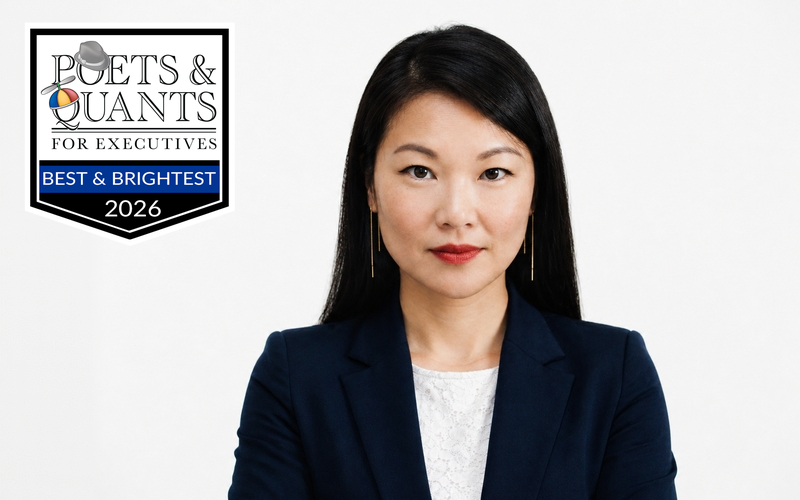
Tra Linh TRAN
ESSEC Business School
Age: 41
“Data & AI executive driving performance, value creation, and responsible transformation across global ecosystems.”
Hometown: Paris, France (originally Hanoi, Vietnam)
Family Members: One son, my greatest motivation and most demanding board member.
Fun fact about yourself: Born in Moscow, raised in Hanoi, and moved alone to France at 17 without speaking French. Since then, I’ve turned every unfamiliar environment into an opportunity to build, lead, and belong across cultures.
Undergraduate School and Degree:
Sorbonne University × DataScientest – Master’s in Data Analytics & AI
MITx (edX) – MicroMasters in Supply Chain Fundamentals
University Aix-Marseille II – Master’s in Food Industry
Where are you currently working? Data Intelligence & AI Project Manager at the French Ministry of Economy and Finance
Extracurricular Activities, Community Work and Leadership Roles:
President, Digital & Technology Club – ESSEC Alumni
Speaker – including VivaTech and Women in Tech Global Conference 2026
Mentor – supporting young people in building their future
Founder – BrAIdge, promoting ethical and inclusive AI
Which academic or extracurricular achievement are you most proud of during business school? Beyond excellent academic results, I am most proud of taking a leadership role within the ESSEC ecosystem by serving as President of the Digital & Technology Club – ESSEC Alumni.
During my EMBA, I didn’t just consume knowledge: I actively contributed to shaping a community around strategic topics such as data, AI, and digital transformation. I initiated cross-sector discussions bridging corporate, public, and entrepreneurial perspectives, and extended these exchanges to leading institutions and Grandes Écoles.
This experience reflects how I see leadership: not only delivering results individually, but also creating platforms where others can grow, connect, and drive impact collectively. It is this ability to combine expertise, influence, and community-building that I consider my most meaningful achievement during the EMBA.
What achievement are you most proud of in your professional career? I am most proud of consistently driving data and process transformations across diverse environments – from global supply chains to the French Ministry of Economy and Finance – while bridging technical expertise with strategic decision-making.
Beyond delivery, my key achievement has been to elevate data from a support function to a strategic lever, influencing how organizations make decisions, measure performance, and create value.
What makes this meaningful to me is not just the business impact, but the ability to bring clarity, structure, and long-term vision in complex environments where data was previously underutilized.
Who was your favorite MBA professor? If I had to choose, it would be Aurélien Colson, whose teaching on negotiation reshaped how I approach complexity.
What stood out was his ability to connect academic rigor with real-world geopolitical and business challenges. His approach goes beyond transactional negotiation: it is about understanding power dynamics, building long-term relationships, and exercising strategic influence.
This strongly aligns with my career ambitions at the intersection of data, international environments, and transformation.
Why did you choose this school’s executive MBA program? I chose ESSEC’s Executive MBA for its ability to combine academic excellence, international exposure, and access to influential networks.
At this stage of my career, I was not looking for knowledge alone, but for a platform to accelerate my trajectory toward executive leadership. ESSEC offered the right balance between strategic depth, diversity of perspectives, and proximity to decision-makers across industries.
What is the biggest lesson you gained during your MBA and how did you apply it at work? The biggest lesson I gained is that leadership is not only about expertise, but also about framing the right problems and mobilizing the right people and capabilities.
I applied this directly at work by shifting my approach from execution-focused to influence-driven: aligning stakeholders, structuring complex topics, and positioning data initiatives as strategic priorities rather than technical projects.
Give us a story during your time as an executive MBA on how you were able to juggle work, family and education? Balancing a demanding role, an EMBA, community engagement, and raising my son required discipline and clarity of priorities. At one point, I was managing a critical project while preparing a major academic deliverable, leading the Digital & Technology Club, mentoring young talents, and supporting my son through an important period. Instead of aiming for perfection, I focused on the 80/20 principle: prioritizing what truly mattered. This experience taught me not just resilience, but intentionality, and the importance of delegating to the right people.
What advice would you give to a student looking to enter an executive MBA program?
Do not treat the EMBA as a learning experience – treat it as a transformation platform. Be intentional: build your network strategically, test ideas in real time, and position yourself for your next role before the program ends.
What was your biggest regret in business school? If anything, it would be not leveraging the network even earlier and more aggressively. The value of an EMBA lies as much in its people as in its content – and the sooner you activate that, the greater the return.
What is one way that your business school has integrated AI into your programming? What insights did you gain from using AI? AI was both a subject of study and a practical tool throughout the program.
It reinforced my conviction that AI is not just a technological shift, but a strategic and societal one. I learned to treat AI as a powerful assistant: excellent at synthesis, but blind to context and dependent on human judgment. The key insight is simple: the value of AI depends on the quality of the data and the questions we ask. Poor input leads to poor outcomes.
What was the main reason you chose an executive MBA program over part-time or online alternatives? I chose an Executive MBA for its intensity, peer quality, and immersive experience.
At my level, transformation requires confrontation of perspectives, real-time debate, and exposure to high-caliber professionals – something online formats cannot fully replicate.
How did you finance your EMBA and what did you do to make tuition and associated costs more affordable? A combination of a student loan, a scholarship, personal savings, and support from family and friends. I approached the EMBA as a strategic investment, with a clear return in career acceleration, network expansion, and future ventures.
What is your ultimate long-term professional goal? My long-term goal is to become a global executive leader driving data and AI transformations across Europe and Asia, while building ventures that put humans first. Ultimately, I aim to operate at the intersection of business, technology, and societal impact – shaping how organizations leverage data, AI, and technology responsibly at scale.
I build solutions that scale performance, empower people, and shape a more human future.
DON’T MISS: BEST & BRIGHTEST EXECUTIVE MBAS: CLASS OF 2026
© Copyright 2026 Poets & Quants. All rights reserved. This article may not be republished, rewritten or otherwise distributed without written permission. To reprint or license this article or any content from Poets & Quants, please submit your request HERE.

