





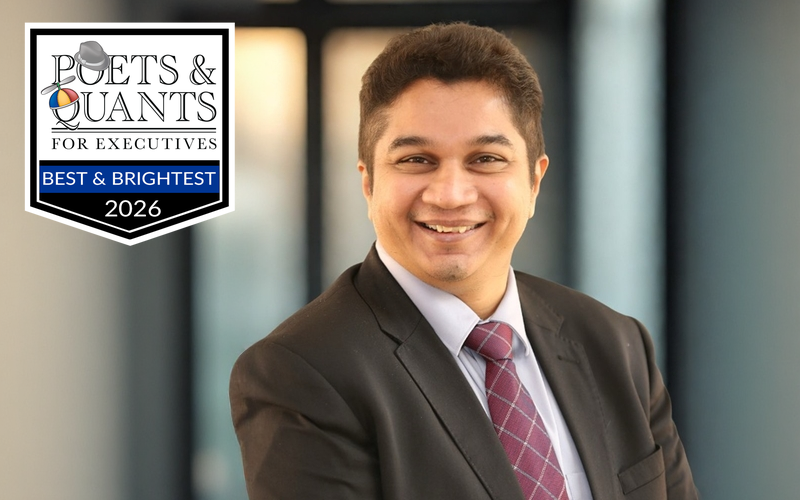
Jeckin Kirti Chheda
Indian School of Business
“Twenty years in. Founder and builder at the intersection of supply chain, finance, and AI.”
Age: 41
Hometown: Mumbai, Maharashtra, India
Family Members: Monali (wife), MBA in Consultancy Management, BITS Pilani; Jatin (brother), cyber security specialist; mother (home-maker), father (Ex-Businessman).
Fun fact about yourself: I backpacked across India and abroad, often staying with locals. My first ever bike ride was a rented Royal Enfield through Ladakh, on a backpacking trip across the Himalayas spanning Kashmir to Himachal Pradesh, in cold, rain, snow, and storms. I went with three backpackers I had just met at kickboxing class. What we took back was not about survival. It was about people from all over the world, unique places and experiences, and the quiet skills that do not show up on a CV.
Undergraduate School and Degree:
Undergraduate: B.Eng, Electrical and Electronic Engineering, Brunel University of London, United Kingdom
Post-Graduate: Executive MBA (PGPMAX), Indian School of Business (ISB)
Additional qualifications:
- CFA Level 2 (CFA Institute)
- MicroMasters in Supply Chain Management, MITx (Massachusetts Institute of Technology)
- Certification in Data Science, Machine Learning and Artificial Intelligence — Intellipaat / MIT IDSS
Project Management Professional (PMP), Project Management Institute
Where are you currently working? Co-founder, Silverline Logistics Pvt Ltd. Independent advisor to select corporates on supply chain, finance, and AI strategy. Business mentor to entrepreneurs.
Extracurricular Activities, Community Work and Leadership Roles:
- Scholar of Excellence, Gold Medal — ISB PGPMAX Class of 2025
- Dean’s List — ISB PGPMAX Class of 2025
- Valedictory Speaker — ISB PGPMAX Class of 2025 convocation
- CFA Level 1: 90th percentile globally (among 77,245 candidates)
- Mentor to early-stage founders across the supply chain, fintech, and technology
Which academic or extracurricular achievement are you most proud of during business school? Graduating as Scholar of Excellence with the Gold Medal, earning a place on the Dean’s List, and being chosen to deliver the valedictory address for the Class of 2025.
The pride is not about the medal. PGPMAX does not grade on sympathy. Every person in that cohort arrived already senior, accomplished, and time-pressed. Being judged highest in that room, across a program deliberately designed to stretch senior operators, meant the work had held up against the right audience. That mattered more than any single grade.
The deeper reward was the learning arc itself. Bringing real industry experience into each term, testing it against frameworks and peer pushback, and carrying the synthesis back into work changed how I read business problems. Classroom-to-boardroom-and-back, on a short loop.
Delivering the valedictory speech tested something different. Speaking on behalf of a cohort of global senior leaders, not just about what we had learned but about the responsibility we now carry, was the moment the program stopped feeling like a degree and started feeling like a charter.
What achievement are you most proud of in your professional career? It was co-founding Silverline Logistics at 22. It happened during a family crisis that had just halted operations at a prominent logistics company across India, and I was able to lead it through the 2008 financial crisis from the ground up.
Those years forged a leadership style from the warehouse floor to the boardroom. Working with global corporations like Supreme Group and Inox Group, while also owning the operational reality of a young SME, gave me both lenses in the same decade. That dual perspective now lets me read cross-industry problems with unusual directness.
The second achievement is quieter but, for me, the more important one. After nearly twenty years across chemicals, energy, petrochemicals, textiles, food, and bulk commodities, one pattern had become unavoidable. Risk rarely lives where the risk conversation happens. Vendors at the bottom of the pyramid carry disproportionate fragility. Pricing power and risk flow in opposite directions.
The professional decision I am proudest of is the choice to work with these Tier 2 and Tier 3 enterprises on resilience, rather than keep commenting on the pattern from a safer vantage.
Who was your favorite MBA professor? Professor Ashwini Chhatre, for Government, Society and Business.
Seven days of classroom grind, and he never read from slides or notes. Every case study was built on the one before it, and the through-line was consistent: real leadership is holistic, not profit-myopic. Decisions taken now will be judged by the value they create for every stakeholder at the table, not just the loudest one.
What he expanded was not a framework. It was a time horizon. The question shifted from what this project earns this quarter to what this project becomes if we design it to create a meaningful impact over a decade. For a cohort of senior operators used to optimising for short cycles, that reframing was the most valuable lesson of the program.
Honourable mentions belong to Professor Michael Schraer for Negotiation Analysis, whose role-play-driven approach trained us to expand the pie instead of simply winning the split. The same goes for Professor Rajib Saha for Strategies for the Digital Economies, whose sessions on data, algorithms, and trade-offs sharpened how I now think about AI in cross-functional decisions.
Why did you choose this school’s executive MBA program?
I treated this decision the way I would treat a capital allocation call. I researched the global field of senior-leader programs, benchmarked PGPMAX against equivalents in the US, Europe, and Asia, and stress-tested the comparison on three criteria: academic rigour, peer calibre, and genuine depth in the markets where my next decade will actually happen.
ISB came out uniquely positioned. Few programs combine those three in one place. For someone whose work sits at the intersection of India’s supply chain, finance, and AI transformation, no other option was in the same bucket.
A second reason, less spoken: ISB earned its global ranking inside a compressed timeframe. That trajectory itself carries a lesson worth being close to.
A third, equally practical reason: the post-program alumni ecosystem. Lifelong learning, back-to-school access, and the density of the alumni network were decisive. ISB’s stature, proximity, and market relevance made the long-term dividend compounding case the strongest.
What is the biggest lesson you gained during your MBA and how did you apply it at work? What got me here is not enough for where I am going next. That was the quiet premise under the whole program, and it is the one line I carry back into work.
The specific lesson: the best decisions in cross-functional environments are rarely the ones with the most data. They are the ones where the decision-maker has personally earned the right to read signals across silos. Signals distort before they reach leadership. Every layer absorbs, smooths, or reframes. By the time a number shows up in a board deck, the texture it carried at the ground level is usually gone.
The application: I now refuse to frame supply chain, finance, and AI as separate problems for separate teams. In practice, that has meant redesigning briefing formats, meeting structures, and data requests so the full picture is visible first, not stitched together afterwards. Fewer decks. Shorter loops. Better decisions.
Give us a story during your time as an executive MBA on how you were able to juggle work, family and education? The year tested three systems at once.
On the family side, within a few months, my London-based brother contracted meningitis, then severe fevers followed by bilateral palsy. My mother was diagnosed with Parkinson’s. My father suffered a fractured shoulder from frequent blackouts. On the business side, trade wars and market shifts were reshaping the operating environment in real time. On the academic side, PGPMAX was not slowing down for anyone.
What held it together was a regimented schedule, a wife who refused to let the weight settle anywhere it should not, and a few trusted peers from the cohort I could count on at odd hours. What I learned was that resilience is built very young. What made it workable was knowing that both the pressure and the program would pass, and that the window to extract every bit of value from the EMBA was finite.
I came out the other side with two clearer reads on myself. One: I know where my operating limits are, which is information a leader needs long before a crisis arrives. Two: the year confirmed that the people I choose to build with and live with are the right ones. That was not a lesson from a syllabus. It was the lesson the year insisted on teaching.
What advice would you give to a student looking to enter an executive MBA program? Do not enter for the credentials. Enter for the transformation, for what the program nudges you to become. A senior-leader EMBA only works if you arrive ready to be uncomfortable with your own patterns, not defensive about them. The credential is downstream of that. It is not a substitute for it.
Second: the cohort is the curriculum. Case studies age, frameworks evolve, and professors rotate. Peers compound. Pick a program where the people around you will still sharpen you ten years after graduation, not just during the two years you are formally enrolled. And recognise this early: the peers whose excellence makes you uncomfortable are the ones with the most to teach. Do not resent the gap. Work closely with them. Close it.
Third, specific to senior operators: the program will not lower its standards because your calendar is full. Do not ask it to. That is the whole point.
What was your biggest regret in business school? Not arriving fully prepared for our Wharton immersion, and for one other term during a similar stretch of personal circumstances. I made up the lost ground, but the experience was diminished in a way that recovery could not fully repair.
What I learned was simple. The program is designed to elevate you, but how high depends almost entirely on what you bring in before it starts. Preparation is not about scores. It is what allows you to drive the discussion in the room, build on a classmate’s argument, or challenge a popular assumption. Without it, you default to adhering rather than contributing.
It is the same logic as a boardroom meeting. You can either come prepared to make decisions or you can turn up and defer. Leaders are paid for the first. The regret was letting circumstances pull me into the second for two stretches when the opportunity cost was at its highest.
What is one way that your business school has integrated AI into your programming? What insights did you gain from using AI? AI was woven throughout the curriculum rather than bolted on as a single course. Two examples stand out.
Decision Making Under Uncertainty, which opened the program, grounded the cohort in probability, decision trees, and data-driven framing. Strategies for the Digital Economies went deeper, tracing the arc from traditional AI through modern large language models and anchoring every concept in real business situations. The course pushed us past tools and toward judgment: what data actually means, where algorithms earn their trade-offs, and where human discernment remains non-negotiable.
The most memorable integration came from an unexpected course. In Corporate Governance: Sustainable Business and Ethics, the professors flipped the learning practice. We were expected to read the case pre-reads, after which a custom GPT built for the course asked us probing questions, forced us to defend our positions, and made us revisit assumptions. The tool did not replace the discussion. It sharpened the discussion.
The core insight I took from the program was this. AI is very good at compression: summarising, surfacing patterns, and drafting first versions. It is not yet good at the judgment calls where the stakes include reputation, relationships, and risks that have not yet shown up in the data. Knowing which side of that line a given decision sits on is the capability senior leaders now need most. What I said at our convocation applies here: “What we bring that AI cannot yet replicate is Actual Intelligence, shaped by our diverse experiences, and Actual Wisdom, forged in our successes and our failures.” Fluency with AI is table stakes. Discernment is the edge.
What was the main reason you chose an executive MBA program over part-time or online alternatives? Part-time and online formats dilute the one thing a senior operator cannot get anywhere else at this stage of a career: forced proximity to other senior operators under shared pressure.
Professional life already offers flexibility. It does not offer a room of peers who are simultaneously being tested at the same intensity, on the same problems, in front of the same faculty. That compression is the specific scarcity a proper EMBA solves. Everything else – frameworks, reading lists, and even faculty access – can be approximated in other formats. The cohort cannot. The real education compounds over dinners, travels, and late-night strategy threads as much as in the classroom. That density is what no other format can deliver. What you learn there stays. And shapes you far beyond what you can grasp while still inside the program.
At our level, being in a room of seasoned leaders who will push back and challenge relentlessly until one side is convinced, rebuilds a muscle that tends to atrophy as you climb. For me, that compression was the entire reason to enroll. Optimising for convenience would have defeated the purpose.
How did you finance your EMBA and what did you do to make tuition and associated costs more affordable? The original plan was to self-fund the program in full. Personal circumstances shifted partway through, and I secured an education loan as a backup. I did not receive scholarships or external funding. Given ISB’s standing, the loan process was quick and straightforward.
What is your ultimate long-term professional goal? In my valedictory speech, I said our class would be remembered not only for the scale of our success but for the quality of our decisions and the impact we leave behind. That is the frame I hold myself to.
The specific goal: help India’s most critical supply chains hold under pressure that will only intensify from here.
Over the next decade, the resilience of Tier 2 and Tier 3 enterprises will matter more to global trade than most boardrooms currently recognise. My goal is to build the institutional layer these enterprises lack, and to do it at a scale that makes the resilience structural rather than incidental.
CXO and board roles are the instruments. The institution is the destination, and the test of it is whether it outlives both the founder and the founding idea.
DON’T MISS: BEST & BRIGHTEST EXECUTIVE MBAS: CLASS OF 2026
© Copyright 2026 Poets & Quants. All rights reserved. This article may not be republished, rewritten or otherwise distributed without written permission. To reprint or license this article or any content from Poets & Quants, please submit your request HERE.

