






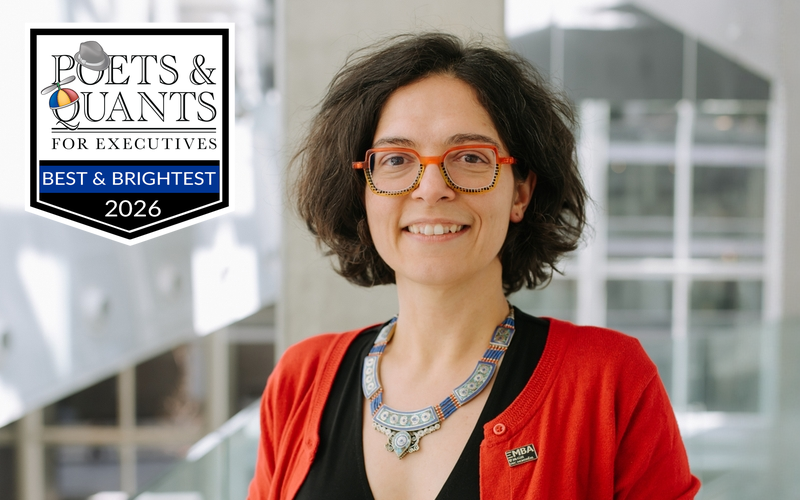
Anjali Mishra
McGill-HEC Montréal EMBA
Age: 45
“Curious, optimistic leader building inclusive, sustainable cities through collaboration, creativity, and public value.”
Hometown: Montreal, Quebec
Family Members: Partner and three sons
Fun fact about yourself: I’d rather sit on a bench under a tree along a busy street than in the woods. The noise helps me keep perspective.
Undergraduate School and Degree:
Bachelor of Engineering, McGill University
Master of Urban Planning, McGill University
Where are you currently working? Project Director, Blue Line Extension, Société de transport de Montréal (STM) (Montreal’s public transit authority)
Extracurricular Activities, Community Work and Leadership Roles: During the program, I deliberately limited additional commitments to balance a full-time leadership role, family life, and the EMBA. I remained engaged as a board member of Arts in the Margins, a Montreal-based cultural non-profit, supporting its mission to advance equity and inclusion through innovative arts programming and by creating opportunities for historically marginalized artists and communities.
This also allows me to stay connected to the emerging arts and music scenes that I value personally. It complements my professional focus on shaping high-performing, inclusive environments by expanding access and representation in the spaces we create.
Which academic or extracurricular achievement are you most proud of during business school? Coming from a career primarily in the public sector, I initially considered pursuing a degree in public policy. Choosing an MBA instead meant stepping into a context where the underlying assumptions, particularly around value creation and performance, are often framed very differently.
Public sector objectives, focused on creating public value with constrained resources, can appear at odds with private sector models centered on financial performance. Navigating that tension became both a challenge and an opportunity.
What I am most proud of is having successfully bridged these perspectives: learning to translate concepts, frameworks, and strategic tools across contexts, and applying them in a way that remains meaningful for public organizations. This ability to work across paradigms has strengthened both my analytical approach and my capacity to generate more impactful, grounded recommendations.
What achievement are you most proud of in your professional career? I have always approached my work with a simple challenge: create environments where I would want to live myself. In practice, this meant transforming infrastructure projects from basic maintenance into opportunities to improve public life, designing streets and public spaces that are safer, more inclusive, and more empowering for all their users.
What I am most proud of is not a single project, but the consistent shift in mindset: ensuring that every intervention, no matter how technical, contributes to a better experience for the people who use it. This ranges from creating a meeting space on a shared street in a public housing project in Saint-Michel (allée Léo-Bricault), to integrating an invitation to dialogue with First Nations into a downtown watermain renewal project (Peel Street).
Who was your favorite MBA professor? It’s genuinely difficult to choose just one: the program brought together an exceptional group of professors, each with a distinct and lasting impact.
That said, Gwyneth Edwards stands out, as I had the opportunity to work with her as a peer coach (in the program, each participant is part of a small peer team that provides support, coaching, and feedback while being guided by a faculty member). She had a remarkable ability to help us ask hard questions while keeping our thinking structured and clear. More importantly, she pushed me to gain confidence in my own judgment, to not just analyze, but to take a position, formulate recommendations, and stand behind them.
That shift, from careful analysis to clear, confident decision-making, has had a lasting impact on how I lead and communicate.
I would also highlight Jacques Neatby, who helped me better understand organizational dynamics, and Louis Gialloreto, who made strategic alignment and how it translates into execution and business models, both tangible and genuinely engaging.
Why did you choose this school’s executive MBA program? I was looking for a program that went beyond financial and analytical tools to develop a truly holistic perspective on leadership.
The McGill–HEC Montréal EMBA stood out for the quality and experience of its participants, integration of multiple management disciplines, and in-person format, which fostered deep discussions and peer learning.
The program’s bilingual structure added another layer of richness, bringing together two academic cultures and ways of thinking, and forcing their interaction in ways that challenged assumptions and deepened understanding.
In that context, learning alongside experienced professionals from diverse fields ensured that theory was constantly tested against real-world experience.
What is the biggest lesson you gained during your MBA and how did you apply it at work? The most important lesson I gained was learning to understand large organizations as systems, and to reconcile with how they can remain effective despite their complexity.
Before the EMBA, I often saw challenges through a more immediate, operational lens. The program allowed me to step back and recognize how structures, governance, and incentives interact to shape outcomes. This shift enabled me to better distinguish between organizational dynamics and individual performance.
It has made me a more effective leader, able to move beyond surface-level issues, focus on system design, and help organizations remain resilient in increasingly complex and uncertain environments.
Give us a story during your time as an executive MBA on how you were able to juggle work, family and education? Balancing a demanding full-time professional role, family life, and the EMBA required discipline, but also a strong support system.
I am deeply grateful for my family’s support, and for my friends’ understanding that I would be far less available during that time. Once I accepted the level of commitment required, I became intentional about making every spare moment count.
Hours spent waiting at the arena during my son’s hockey practices turned into focused study time, often on a bench, with readings in hand. A few business-minded parents even stepped in to help unpack more complex concepts, turning those moments into unexpected learning opportunities.
It was demanding, but it reshaped how I manage time, energy, and priorities across every aspect of my life.
What advice would you give to a student looking to enter an executive MBA program? Commit fully and stay open.
An EMBA is not just an academic experience; it is a transformation. The greatest value comes from engaging deeply with your peers, challenging your assumptions, and being willing to rethink how you lead.
Take the time, from the very beginning, to learn from those around you and to be challenged by them. It is a rare opportunity to learn alongside people from very different fields, broadening your perspective in ways few professional environments allow. Those exchanges are not a side benefit. They are the program, and they often continue long after it ends.
Also, start early in identifying meaningful questions from your professional context that could become strong impact paper topics. The timelines move quickly. Having both a well-defined question and access to colleagues at work who can engage with it while using your peers as a sounding board makes the work far more relevant and impactful.
The real return on investment is not the diploma; it is how much you allow yourself to evolve.
What was your biggest regret in business school? It was not taking even more time to fully connect with and learn from everyone in the cohort.
The pace of the program is intense, and it is easy to focus on deliverables and immediate priorities (alongside ongoing professional responsibilities). In hindsight, I would have made more time outside of class to deepen relationships and continue conversations beyond structured sessions.
Those informal exchanges often lead to the most unexpected insights, and I would have invested even more in them.
What is one way that your business school has integrated AI into your programming? What insights did you gain from using AI? AI was integrated into the program both as a tool and as a subject of critical reflection.
Our cohort reflected a wide spectrum, from participants developing AI technologies to others who had barely used it at the outset. That diversity grounded the discussion in real-world perspectives.
As leaders, the program strengthened our judgment and awareness of risk. AI does not operate in a vacuum; it can amplify and accelerate biases that have existed in organizations for years.
At the same time, it helped us better understand both the strengths and limitations of these tools, where they can create real value and where human judgment remains essential. It reinforced that critical thinking is not optional, but essential to using AI responsibly and effectively.
The goal is not to avoid AI, but to use it deliberately, to accelerate work while strengthening, not undermining, strategic advantage.
What was the main reason you chose an executive MBA program over part-time or online alternatives? I chose the EMBA for the depth and intensity of the learning experience.
The in-person format made it easier to be fully present—fostering deeper concentration, richer interactions, and more meaningful exchanges with peers and faculty. It also created a strong sense of momentum, allowing concepts and discussions to build on one another over time.
What became clear throughout the program is that it truly is a process. The idea of “trusting the process” resonated more-and-more as we progressed, as each component built toward a broader and more integrated understanding.
Combined with a highly experienced and diverse cohort, this made it possible to get significantly more out of an accelerated program than would have been possible in a more fragmented or remote format.
How did you finance your EMBA and what did you do to make tuition and associated costs more affordable? I was fortunate to receive partial support from my employer and to benefit from Canada’s Lifelong Learning Plan.
However, I funded most of the tuition through my own personal savings. The greatest cost, though, was time: the opportunity cost of fully committing to the program and deliberately prioritizing it over other professional and personal pursuits during that period.
What is your ultimate long-term professional goal? I want to shape how organizations set the conditions for high-performing, inclusive environments, aligning investment decisions, governance, and system design to maximize long-term value.
DON’T MISS: BEST & BRIGHTEST EXECUTIVE MBAS: CLASS OF 2026
© Copyright 2026 Poets & Quants. All rights reserved. This article may not be republished, rewritten or otherwise distributed without written permission. To reprint or license this article or any content from Poets & Quants, please submit your request HERE.

