




Annika Bellon, EMBA 2025, on a trip with her ESMT Berlin EMBA classmates. Bellon, a mechanical engineer by training, became a first-time mother during her executive MBA. Courtesy photo
The executive MBA at ESMT Berlin is intentionally small, enrolling just 35 to 40 students per cohort. It’s striking, then, to consider the level of diversity the program manages to attract within those size constraints.
Take Annika Bellon, EMBA ’25, a sustainability manager at Siemens who graduated with honors while becoming a first-time mother, building a house, and relocating across cities.
Or Erik Mohr, EMBA ’26, a German-Mexican middle manager in renewable energy who entered the program during a corporate reorganization, with limited room for advancement and a clear need to reposition his career—now moving into battery energy storage.
Then there’s Luciano Parro, EMBA ’24, a Brazilian-Italian university dropout who became the first in his family to earn a master’s degree. A self-taught digital leader, Parro has continued to grow his leadership role in oncology while launching a successful entrepreneurial venture with his wife in Switzerland.
Taken together, their stories underscore the resilience and transformative potential of the ESMT Berlin EMBA experience, where different life paths reshape how participants think about leadership and possibility.
“I completely underestimated the power of a network of people who are foreign to your industry, but it is actually this diversity that drives a valuable exchange of insights,” says Mohr, Head of Section for Wind and Solar Energy Advisory at COWI, a Danish civil engineering firm.
“You learn so much from those exposed to other markets, geographies, and professional roles. I have been exposed to that during individual events, but the long-term engagement creates room to truly dive deeper into others’ views.”
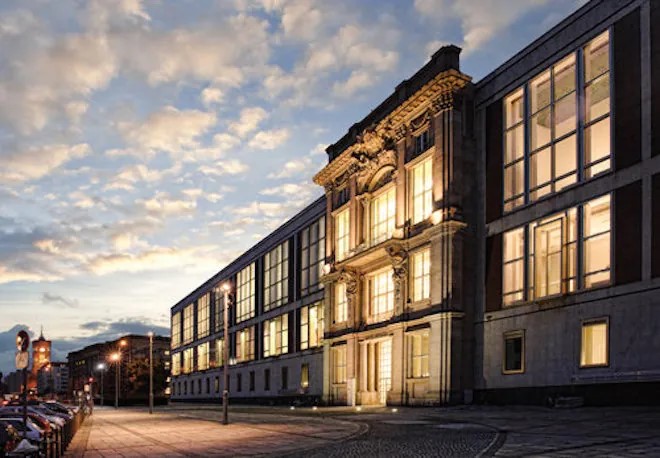
ESMT Berlin’s campus at Schlossplatz 1, the former State Council building of the German Democratic Republic, illuminated at dusk. The historic site has housed the international business school since 2006.
ESMT BERLIN EMBA SPOTLIGHT
ESMT Berlin’s Executive MBA is built on four pillars: Personal development with a strong emphasis on coaching, reflection, and peer dialogue; application and experimentation; career advancement, and the city of Berlin itself.
“The city plays a central role in the program. It is constantly reinventing itself, creating a sense of dynamism and change, ” says Rebecca Loades, director of MBA programs.
Berlin is Germany’s capital and ESMT has deep connections to government. A former dean, for example, served as Chancellor Angela Merkel’s chief economic adviser before returning to the school. Berlin is also a major hub for startups and innovation, attracting around €22 billion in startup capital each year.
Starting next fall, the 18-month program will launch a new format as part of a broader overhaul. It has streamlined its 10 one-week, in-person modules down to eight in response to student feedback. Six of the modules will be in Berlin while two are international.
While the ESMT EMBA caters to candidates you’d expect in a prestigious Executive MBA – corporate managers or executives who may or may not be sponsored by their companies and looking to advance their positions – the program increasingly attracts entrepreneurs looking for more formal business training as well as season professionals looking for a career pivot.
“Ten or fifteen years ago, most Executive MBA students were focused almost exclusively on advancement. Now we see much more reflection around purpose, what they really want to do, how they can manifest that, and how they can learn more about themselves in the process,” Loades says.
ESMT Berlin Executive MBA At A Glance |
|
| Length | 18 months |
| Format |
Part-time, modular
|
| Online/Hybrid Options |
In-person modules with applied work between modules (no fully online track)
|
| Intake |
Annually (October start)
|
| Cohort Size |
35–40 students
|
| Residencies |
8 total: 6 one-week modules in Berlin and 2 international modules (GNAM exchange + International Field Seminar)
|
| GMAT or EA |
GMAT, GRE, ESMT admissions test, or GMAC Executive Assessment (waivers possible for strong quantitative backgrounds)
|
| Cost | €64,800 |
Q&A WITH REBECCA LOADES
ESMT Berlin ranked 42nd out of 100 in the Financial Times’ 2025 Global EMBA ranking, including a 14th place finish for career progression. ESMT was also ranked No. 1 in Germany and No. 12 in Europe in FT’s European Business School Ranking.
As part of our EMBA Spotlight series, we spoke with Rebecca Loades, director of MBA Program, about ESMT Berlin’s newly redesigned Executive MBA, its distinctive learning model, and how Berlin itself shapes the program’s impact.
You can also read in-depth profiles of three current and recent students exploring the program’s transformative impact on their careers. Conversations have been edited for length and clarity.
Describe the structure and format of the ESMT Berlin Executive MBA.
Our Executive MBA has recently undergone a change. I’m going to talk about the version of the program that we are just taking to market now, the one we’ll be recruiting for and delivering starting in October 2026. This is effectively the first step in a much more significant overhaul.
One of the key changes is the structure. The program students will be applying for next year is now an eight-module program, with each module consisting of one week in person. It used to be ten modules, but we received a lot of feedback reflecting how exceptionally busy our participants are. Of those eight modules, six take place in Berlin and two are international.
One of the international modules is connected to our membership in the Global Network for Advanced Management, or GNAM. We participate in the GNAM Week, which is a one-week international exchange. It’s a great experience. At the last one, we welcomed about 55 to 60 students from around the world, and our students also have the opportunity to learn at other institutions within the network.
The final residency is a one-week international field seminar. This takes place abroad at a location selected by the students, and it is a co-created week.
What would you say are the differentiating factors and mission of your EMBA?

Rebecca Loades, director of MBA programs
If we step back and think about the Executive MBA overall, the program is built around four pillars. The first is a strong focus on personal development. We’ve done a lot of work in this area, including coaching, more reflective modules, and an emphasis on peer dialogue. The goal is to help participants think deeply about who they are as leaders, how they lead, and how they are perceived by others.
The second pillar is micro-experimentation. Previously, we encouraged students to set up experiments and report back, but this is now formally embedded in the curriculum. Students earn credit for it on a pass/fail basis. The Executive MBA only has real impact if participants take what they learn in the classroom and combine it with what they are doing at work. At the end of each module, we ask participants to reflect on what they’ve learned and how they can apply it. They develop a plan, implement it, write about the experience, and submit it for evaluation. They then share their learnings with one another. Sometimes an experiment works, and sometimes it fails, but there is always shared learning. This approach turns the program into a deeply applied learning experience.
The third pillar is career advancement. We focus on how the program can have an impact on participants’ careers, whether that means progressing in their current roles or making a pivot. Many of our Executive MBA students are interested in switching careers or even setting up their own ventures, and the program is designed to support those goals.
The fourth pillar is Berlin itself. The city plays a central role in the program. Berlin has a strong political dimension, with deep connections to government. For example, Lars-Hendrik Röller, who was dean two deans ago, went on to serve as Angela Merkel’s chief economic advisor and has since returned to ESMT. Our current president and CEO, Jörg Rocholl, is also very well connected. Beyond politics, Berlin is a major hub for startups and innovation, attracting around €22 billion in startup capital each year. The city is constantly reinventing itself, creating a sense of dynamism and change.
For those coming from outside Germany, Berlin is not Germany in the traditional sense—even Germans say this. When I think about what truly differentiates our program, it’s not just the core curriculum. All business schools teach finance, and we have outstanding faculty. What sets us apart is our focus on creating real impact and ensuring that participants put what they learn into action.
Thinking about those four pillars, how would you describe the typical Executive MBA cohort you attract? Who are you targeting in terms of backgrounds and industries?
We typically see three main personas in the classroom. The first group comes from large corporate organizations. These are usually candidates who are sponsored by their employers, sometimes by one of our founder companies. They’re used to working in large, structured environments, and for them the Executive MBA is very much about career advancement.
The second group includes entrepreneurs who have already built successful businesses. These are often multimillion-euro companies with established teams and solid operations. At that stage, many entrepreneurs start to reflect on whether there are gaps in their knowledge or leadership approach. They ask themselves whether they are truly well rounded, and whether there are things they don’t yet realize they don’t know. The program gives them a chance to step back, reflect, and develop those missing pieces.
The third group consists of participants who are thinking about making a career switch. We’re seeing more and more people view the Executive MBA as an opportunity to build a new skill set and then pivot into something different. This is true not only in the Executive MBA, but to some extent in our part-time MBA as well. That segment is growing. Ten or fifteen years ago, most Executive MBA students were focused almost exclusively on advancement. Now we see much more reflection around purpose—what they really want to do, how they can manifest that, and how they can learn more about themselves in the process.
Do you have any thoughts on why more people are viewing the Executive MBA as a pathway to a career switch?
With everything that’s happening, we’re seeing constant disruption—economic shifts, exogenous shocks, the pace of change, and information overload. There’s a growing sense that traditional, linear career paths no longer exist. Employers aren’t saying, “Stay here and you’ll move to this role next.” Instead, individuals are increasingly expected to be the owners of their own destiny and to actively drive their careers.
When that responsibility is pushed onto you, it naturally forces reflection. You start asking yourself what you’re going to do next and how you want to shape your future. That shift in focus is becoming more common.
I also think there’s another aspect to this. Some people argue that you can learn everything through platforms like Coursera or by building your own learning path. But there is still something very unique about a nurturing business school environment. The interaction between classmates, peers, and faculty—and the role of faculty as facilitators and enablers—is difficult to replicate elsewhere.
Business schools also carry a reputation and a brand. There is a recognized stamp that comes with the degree. It signals something concrete about what you’ve achieved and makes you a more known entity in the market.
About how large is a typical Executive MBA cohort?

From ESMT Berlin’s auditorium, floor-to-ceiling windows frame the iconic Berlin TV Tower on Alexanderplatz. The tower inspired the school’s logo, symbolizing its blend of history, innovation, and global perspective.
It’s small—usually around 35 to 40 participants. It’s very much a boutique program. One thing I often tell prospective students is that if you’re looking for a school where you can hide in the background, this is not the place.
We know our students by name. You have lunch in the same restaurant as the faculty and other students, and reception greets you by name when you walk through the door. It’s a community where people are truly known.
We also have excellent program managers who provide very high-touch support. That’s something we really pride ourselves on—creating a supportive environment so students can focus on studying and, more importantly, on how to put what they’re learning into practice.
Are you typically attracting a more Germany-based cohort, or is the Executive MBA more international in nature?
I would say that about two thirds of our students are living in Germany, with the remaining third coming from elsewhere. We’ve had participants fly in from places like San Francisco, and in the current cohort we even have someone coming from Mongolia. So we really do attract people from all over the world.
Even among those who are based in Germany, the cohorts are highly international. We’re a small, boutique school, and that really defines ESMT. Our classes are relatively small—typically around 35 to 40 students—but we often have around 25 different nationalities represented. It truly reflects Berlin as a melting pot and a place where diverse ideas come together.
We are, of course, a European business school, and that influences the perspective we bring. Our cases and teaching take a global view, but there is naturally a European dimension. For example, when we talk about governance models, the U.S. tends to emphasize shareholder capitalism, whereas in Germany there is a stronger focus on stakeholder capitalism. It’s not that we are anti-profit, but rather that we emphasize responsibility—working with and respecting all stakeholders, rather than focusing solely on the benefit of one group.
With the new program format you’re rolling out, are there curriculum updates as well? What can you share about how you’re approaching AI?
In terms of AI, we see it as something participants need to understand conceptually, but also something that needs to be embedded throughout the curriculum. We do have a couple of courses with AI in the title, but that doesn’t mean AI isn’t referenced elsewhere. It’s similar to sustainability in that these are transversal knowledge areas that need to be integrated across the curriculum, even if they’re not always explicitly called out in course titles.
To apply AI effectively, participants also need to use it and develop a deeper, more personal understanding of it. Right now, a major focus is on agentic AI and what that means for leaders. You’re increasingly managing both people and tools—what some describe as “wetware” and “hardware.” That’s a key theme we’re thinking about, and it’s something our faculty are actively engaging with as well.
We have a relatively flexible AI policy, in the sense that individual faculty decide how to approach it in their courses. At the same time, AI is integrated into the learning experience in very practical ways. For example, some simulations explicitly require the use of AI tools to complete the work. So there is both teaching about AI and teaching with AI, with deeper integration across the program.
During those in-person weeks, are the modules five days or seven days? And how are they structured in terms of coursework before, during, and after each module?
The in-person modules run from Monday to Saturday.
Each in-person week is focused on a specific theme. For example, the program begins with a module on the centered leader, which is about understanding yourself more deeply. Another module focuses on the decisive leader. Each module has its own theme, and we approach that topic from a holistic perspective.
The in-person component is only one part of the learning experience. This is very much a team-based program, and participants develop close relationships within their groups. These are also the groups they work with for group coaching. Creating psychological safety is essential—both to support experimentation in the workplace and to encourage openness within the learning groups.
There is work to complete before coming to campus. This can include readings, case studies, and preliminary assessments. In one instance, participants are even asked to read a book written by one of our faculty members. Then participants come to campus for an intensive week. The days typically run from around 8:30 a.m. to 6:30 p.m., and some evenings include CEO dialogues or other events beyond the core academic sessions.
After the in-person week, participants return to their regular routines and complete post-module work, either independently or with their groups. On average, we estimate about 10 to 15 hours of work per week outside of the in-person modules. During the campus weeks, the workload is significantly higher, closer to 50 or 60 hours.
We’ve intentionally built in pauses so the cadence isn’t a constant, straight line of intensity. Instead, it’s designed to ebb and flow in a way that’s demanding but sustainable.
With what’s happening in U.S. higher education, have you seen increased interest from U.S. students in the Executive MBA, or is that not really an EMBA phenomenon?
We haven’t really seen that effect in the Executive MBA. We’ve seen it more in other programs, but not so much at the EMBA level. Typically, when participants come to us for the Executive MBA, they already have some kind of business interest in Germany or a desire to build a deeper network here. There usually needs to be a clear connection to Germany.
If someone is based in the U.S., it’s a significant commitment to make eight international round trips unless they expect to spend meaningful time here. There are also sustainability considerations, not to mention the impact on your body clock and circadian rhythms. For those reasons, it’s not something we see very often.
That said, we do occasionally have U.S.-based participants, usually through German organizations or our founder companies that operate internationally.

ESMT EMBA Class of 2025 graduation. Photo by Peter Himsel
Are students asking for more content around geopolitics, especially after such a turbulent year?
We already have geopolitics embedded in the program. We introduced it a couple of years ago, and we’ve been fortunate to work with Peter Wittig, a former German ambassador to several countries. He has been integrated into the curriculum for the past two to three years, because we believe this perspective is critically important.
We’re also doing more work around foresight and strategy. This is a newer emphasis, focused on how leaders can anticipate and respond to a rapidly changing world. Strategy development has always been fundamental, but now it has really moved front and center as organizations face increasing uncertainty and volatility.
What would you say is the value proposition of the ESMT Executive MBA?
I would frame it around those core pillars. At its heart, the value proposition is about accelerating your growth as an individual. That acceleration comes from demonstrating that you can create impact and drive change. We place a strong emphasis on learning through experimentation—learning, applying, reflecting, and then adjusting. This is something we’ve invested much more in over time, and it’s an area I’m particularly proud of because it wasn’t as emphasized in the past.
Being located in Europe also matters. We’re positioned in a way that allows participants to engage with the world at times that are practical and realistic. European businesses tend to operate globally by default, and that perspective is deeply embedded in the curriculum.
Finally, our size is a key part of the value proposition. We’re a small school, and while that may not suit everyone, it allows us to create something special. We attract genuinely world-class faculty who are accessible—people you can stop and say, “Can I just have a quick chat about this?” You’re not just joining a program; you’re becoming part of a community.
I remember students saying that within their groups they do peer coaching. I’ve spoken to alumni whose peer coaching groups are still going strong years after they graduated. To me, that’s such a lovely testament, because they’ve carried those relationships forward as their careers have developed. It’s really rewarding to hear that.
As ESMT looks ahead to campus expansion, do you see the Executive MBA growing in size, or is it important to protect that 30 to 40 student range?
I think it’s important for us to protect that range. It might grow a little, but delivering a personalized, high-caliber experience is core to who we are. Scaling significantly beyond that isn’t really in our DNA.
The campus expansion is really about creating more flexible space. As you saw, our campus is beautiful, but we actually don’t have that many lecture rooms. The expansion gives us more multifunctional rooms that can be used for teaching and other activities. We’ve already seen growth potential in areas like our MSc portfolio, which we revamped a couple of years ago, as well as in executive education and custom programs.
For the MBA—and especially the Executive MBA—it’s essential that we preserve that boutique, high-touch learning experience.
Obviously, the MBA and Executive MBA landscape is changing, and business education is evolving. What do you see as the major challenges facing schools today, and where do you see opportunities—particularly for ESMT?
One of the biggest challenges we’re facing is the level of uncertainty we’re living with. That uncertainty shows up everywhere—in our social lives, our private lives, how we imagine our careers, and how we think about learning and development. We’re in a period of real turbulence. Every period has its challenges, of course, but the scale of information overload today is genuinely different. The amount we’re processing and the speed at which we’re expected to operate has changed enormously.
There’s also increasing competition in business education. It would be hubristic for any business school to dismiss alternatives. People have many more choices now—whether that’s platforms like Coursera or other ways of building skills independently. Globalization has also expanded access, so competition is no longer just local or regional; it’s truly global.
At the same time, those challenges open up opportunities. Where I see an important distinction—and perhaps a growing divergence—between the MBA and the Executive MBA is around life stage. Our Executive MBA students typically have around 15 years of work experience, while our MBA students average about seven. They’re at very different points in their careers.
For MBA students, the focus is largely on employability—how to secure that first role, how to position yourself for promotion, and how to continue developing. That means providing evergreen skills, but also very current, relevant context. For Executive MBA participants, the emphasis is more on ensuring that what they learn is put into action. That principle, though, cuts across all of our programs.
One of the biggest challenges we all face as business schools is measuring impact. Without impact, none of this really makes sense. Prospective students are rightly asking, “Why should I make this investment? Why should I do it with you?” And the investment isn’t just financial—it’s time, hope, dreams, and aspirations. It’s essential that we can demonstrate the impact we have and show that we can help people achieve what they want to achieve.
Anything else you’d like to add?
I would just highlight the international experience again, because that’s something participants consistently say they value. They take away not only the learning itself, but also a global network beyond ESMT through those experiences. They’re able to connect what they learn in the classroom with what they see and do in the field.
It might not sound extraordinary on its own, but when you listen to how participants talk about it afterward, you can really hear the impact it’s had on them. I also know that for some students, these international experiences were a specific factor in their decision to choose the program.
I’ve heard similar feedback from students at the most recent graduation. They said the international field seminar was a truly unique experience—something they couldn’t have replicated anywhere else. Those standout moments, where learning is applied in a meaningful and positive way, are what create lasting impact.
Next Page: Student profile – Annika Bellon
© Copyright 2026 Poets&Quants. All rights reserved. This article may not be republished, rewritten or otherwise distributed without written permission. To reprint or license this article or any content from Poets&Quants, please submit your request HERE.

