






Participants in IIM Visakhapatnam’s Executive MBA 2024-2026 Winter Intake take part in a sponsored city tour of Visakhapatnam.
Executive education in India is undergoing a structural shift.
Mid-career professionals are no longer pursuing an Executive MBA primarily for career acceleration or salary progression. Increasingly, they are returning to the classroom to solve a different challenge. They seek to transition from functional expertise to enterprise leadership while continuing to lead mission critical responsibilities within their organizations.
The Executive MBA 2024 to 2026 Winter Intake at IIM Visakhapatnam reflects this transition.
Based on a structured participant survey conducted for this editorial brief, respondents represent five distinct industries including SaaS, Healthcare Analytics, Manufacturing, Infrastructure, Education, and Media. Professional experience ranges from 5 to 15 years, spanning operational managers, client leaders, enterprise project managers, entrepreneurs, and managing directors.
Despite representing vastly different industries, participants converge around one common objective. They seek to become stronger enterprise decision makers capable of integrating strategy, finance, technology, operations, leadership, and innovation into measurable organizational outcomes.
Rather than describing the program through rankings or promotional language, this commentary explores the Executive MBA through the experiences of working professionals applying classroom learning directly inside their organizations.

Participants in IIM Visakhapatnam’s Executive MBA 2024-2026 Winter Intake attend a classroom session with the INTSS professor.
A COHORT DEFINED BY DIVERSITY AND SHARED AMBITION
The respondents collectively represent organizations operating across technology, healthcare, manufacturing, infrastructure, education, and the creative economy.
Participants work across organizations including Exotel, IQVIA, Rashtriya Ispat Nigam Limited, the National Film Development Corporation, and KBR Infra Projects. Their professional experience ranges from five to 15 years.
Their current roles span a similarly broad range of responsibility, including associate manager, assistant manager, operations manager, team lead, and managing director.
Unlike traditional MBA classrooms dominated by similar career trajectories, the Executive MBA environment creates interaction between professionals solving fundamentally different business challenges while learning common strategic frameworks.
Participants consistently described this cross industry exchange as one of the strongest dimensions of the learning experience.
WHY EXPERIENCED PROFESSIONALS RETURN TO THE CLASSROOM
Across all responses, four themes emerged consistently.
Enterprise Leadership: Participants are no longer seeking functional excellence alone.
Instead, they are preparing for larger enterprise responsibilities involving strategic planning, governance, capital allocation, organizational transformation, and executive decision making.
One respondent leading enterprise SaaS implementations summarized the transition succinctly.
“The EMBA enabled me to move from managing project timelines to architecting enterprise level delivery systems that drive measurable ARR, efficiency, and leadership visibility.”
Career Reinvention: Participants view the Executive MBA as a platform for reinvention rather than incremental progression.
Several respondents described ambitions that extend beyond incremental career advancement, including transitioning into senior leadership roles, expanding their cross-functional influence, leading business transformation initiatives, and assuming greater P&L responsibility.
This reflects an orientation toward long term leadership rather than immediate promotion.
Entrepreneurship: Entrepreneurial ambition emerged repeatedly.
Respondents described the program as supporting ambitions around venture creation, business expansion, strategic consulting, and long-term value creation.
One participant articulated this progression as moving from an operations manager to a strategic consultant, enterprise leader, data driven business analyst, and entrepreneur.
Strategic Capability: Across industries, respondents consistently emphasized strengthening their capabilities in strategic finance, enterprise strategy, data-driven decision making, corporate governance, and executive communication.
The program is viewed not as an academic exercise but as preparation for increasingly complex organizational decisions.

IIM Visakhapatnam
CURRICULUM DESIGNED FOR ENTERPRISE DECISION MAKING
The Executive MBA curriculum follows a structured developmental sequence rather than isolated subject delivery.
The first stage strengthens analytical foundations through finance, accounting, economics, operations, organizational behaviour, marketing, statistics, and strategy.
The second stage integrates these disciplines through cross functional cases, simulations, presentations, and applied assignments requiring enterprise thinking.
The final stage emphasizes governance, digital transformation, analytics, innovation, leadership, entrepreneurship, negotiation, and value creation through advanced electives and capstone work.
This progression reflects an intentional movement from functional expertise to integrated management to enterprise leadership.
Participants consistently described this sequencing as one of the defining characteristics distinguishing the program from traditional modular executive education.
LEARNING THAT TRANSFERS IMMEDIATELY INTO THE WORKPLACE
Perhaps the strongest observation emerging from the participant responses is the immediate application of classroom learning.
Rather than postponing implementation until graduation, participants described applying frameworks during the program itself.
Representative examples include:
- A technology leader improving project delivery predictability by 30 percent, reducing implementation time by 25 percent, sustaining 98 percent on time delivery, while maintaining less than 2 percent budget variance across enterprise implementations.
- Manufacturing professionals integrate strategic and analytical frameworks into operational decision making while preparing for broader enterprise leadership.
- Business owners incorporate management frameworks directly into organizational growth and long term expansion planning.
- Healthcare professionals strengthen structured decision making and leadership capability within highly analytical environments.
These examples illustrate that workplace application is embedded throughout the learning experience rather than reserved for a final capstone.
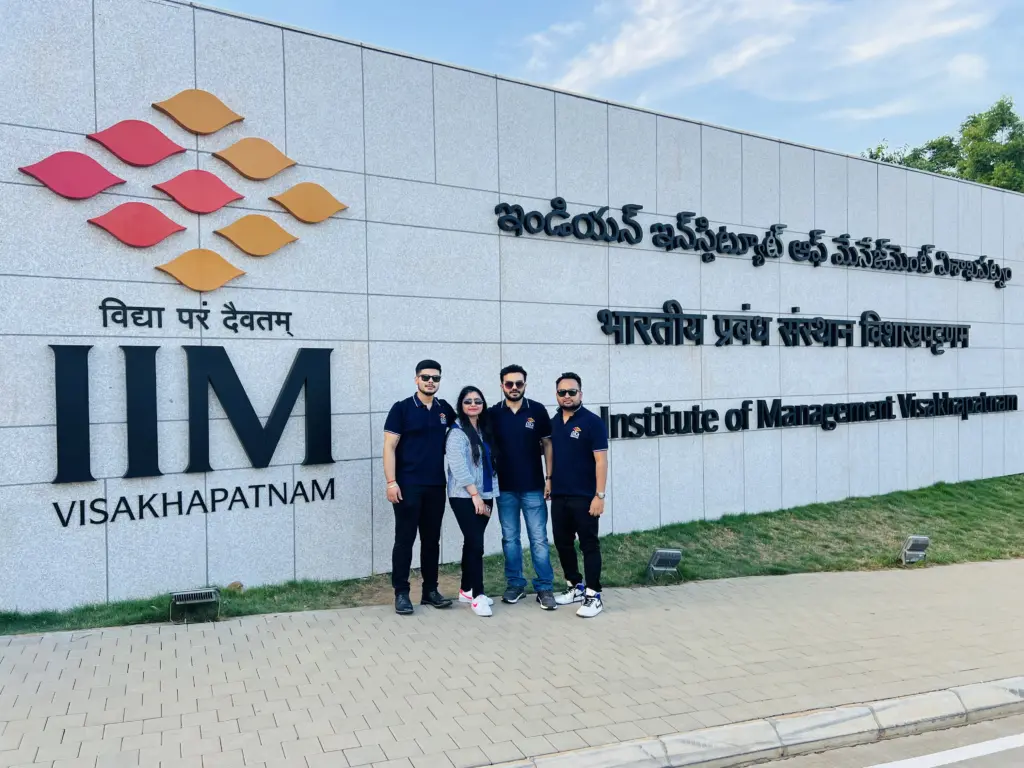
EMBA students at the entrance of the IIM Visakhapatnam campus.
FACULTY AND PEDAGOGY
The Executive MBA combines research driven faculty with executive education methodologies that prioritize application over memorization.
The curriculum combines case-based learning, business simulations, applied assignments, capstone projects, and executive presentations to connect classroom concepts with real-world decision making. Classroom debates, peer learning, and continuous evaluation further reinforce the collaborative and applied nature of the program.
Faculty expertise spans leadership, organizational behaviour, finance, analytics, operations, strategy, information systems, marketing, and digital transformation.
Leadership development extends beyond theory through executive communication, negotiation exercises, structured argumentation, faculty questioning, peer critique, and boardroom style presentations.
Participants consistently identified these experiences as central to developing executive confidence and decision making capability.
EXECUTIVE RETURN ON INVESTMENT
Traditional MBA outcomes often focus on compensation. Executive participants described success differently.
Participants measured return on investment through expanded leadership responsibility, greater enterprise-level influence, stronger strategic judgment, and more confidence making decisions under ambiguity. They also pointed to improved cross-functional decision making and executive communication, along with greater entrepreneurial capability, stronger professional networks, and the institutional credibility that comes with the degree.
One respondent summarized this perspective clearly: “Executive MBA ROI extends beyond salary to include both tangible business outcomes and the transformation from a functional specialist into an enterprise leader.”

Winter Intake EMBAs gather for lunch on campus.
REPRESENTATIVE EXECUTIVE PROFILES
The Executive MBA 2024-2026 Winter Intake at IIM Visakhapatnam includes 96 participants, representing a wide range of industries, roles, and professional backgrounds.
The EMBA classroom is more like a strategic laboratory than an academic venue. Professionals continue leading organizations throughout the week while immediately testing classroom frameworks against live business challenges.
Technology leaders exchange ideas with manufacturing executives. Entrepreneurs debate governance alongside healthcare professionals. Infrastructure leaders discuss digital transformation with SaaS practitioners.
The diversity of the cohort becomes clearer in the backgrounds and ambitions of its participants. These four executives offer just a sample, but illustrate the breadth of experience spanning technology, manufacturing, healthcare, media, infrastructure, and education. All share a common goal of expanding their leadership capacity beyond their current roles.
- Satya Sai Kiran Kumar Dakavarapu: Operations Manager at Rashtriya Ispat Nigam Limited with seven years of experience in manufacturing, energy, and utilities. His Executive MBA journey is focused on broadening leadership capability beyond operational management through strategic analysis, entrepreneurship, and enterprise thinking.
- Mohammed Mausim: Team Lead at IQVIA representing the healthcare analytics sector. His primary objective is transitioning into broader leadership responsibility while applying structured management frameworks to improve decision making and long term organizational impact.
- Harsha Prajapati: Assistant Manager at the National Film Development Corporation representing the media and entertainment industry. His motivation centers on career advancement while applying management principles to an evolving creative economy.
- K Narayan Rao: Managing Director at KBR Infra Projects and KBR International School. His participation reflects the growing role of executive education among business owners seeking structured frameworks for scaling organizations and strengthening strategic leadership.
You can read more about me, Associate Manager at Exotel, on the Q&A on the next page.
WHY EXPERIENCE ALONE IS NO LONGER ENOUGH
The Executive MBA at IIM Visakhapatnam reflects a broader transformation occurring across executive education in India.
Participants are not returning to the classroom because they lack experience.
They are returning because experience alone is no longer sufficient.
In an environment shaped by digital disruption, artificial intelligence, geopolitical uncertainty, and increasingly complex stakeholder expectations, leadership demands the ability to integrate finance, strategy, technology, operations, governance, and human behavior into coherent enterprise decisions.
The professionals represented in this brief are already leading projects, teams, businesses, and transformations. The Executive MBA is not the starting point of their leadership journey. It is the platform through which they are expanding their ability to create sustained organizational value.
Learn more about the Executive MBA at IIM Visakhapatnam here.

Oishik Das
Oishik Das is Associate Manager at Exotel with nearly five years of experience across SaaS, CPaaS, CCaaS, and fintech organizations. His career includes leadership roles at HighRadius, Zluri, Kapture CX, and Exotel, where he has delivered enterprise implementations generating more than USD 5 million in annual recurring revenue.
Since beginning the Executive MBA, his responsibilities have expanded toward enterprise governance, executive reporting, portfolio visibility, and strategic delivery leadership. He views executive education as preparation for larger transformation, product, and general management roles.
NEXT PAGE: Q&A with Oishik Das
© Copyright 2026 Poets & Quants. All rights reserved. This article may not be republished, rewritten or otherwise distributed without written permission. To reprint or license this article or any content from Poets & Quants, please submit your request HERE.

