





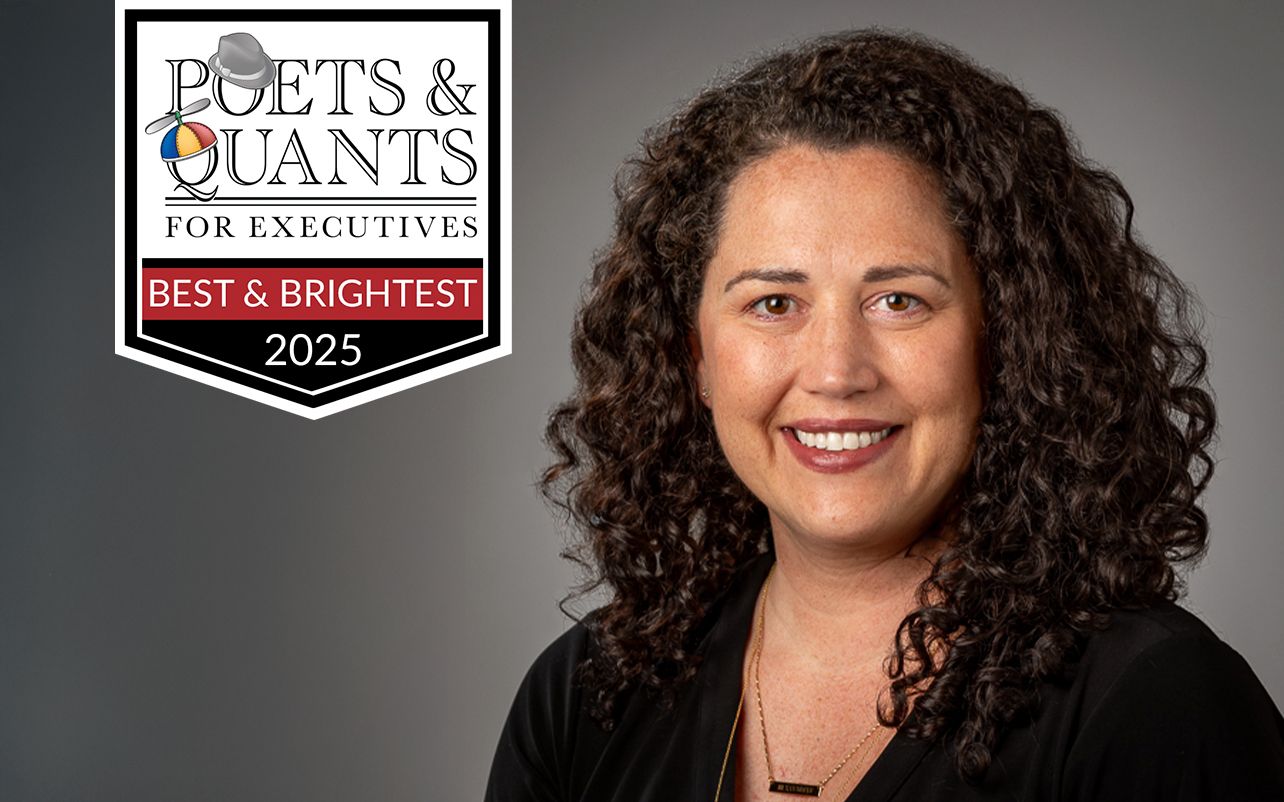
Ashley Landay
Samuel Curtis Johnson Graduate School of Management, SC Johnson College of Business, Cornell University
Program: Cornell EMBA/MS in Healthcare Leadership.
Program Description: The EMBA is from the Johnson School and the MS is from Weill Cornell Graduate School of Medical Sciences in NYC. Classes are taught at the Tata Innovation Center at Cornell Tech on Roosevelt Island in New York City.
Age: 44
“Joyful, generous, and fun advocate. Passionate about equitable healthcare and protecting our most vulnerable citizens.”
Hometown: New York City, NY
Family Members: My wonderful husband and biggest supporter, Josh Landay. He is the best family foundation for me, our rescue dog Koda, and our rescue cat Theo.
Fun fact about yourself: I was my high school mascot – a Mustang
Undergraduate School and Degree: Southern Methodist University- Bachelor of Fine Arts
National Theatre Conservatory- Master of Fine Arts
Where are you currently working? Memorial Sloan Kettering Cancer Center, Research Project Associate, Clinical Trials Office, Gastrointestinal Oncology
Extracurricular Activities, Community Work and Leadership Roles:
EMBA/MS Class Representative of our 2025 cohort
Team Captain- 7x – SmashCancer, a NYC Marathon team raising money for cancer research at Memorial Sloan Kettering. My team raised over $1 million in 7 years.
Member of Cancer Support Community – Guest speaker at multiple events
Which academic or extracurricular achievement are you most proud of during business school? I continued to run the NYC Marathon while in school, working full time, and raising money for cancer research; the NYC Marathon of 2024 is when my team broke $1 million. But part of what made it so special is that one of my business school professors, Steve Sauer, ran it with my team. He had been my teacher the first week of school and taught an elective that I took. He dove in to run the marathon, raise money, and support me and my cause. That speaks to the quality and care of our professors and this program.
What achievement are you most proud of in your professional career? Putting my advocacy and personal knowledge to use for cancer research and advocacy. I went to DC and stayed with a classmate and participated in a hill day for the NIH. I was there representing the American Association of Cancer Research and advocating for continued financial support from Congress for the NIH. I met with Senators and House Reps to make a case for why funding cancer research is crucial and the importance of supporting a scientist’s work. While this was a voluntary decision, it directly impacted on the work that I do, as well as the work of many of my colleagues. If I were not working in a cancer hospital or in a healthcare program, I don’t believe my awareness and participation in this event would have happened.
Who was your favorite MBA professor? This is the hardest question of all: I have many favorites but one I will highlight is Professor Nick Sanders. He was our microeconomics professor. Professor Sanders was a captivating teacher, and we should all be as enthusiastic as he is in our work. He could make a 4-hour class feel like it went by in minutes. He was challenging, funny, and engaging, and I ended up learning so much and loving this course. His coursework was demanding and supremely valuable. I would take a course from him again in a heartbeat.
Why did you choose this school’s executive MBA program? It checked off all the elements I was seeking for my education. I wanted to study in person, on weekends, stay in NYC and continue to work at Sloan Kettering. More than that, I wanted to complete a dual degree where I get the core fundamentals of the MBA while ALSO getting specialized classes that used these fundamentals and applied them to the healthcare sector. It’s a supremely unique program; it’s young, it’s growing, and it’s at one of the finest institutions in the country. This program is exceptional.
What is the biggest lesson you gained during your MBA and how did you apply it at work? Getting my MBA has encouraged me to think about problems, leadership, healthcare, and professional relationships much differently. The biggest lesson I gained was to truly see problems from multiple stakeholders and points of view and then analyze the priorities of those stakeholders to truly address the problem needing to be solved. This has also created confidence and awareness in the work that I do and how I participate in work conversations. I bring valuable insight to my job because of my MBA coursework.
Give us a story during your time as an executive MBA on how you were able to juggle work, family and education? It’s not one story- it’s an entire experience. The entire two years is a constant juggle between work, school, and social calendars. It wasn’t hard to juggle as I knew this was a temporary and finite amount of time. I trusted that my friends knew me and loved me accepted that I might not be as accessible because I must focus on school. I got promoted after my first year, so learning a new job and going to school was challenging. However, I leaned on the support of my classmates, friends, and my husband. They all helped triage what was important, necessary, and showed up when I needed it most.
What advice would you give to a student looking to enter an executive MBA program? A couple of pieces of advice:
1. Know why you want the MBA. This kind of intense schooling is not for the faint of heart. Juggling work full-time, classes, learning teams, projects, and family is complicated and requires a lot of patience. It is important to be clear on the foundation of why you feel you need the degree.
2, Be all in. The time in school is temporary, and it GOES FAST. Participate in social events, professional events, and anything and everything you possibly can while in school. Develop relationships and truly commit to this moment in time, where you get to be in school again.
3. Have fun. This has been one of the best decisions I have ever made. You will get as much from this experience as you’re willing to put in. Again—be ALL IN.
What was your biggest regret in business school? It is not so much a regret, but leading up to starting school, I wish I had done more prep work. There is a lot of trial-by-fire and feeling as though you’re drinking water out of a firehouse when you go back to school, especially in your early 40s. In the first few months of school in my first year, I felt like I was learning how to learn. That was a challenge to work through.
Which MBA classmate do you most admire? Dr. Hamza Ijaz. He is an ER doctor currently working at Cornell. He is one of the smartest and most interesting classmates I have gotten to know. I look forward to his continued personal and professional growth. When he runs a hospital (because I envision that he will), I want to work for him. He is a quality human, friend, colleague, and someone I deeply admire.
What was the main reason you chose an executive MBA program over part-time or online alternatives? I learn better when I can sit in a classroom and see people’s faces when they respond to a question or ask a question. Many classes in business school revolve around collaboration, learning teams, and group work, and I was craving all these elements in person. I work in a people-centric industry, and my superpower as an individual is my ability to work with people. When I decided to return to school, I did not consider online or part-time programs. I work in the field that I want to be in, healthcare. Even more, I wanted to be in a room with a diverse group of people challenging my ideas, my way of working, and supporting my growth intellectually and emotionally. The weekend EMBA was perfect for me. I was able to use my learning from the previous weekend in the work environment. It has been exceptional.
How did you finance your EMBA and what did you do to make tuition and associated costs more affordable? I have taken on student loans. It is a lot, and I am trusting that I will be able to pay them back eventually. I invested in myself, and I am comfortable with the financial cost of that investment.
What is your ultimate long-term professional goal? I want to be a good mentor to the next generation of healthcare leaders. To continue my work in the cancer space, as a Stage IV breast cancer patient, I was inspired to come back to school to help drive operational excellence for cancer patients. I want to excel in continuing to grow in Hospital Administration, Clinical Trials, and help facilitate communication and encourage collaboration among our Department of Medicine and our Outpatient clinical spaces.
DON’T MISS: BEST & BRIGHTEST EXECUTIVE MBAS: CLASS OF 2025
© Copyright 2026 Poets&Quants. All rights reserved. This article may not be republished, rewritten or otherwise distributed without written permission. To reprint or license this article or any content from Poets&Quants, please submit your request HERE.

