






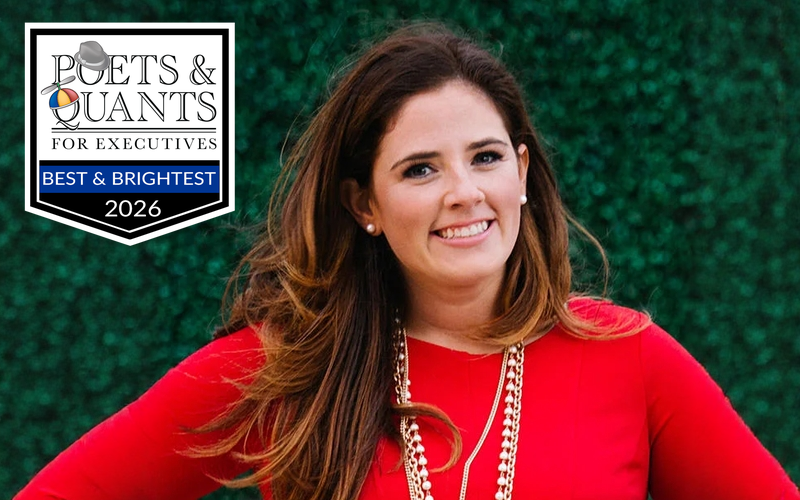
Kathleen Perley
Jones Graduate School of Business, Rice University
Age: 38
“Mother, founder, instructor, Fulbright linguist. Building AI where language moves markets.”
Hometown: Houston, Texas
Family Members: My husband, Nick Becraft, and our two children: my 7-year-old son and my 5-year-old daughter. My sister, Meghan, and my father, Douglas, are also in Houston. My mother, Eileen Campbell, passed away, but she is still one of the strongest forces in my life. Growing up with dyslexia, dysgraphia and ADHD, I was told I was not “college material.” But my mother’s successful executive career in a male-dominated industry and fierce protectiveness for our family taught me to work hard and never give up.
Fun fact about yourself: I have been cool exactly three times in my career. The first was when the movie Arrival (2016) came out and everyone suddenly wanted to talk about linguistics at dinner parties. The second was when Game of Thrones made language invention weirdly fascinating to normal people. And the third and most recent instance was when ChatGPT became mainstream — and my years of working in natural language processing and machine learning finally made me relevant at the dinner table.
Before AI was the thing everyone added to the first sentence of a pitch deck, I built a digital healthcare company using machine learning to build propensity models for advertising. We supported major U.S. health systems from day one of COVID, which taught me that technology only matters if it works under pressure, inside real institutions, with real people depending on it.
Undergraduate School and Degree: Texas Christian University, B.A. in Linguistics and Spanish; Fulbright Scholar to Madrid
Where are you currently working? I am the CEO and founder of AdaIR. AdaIR helps public companies understand how the market will hear them before they speak.
We started with the most market-sensitive communication moment a company faces: the earnings call. Every quarter, CEOs and CFOs walk into a room where analysts, investors and algorithms are all listening at once. A sentence that sounds clear internally can land differently to those on Wall Street.
Extracurricular Activities, Community Work and Leadership Roles:
* Faculty member and Gen AI instructor, Jones Graduate School of Business, Virani Undergraduate School of Business, and Rice Business Executive Education
* AI advisor to the deans, Rice Business
* Partnered with Rice University to help build an online AI training and education program for faculty and staff
* Co-President, Valhalla Investment Network, Rice EMBA Angel Investment Group
* Advance team, The University of Texas MD Anderson Cancer Center
* Member, nCourage (Houston women’s angel investment group)
* Author of AI Made Simple. Results Made Real: An Executive’s Guide to Partnering with the Future
* Co-host of “Not Artificial, Just Intelligent,” podcast launching fall 2026
* Fulbright Scholar, Madrid; researched phonetic patterns in second-language English acquisition
Which academic or extracurricular achievement are you most proud of during business school? I am proud of everything that happened on top of the coursework. During the program, I taught a course on Gen AI at Rice Business, advised the deans on AI strategy, helped Rice build an online AI education program for faculty and staff, published my first book and founded AdaIR.
I also strived to be a good wife, mother, daughter, sister, friend and occasionally the person who remembered to order school snacks before 10 p.m. I did not do all of it gracefully: I missed things, I was late to events, I answered investor emails from parking lots and finished assignments after bedtime. But I kept showing up.
That is what I am proud of: not doing one thing perfectly, but building a life where the things I care about most could coexist.
What achievement are you most proud of in your professional career? There are two chapters, but one through-line: using technology to make invisible problems visible. The first was building DECODE, a healthcare digital transformation agency, and selling it to a private-equity-backed buyer. I am proud of the exit and the fact that we helped health systems modernize when the stakes were very real.
The second chapter is AdaIR. AdaIR came from a belief I have carried for a long time — that language is not soft. Language moves trust, perception, risk, and (in capital markets) value.
During my Executive MBA, we took AdaIR from thesis to traction: we closed seed funding at a $45 million pre-money valuation, were cited in The New York Times and The Wall Street Journal, signed Fortune 500 enterprise customers, and began building a new category around communication risk in capital markets.
Who was your favorite MBA professor? Yael Hochberg and Jim Hackett. Two very different teachers with two very different gifts.
Hochberg holds the Ralph S. O’Connor Professorship in Entrepreneurship and heads Rice’s Entrepreneurship Initiative. Her lab was invaluable to AdaIR’s first year. I had built and sold a company before, but building a venture-scale AI company is a different animal. Her mentorship helped me think more clearly about financing, category creation, and the difference between building a good company and building the right company at the right moment.
What I took from Hochberg was sharper company-building judgment.
Jim Hackett is the former chairman and CEO of Anadarko Petroleum and an adjunct professor at Rice. His course on mission and values stayed with me because it made room for the questions founders do not always stop long enough to ask. What kind of leader am I becoming? What am I optimizing for? What is the cost of winning if I lose myself in the process?
Hackett taught me to set a higher bar for myself.
Why did you choose this school’s executive MBA program? I was already teaching at Rice Business when I enrolled, so I had the unusual advantage of seeing the institution from the inside first. I knew the faculty, I knew the caliber of the students, and I knew what the Rice network could do in Houston and beyond.
I wanted a program that would make me better while I stayed in the operating seat. I did not want a theoretical business education detached from the company I was building. I wanted to learn something on Friday and use it on Monday.
What is the biggest lesson you gained during your MBA and how did you apply it at work? The biggest lesson I gained during my MBA at Rice Business was that range matters. As a founder, you are constantly operating just outside your original expertise. One hour you are making a product decision; the next, you are negotiating financing terms. Then hiring, pricing, procurement, enterprise security, customer success, cash flow, board dynamics and whether the school nurse is calling because someone forgot their lunch or because someone needs stitches.
The Executive MBA gave me a broader operating vocabulary across finance, accounting, strategy, operations, marketing, negotiations and organizational behavior. You leave knowing how to ask better questions, spot weak logic faster, and move with more confidence when there is no perfect answer.
At AdaIR, that fluency matters every day. I do not need to be the expert in every room. I need to translate between experts, see the pattern and make the call. In many ways, that is the job of a CEO. It is also, fittingly, the job of a linguist.
Give us a story during your time as an executive MBA on how you were able to juggle work, family and education? There was one day I will never forget.
I was in the passenger seat of an AdaIR colleague’s car, driving across Houston and into the suburbs. That day included back-to-back in-person meetings with a Fortune 500 CEO from one company and a Fortune 500 CFO from another; calls with AdaIR’s engineering team on a product rollout; emails from students because I was teaching at the time; WhatsApp threads with my Executive MBA teammates finalizing a group presentation due that night; a solo homework assignment due by midnight; a call from my son’s school because he had gotten into trouble.
That drive was chaotic, absurd and probably the clearest picture I have of what an Executive MBA actually teaches you. You stop asking whether you can keep every ball in the air. You get very good at knowing which ball cannot touch the ground.
What was your biggest regret in business school? I don’t have any real regrets. I left with lifelong friends, sharper judgment, a stronger company, and a clearer sense of the leader I want to become. Also a few more gray hairs, but I am choosing to call those strategic highlights.
What is one way that your business school has integrated AI into your programming? What insights did you gain from using AI? Because I taught Gen AI and served as an AI advisor to the deans, AI was not something I just encountered during the EMBA. It was something I was helping Rice Business teach, translate, and operationalize.
I teach two AI courses. The first is AI Tools, in which non-technical students learn to build AI wrappers and applied workflows. The second is AI Strategy and Implementation, which teaches students to shepherd a company through AI transformation, not just experiment with tools.
That distinction matters. One course teaches students how to build. The other teaches them how to lead.
I also worked with Rice University to help build an online AI training and education program for faculty and staff. That work mattered to me because AI transformation doesn’t happen through hype — it happens when people understand what the tools can do, what they cannot do, and how to use them responsibly inside real institutions.
The biggest insight I gained is that AI raises the floor, but it does not automatically raise the ceiling.
AI can help students move faster, build prototypes, test ideas, and get past the blank page, but judgment, taste, courage, ethics, and lived experience still matter. The best work does not come from asking AI to think for you. It comes from using AI to close the gap between what you can imagine and what you can execute.
That insight also shaped AdaIR. AI has made language generation abundant. What remains scarce is evaluation: Did the message land? Did it create confidence or confusion? Did it reduce risk or introduce it? Did the market hear what the company intended?
What was the main reason you chose an executive MBA program over part-time or online alternatives? The biggest reason was the room — it was full of senior operators, founders, executives, physicians, investors, engineers, energy leaders and builders. These were people carrying real responsibility while choosing to get better.
That kind of peer group changes the experience. You are not just learning concepts. You are testing them against people who have lived through acquisitions, layoffs, board meetings, turnarounds, product launches and the occasional toddler meltdown before class.
For me, the EMBA was particularly valuable because it happened in a room with brilliant people I still call on when I’m thinking through a hard decision.
How did you finance your EMBA and what did you do to make tuition and associated costs more affordable? Self-financed.
What is your ultimate long-term professional goal? My long-term goal is to make communication risk as measurable and manageable as financial risk.
Every public company CEO is one earnings call away from losing control of the narrative. AI has raised the stakes on both sides of the microphone. Humans are listening, machines are listening and markets are reacting faster than ever.
AdaIR’s ambition is to build the intelligence layer for the moments when language carries enterprise value: earnings calls, investor days, M&A announcements, activist defense, IPO roadshows, regulatory testimony, and board-level communications.
I also plan to keep researching and teaching, as it brings me real joy. Teaching keeps me close to students, curiosity and the original questions that made me fall in love with language in the first place.
The work ahead is bigger than building a company. The work is to build a field where communication is not treated as the soft stuff after the numbers, but as part of how the numbers are received, trusted and valued.
DON’T MISS: BEST & BRIGHTEST EXECUTIVE MBAS: CLASS OF 2026
© Copyright 2026 Poets & Quants. All rights reserved. This article may not be republished, rewritten or otherwise distributed without written permission. To reprint or license this article or any content from Poets & Quants, please submit your request HERE.

