



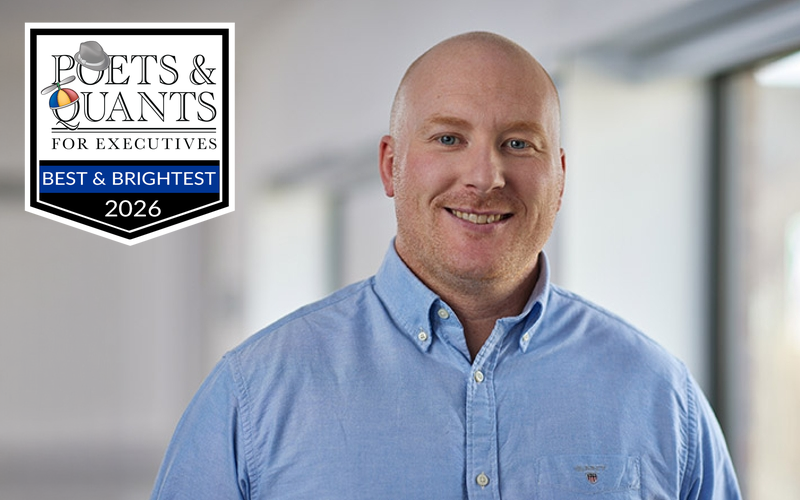
Luke Parker
Warwick Business School (WBS)
Age: 35
“British Army Officer turned Technology Leader, driving sovereign transformation across the UK Public Sector.”
Hometown: Hitchin, Hertfordshire
Family Members: I have a phenomenal family who are my number one supporters. They are made up of my Wife, Emily; two-year-old son, Wilfred; and my dog, Jupiter.
Fun fact about yourself: I love a Moonshot aspiration and I once applied to become a European Space Agency (ESA) Astronaut. I didn’t quite make it to the moon, but I passed the rigorous medical evaluations—so I can officially say I have the eyes of an astronaut.
Undergraduate School and Degree:
University of Leeds – Bachelor of Science (BSc) in Geography
Cranfield University – Master of Science (MSc) in Geospatial Intelligence
Professional Designations & Accreditations:
Chartered Engineer (CEng) – UK Engineering Council, Fellow of the Institute of Royal Engineers (FInstRE)
Where are you currently working? Google Cloud, Delivery Executive (Leading strategic cloud transformations and digital delivery for large-scale Public Sector customers).
Extracurricular Activities, Community Work and Leadership Roles:
Academic Leadership & Mentorship:
Elected Cohort Representative, WBS EMBA.
WBS Technology Network Ambassador
WBS Founders Hub Mentor
Professional Engineer Accreditation Mentor, Corps of Royal Engineers
Veteran Advocacy & Social Impact:
Founder, Ante-Bellum Angels: Established the UK’s first “Defence First” Angel Network focussing on growing the next generation of DefTech startups.
Google Veterans Network Leadership Committee EMEA
Homeless Veteran Charity Lead: Spearheaded fundraising initiatives that raised over £10,000 to provide emergency housing and support for homeless UK veterans.
Professional Distinction & Thought Leadership:
Recognised on the Data IQ 100: Named one of the UK’s most influential people in Data and AI for public sector work
Finalist, UK Armed Forces Service Leaver of the Year: Shortlisted for excellence in transitioning from military service to corporate leadership.
Heropreneurs/WBS MBA Scholar: Recipient of the prestigious full-scholarship for entrepreneurial veterans.
Keynote Speaker: Frequent industry contributor at the Chief Data and Analytics Officer (CDAO) Conference and the Esri User Conference on the intersection of AI, Geographic Information Systems (GIS), and sovereign security.
Which academic or extracurricular achievement are you most proud of during business school? It was leading a series of career workshops across veteran networks—including TechVets, the GenDit Network, and the Forces Employment Charity—aimed at educating veterans, Service Personnel, and military families on the benefits of pursuing an MBA and how to break into the Technology sector. This culminated in founding Google’s first EMEA Veterans Career Week, reaching participants across the UK, Nordics, Germany, India, and South Korea.
What achievement are you most proud of in your professional career? My proudest professional achievement was as a UK Government Data Science leader during the response to the COVID-19 pandemic. Deployed from the military to the UK Government, I spearheaded a multi-agency team to remove historical data silos and create a national geospatial decision-support tool democratising Covid data to the UK people. This platform provided the critical products briefed daily by the UK Prime Minister to millions of UK citizens, directly informing national policy and enabling life-saving strategic interventions during the country’s greatest modern crisis.
Beyond the technical delivery, I am proud of the cross-functional unity we achieved under immense pressure. This work—recognised by the British Computer Society as ‘IT Project of the Year’ and through a MOD Chief Scientific Advisor’s Commendation—validated my belief that the most complex challenges are solved at the intersection of technical collaboration, prioritisation, and a focus on outcomes.
Who was your favorite MBA professor? For me, it is Professor Simon Barnes. He was the catalyst for my transition from military officer to tech investor. Teaching across modules like Entrepreneurial Finance and New Venture Creation, Professor Barnes went beyond theory, providing the actionable strategies required to navigate the high-stakes world of Venture Capital and Angel Investment.
He is more than an educator; he was a mentor who ignited the spark for my Co-Founder and I to launch Ante-Bellum Angels. The mark of an exceptional professor is the ability to inspire students to create something of lasting value; Professor Barnes did exactly that, translating academic knowledge and research into entrepreneurial impact.
Why did you choose this school’s executive MBA program? I chose WBS for its deep institutional connections with the British Army and its unapologetic ‘Change-Maker’ ethos. As the recipient of the Heropreneurs/WBS MBA Scholarship, I sought an environment that didn’t just understand the military-to-business transition but actively championed the entrepreneurial spirit of veterans.
Throughout my 12-year Army career, I was known for challenging rigid processes—a trait that can be a ‘double-edged sword’ in a military hierarchy. WBS stood out because it promised to harness and refine that innate desire to challenge the status quo. I wanted a programme that would transform my ‘disruptive’ instincts into a toolset for driving innovation in the UK’s public sector.
What is the biggest lesson you gained during your MBA and how did you apply it at work? Coming from the military, I was trained to be operationally outcome obsessed. The financial planning behind my work in the military was often handled separately so I could focus on the mission. My EMBA has fundamentally shifted this lens. Specifically, I have doubled down on financial management modules to turn my gap into a strength.
At Google Cloud, I now apply this knowledge to ensure our technology delivery is not only operationally successful but commercially sustainable. This shift from pure operational execution to financial leadership ensures that, as we drive change in the public sector, we are doing so with a model that is as fiscally resilient as it is technologically advanced.
Give us a story during your time as an executive MBA on how you were able to juggle work, family and education? On paper, the timing was impossible. I was transitioning from a 12-year Army career, relocating my family across the country, starting a role at Google, and navigating life with a four-month-old. I became ruthless with time-boxing my day, ensuring that I assigned time to my family, work, and MBA studies and committed that I would be present to each of those priorities during that time. The reality was that this means learning the power of ‘no’ to opportunities and some social events that would have left me overstretched.
I realised early on that ‘balance’ is a myth. Instead, I went for a priority-led approach. I am indebted to my wife for providing extra support during assignment crunch periods, and to my Google team for their support. Accepting the reality of late nights and early mornings wasn’t a burden, but a deliberate investment. This experience taught me that leadership isn’t about doing everything at once, but about the disciplined stewardship of my energy.
What was your biggest regret in business school? My biggest regret is not documenting my military-to-corporate transition in real-time as a resource for other veterans. I wish I had journaled a module-by-module reflection on how specific MBA concepts, from Financial Management to Organisational Behaviour, to directly map those transitioning.
I am a staunch believer that veterans possess immense, often hidden value, for the corporate world, yet many struggle to translate their experience into a business context. While I had to prioritise the immediate needs of my young family and my new role at Google, I regret not creating this blueprint to help lower the barrier for those following in my footsteps. However, this regret has only sharpened my resolve; I am now even more committed to mentoring service leavers and ensuring this underrepresented group is recognised for the strategic assets they are.
What is one way that your business school has integrated AI into your programming? What insights did you gain from using AI? WBS mirrors the ‘cutting-edge’ reality of business by swapping blanket AI bans in its programme for AI powered simulations in modules like Marketing and New Venture Creation. This bridges the gap between theory and practice bringing theory to life. Additionally, they have proactively given webinars on the ethical use of Generative AI (GenAI) in our studies so that MBA students know how they can use the latest technology as a tool to enhance their learning.
As an AI practitioner in my day-to-day work life, I value this focus on technological fluency over simply painting AI as a ‘cheat code’. The insights that I have taken from this are that AI is a force multiplier for productivity, not a proxy for critical thought. I believe that the ultimate differentiator in business remains human judgment and the originality of thought required to navigate a crisis. If these skills are practiced with AI as a tool to enhance, then we find a sweet-spot creating much more productive people.
What was the main reason you chose an executive MBA program over part-time or online alternatives? In my opinion, nothing can replace the proximity to your classmates to learn from. I chose the Executive MBA because I didn’t just want a curriculum; I wanted to develop a lifelong Board of Advisors and friends.
While online alternatives offer content, they cannot replicate the ‘off-piste’ learning that occurs during late-night study sessions or the spontaneous coffee conversations between modules. These in-person moments allow a level of peer-to-peer mentorship that is essential when transitioning between radically different professional worlds. At Warwick, I have forged an intimate, resilient global support network for the industry hurdles I am likely to face in the next thirty years.
How did you finance your EMBA and what did you do to make tuition and associated costs more affordable? I was deeply privileged to be awarded the Heropreneurs/Warwick Business School MBA Scholarship, a full-tuition award dedicated to empowering the military community. The Heropreneurs charity provides a vital bridge for Service leavers and veterans, offering the mentorship and resources necessary to turn military leadership into entrepreneurial success and pivoting to new careers.
Receiving this scholarship from a pool of such exceptional veteran candidates was a profoundly proud achievement for me. It shifted my perspective on the EMBA from a personal achievement to a stewardship. This phenomenal award acted as a constant catalyst throughout the programme; it drove me to work harder, engage deeper, and ensure that I was a worthy representative of both the charity and the veteran community. For me, the scholarship wasn’t just about making the programme ‘affordable, it was a call to excellence that ensured I extracted every ounce of value from the Warwick experience.
What is your ultimate long-term professional goal? In the near term, my mission is to scale my impact at Google, rising into senior leadership roles that allow me to continue to deliver sovereign digital capabilities for the UK across the public sector and beyond. I am driven by the belief that national resilience in the 21st century is built on the strength of a country’s digital infrastructure.
My long-term professional goal is to create a dedicated UK Growth Capital National Security Fund. My vision is to dismantle the ‘sovereign growth gap’ that currently limits domestic innovation, leading to a financial ecosystem which will fuel the next generation of UK tech unicorns.
DON’T MISS: BEST & BRIGHTEST EXECUTIVE MBAS: CLASS OF 2026
© Copyright 2026 Poets & Quants. All rights reserved. This article may not be republished, rewritten or otherwise distributed without written permission. To reprint or license this article or any content from Poets & Quants, please submit your request HERE.

