




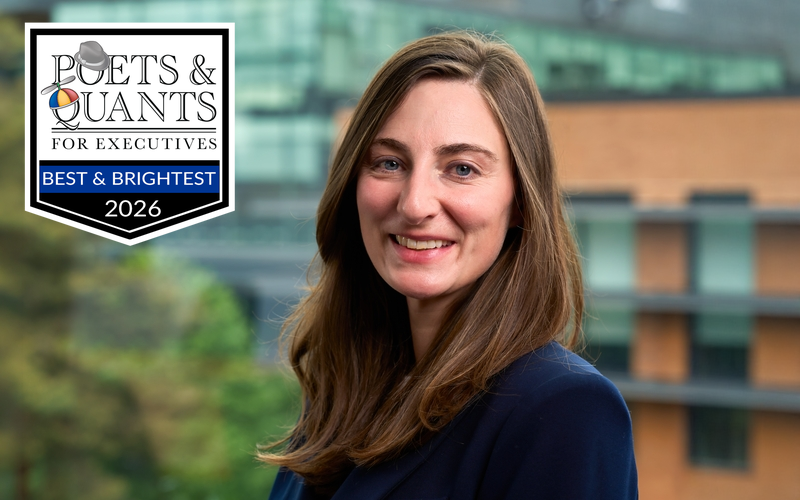
Hannah Roosevelt
University of Washington, Foster School of Business
Age: Freshly 39
“A clinician turned leader who found a love of service to others grows exponentially when building systems larger than yourself.”
Hometown: Ellery, Illinois
Family Members: Ronan (10), Evelyn (7), Daniel (Husband)
Fun fact about yourself: I grew up riding motorcycles and never stopped. The helmet just looks different depending on the day.
Undergraduate School and Degree:
University of Illinois Urbana-Champaign, Bachelor of Science, Food Science and Human Nutrition
Rush University, Master of Science in Clinical Nutrition
Where are you currently working? Seattle Children’s Hospital, Clinical Nutrition Manager
Extracurricular Activities, Community Work and Leadership Roles:
I deliberately scaled back my extracurricular life leading up to the Executive MBA. Balancing full-time work and school required tough choices about capacity, especially for someone with a fondness for taking extra non-degree courses offered by the Foster School of Business. I added community youth softball coaching back into my lineup after the first year. I suppose we could consider the addition of a Great Dane puppy to the household mid-program a choice that at times has felt like an extracurricular activity.
Which academic or extracurricular achievement are you most proud of during business school? Somewhere in there, I helped teach a batch of seven and eight-year-old girls to pitch a softball, which I am choosing to count as a notable achievement. Overall, I’m proud of the entirety of the past two years. The balance was intense, and the fruit is showing. An operational model I recently advocated for was described as the strongest out-of-cycle budget plan the committee had seen, and attributed to my advocacy, strategy, and financial analysis. That is the Executive MBA working.
What achievement are you most proud of in your professional career? I’m proud of building the Seattle Children’s Hospital human milk laboratory. When I began, there was no program, no process, and no compliance framework in existence. I built the team, quality systems, and regulatory compliance across HMBANA, DNV, ISO 9000, and state frameworks. It has turned into an operation that has achieved zero adverse findings across every audit for seven years, operating at the highest staffing efficiency among benchmarked peer institutions. We have kept going, embedding continuous improvement into everything we do as part of our team’s culture. A deeper reward is the messages from people I have managed, telling me our work together still shapes how they lead. This means I’m paying forward the impact my mentors had on me.
Who was your favorite MBA professor? I had many! If I must choose just one: Professor of Accounting Dawn Matsumoto, who taught our first finance course. She transformed finance from “just” a spreadsheet into storytelling numbers. Her enthusiasm for a subject was genuinely contagious. It was so enjoyable that I had to call my best friend, who had studied accounting, to laugh and apologize for doubting her taste in subjects 20 years earlier. I now completely understand.
Why did you choose this school’s executive MBA program? Choosing a program felt like running a net present value calculation. Researching programs across the country, and having lived in Chicago, I was well acquainted with exceptional options there. Wharton also got some consideration, as I’ve long admired Adam Grant’s research and data-based approach to organizational psychology and leadership (If you are reading this, Adam, we can still be friends).
When I ran the analysis, the time spent commuting [to another city] would detract from time studying and building relationships with classmates. Additionally, as technology continually reshapes how we work and deliver care, I wanted to be embedded in a program tied to a genuine tech hub with classmates from industries I do not encounter daily. Foster gave me that. The University of Washington’s connection to Seattle’s technology and innovation culture was core to my decision.
What is the biggest lesson you gained during your MBA and how did you apply it at work? My biggest lesson was confidence in my abilities at the intersection of financial acumen, operations, and people leadership. It felt less like addition and more like compounding. I previously questioned myself in rooms with executive leadership. That has changed. The program polished and refined years of leadership experience and validated it with a language and framework I had been missing. I can now speak the language of people who think in balance sheets rather than bedside charts, and I have demonstrated that with increasing success throughout the program.
Where I may have previously drafted spaghetti spreadsheets, now even my brainstorms are built presentation-ready. In my admissions letter, I wrote about becoming a leader, bridging a persistent gap in healthcare leadership between clinicians who become leaders and administrators who have never been clinicians. I quite enjoy being her.
Give us a story during your time as an executive MBA on how you were able to juggle work, family and education? At the beginning of the second year, there was a stretch of a few months that tested every version of the word juggle. My husband had to travel often for work. Our lab’s centrifuge failed for the first time in the history of the service. My mother had surgery and required more post-op care than originally anticipated. Her partner received a sudden terminal brain tumor diagnosis while I was in the airport waiting to depart for our program’s international immersion. The Great Dane puppy came home. My sister had a baby, and I made it in time to be there for her arrival.
In the midst of all of this, I recall thinking, ” This is my lived version of an Elastigirl movie,” stretched thin, trying to hold all the pieces together while still writing papers I was proud of and showing up for my teams. The reality is, I was not alone. Other teammates were navigating the deaths of parents and complicated medical situations for themselves and loved ones. What I was reminded of in those months was not from a textbook, and not immediately replaceable by AI. It was what a team actually does when things get hard and how we hold each other up. Those experiences did not stay outside the classroom. They waltzed straight into our capstone projects.
What advice would you give to a student looking to enter an executive MBA program? Plan ahead more than you think you need to. Simplify your commitments before you start. Prepare not just yourself but your entire family unit because there will be less of you to go around for a while. When anticipating the time commitment, remember you will need evenings throughout the week for working sessions with teammates and other optional offerings worth attending. Most importantly, treat it like a team sport. The more you give, the more you get. Enter with generosity. When one of us rises, we all rise.
What was your biggest regret in business school? I gave this program everything I physically could in the time I had. If I could do anything differently, it would be to have had more time to participate in the additional experiences Foster offered during the program and to spend more time with each of my classmates. Spending time each week with my peers is the thing I will miss most after graduation.
What is one way that your business school has integrated AI into your programming? What insights did you gain from using AI? Completing an Executive MBA during this particular moment in AI development has been unexpectedly fitting. Integration at Foster evolved tangibly every quarter, modeling the same curiosity and experimentation the program prepares you to bring to your work. Foster leaned in rather than pulling back, offering dedicated training, diving into the science, and providing an explicit invitation to experiment responsibly. My skills are more proficient as a result of their efforts.
What was the main reason you chose an executive MBA program over part-time or online alternatives? I draw energy from being around people. For a cohort of this size, an in-person format was the right choice for me. The Executive MBA structure answered the timing question elegantly. One or two concentrated days, rather than fractured evenings, fit naturally alongside the unpredictable demands of work and family. Multiple people who know me well gave me the same advice independently: do it in person if you can. I am thankful I listened.
How did you finance your EMBA and what did you do to make tuition and associated costs more affordable? I saved intentionally for years before submitting my application. Seattle Children’s contributed to tuition, for which I am grateful, and I covered the remainder through savings and deliberate trade-offs. I have been driving the same car longer than I might have otherwise. I call it my yacht, which is more a psychological reframe than an accurate description. The Foster Executive MBA’s commitment to removing logistical barriers, meals, class logistics, and parking, further reinforced the investment as well spent.
What is your ultimate long-term professional goal? My long-term goal is to lead organizations solving hard problems in human health, making care more accessible, better coordinated, and sustainable for both the people delivering it and the people depending on it.
DON’T MISS: BEST & BRIGHTEST EXECUTIVE MBAS: CLASS OF 2026
© Copyright 2026 Poets & Quants. All rights reserved. This article may not be republished, rewritten or otherwise distributed without written permission. To reprint or license this article or any content from Poets & Quants, please submit your request HERE.

