





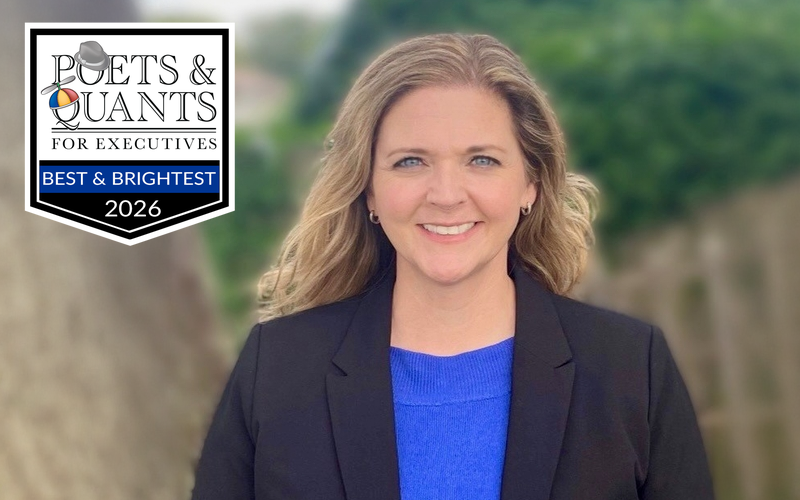
Bridgett Willis
University of Florida, Warrington College of Business
Age: 49
“Strategic, results-focused leader who brings clarity to complexity with humor while valuing strong relationships.”
Hometown: Elkton, Maryland
Family Members: My immediate family includes my husband, John Willis, and two sons, Jakob (20) and Evan (17).
Fun fact about yourself: I played tennis competitively in high school and college. My best friend of 37 years was my doubles partner in high school, which made the experience even more fun.
Undergraduate School and Degree: University of Delaware, Bachelor of Arts in International Relations and Spanish, minor in Economics
Where are you currently working? I am currently working as a Program Leader in new product development for an Edtech organization.
Extracurricular Activities, Community Work and Leadership Roles: As the Cohort Representative for EMBA26, I served as the liaison between our cohort and program leadership, ensuring feedback was communicated clearly and acted upon. This role required balancing diverse perspectives across a group of experienced professionals and helping drive alignment on key issues that impacted the cohort experience.
As part of my Cohort Representative role, I also contributed as a member of the Warrington MBA Student Engagement Committee. I supported initiatives designed to strengthen connection and engagement across the program. This included helping shape events and touchpoints that enhanced collaboration and made the overall experience more valuable for the cohorts.
I enjoyed extending my leadership beyond the classroom, focusing not just own my own experience but on improving the program for others.
Which academic or extracurricular achievement are you most proud of during business school? The achievement I am most of proud of during business school is serving as the Cohort Representative for EMBA26. Our cohort is made up of experienced professionals with diverse perspectives, requiring my focus to be on ensuring the program experience works for everyone. Gathering feedback, identifying common themes, and helping drive constructive solutions became the core of my role. I enjoyed getting to know each member of the cohort on a deeper level by finding out what was most important to them and continually refining our processes for the betterment of the cohort.
What achievement are you most proud of in your professional career? I’m most proud of the cutting-edge products I’ve helped take to market over the course of my career, while guiding customers to gain market share with the use of technology. Leading programs from concept to delivery across complex, cross-functional environments requires more than execution. It requires aligning stakeholders, making tradeoffs under pressure, and ensuring what gets delivered creates value. Seeing customers succeed by using a product I helped to move from concept to reality is very rewarding.
Earning my Program Management Professional (PgMP) certification from the Project Management Institute is also something I am proud of, as it reflects the depth and breadth of experience required to lead at the program level. It validated the work I have done in the past and reinforced my commitment to continuously improving how I lead large-scale initiatives.
Who was your favorite MBA professor? While I was impressed by all my professors, Dr. Brian Miller stands out as my favorite. I was apprehensive about the accounting classes going into the program, not having a background in Accounting or Finance. By the time I started Dr. Miller’s Managerial Accounting course, I had taken courses by Dr. Marcus Kirk and Dr. Joel Houston that prepared me well.
What stood out about Dr. Miller was not just his command of the subject material, but how he taught us to use it to make decisions in the workplace. Having spent years in leading programs, it was important to me to connect the dots between financial data and execution. Dr. Miller also fosters a collaborative environment in the classroom, where our cohort was able to share thoughts and experiences in the context of what we were learning. Further, he made himself available to the cohort for additional help regarding coursework and professional advice and continues to do so, though our course is over.
Why did you choose this school’s executive MBA program? I chose the University of Florida Warrington College of Business Executive MBA program because it aligned with my learning style, in the format that would work for me, and was led by top-tier faculty and staff. At this stage in my career, I was not looking for theory but rather wanted a program that would translate into better decisions and stronger outcomes in my work. Learning across Finance, Strategy, and Operations allowed for real-time application of the material, making a greater impact than a traditional approach.
The cohort structure was also important to me. Being surrounded by experienced professionals from various industries with diverse perspectives pushed me to think more critically, challenged my assumptions, and refined how I lead through complexity. We grew individually and as a unit throughout the program and made life-long relationships.
It was a bonus that the University of Florida is an institution rich in traditions, but is also technology and future-focused to better equip students.
What is the biggest lesson you gained during your MBA and how did you apply it at work? The biggest lesson I gained during my MBA was how to connect financial and operational data more directly to execution and decision-making, while also significantly strengthening my time management. Before the program, I was leading complex programs and teams while delivering results. However, the MBA sharpened how I synthesize inputs and tradeoffs. I am now able to understand cost drivers, prioritize investments, and measure what actually drives value. At the same time, balancing a demanding career, academic work, and personal responsibilities required a much higher level of discipline in how I manage my time and focus.
I’ve applied both lessons directly to my work. I incorporate more structured analysis into program decisions, while also being more intentional about prioritization and how I allocate my time across competing demands. Together, these changes have made my decision-making more disciplined, my execution more focused, and allowed me to operate at the strategic partner level.
Give us a story during your time as an executive MBA on how you were able to juggle work, family and education? One of the most challenging and rewarding periods during my MBA was the Summer term when I was taking three classes, including the international immersion experience in Berlin, Germany. I was away from work and family for two consecutive weeks, one for the program and an additional week traveling with some members of my cohort. It required a significant amount of planning and coordination in advance. On the professional side, I ensured my programs were in a stable position and aligned with my team on clear priorities and decision-making while I was out. At home, it meant planning ahead, setting expectations, and communicating effectively to ensure everything continued to run smoothly in my absence.
While participating in the immersion experience, I focused on being fully present rather than trying to manage my professional and personal life from afar. The experience reinforced that successfully balancing work, family, and education is not about constant multi-tasking, but rather planning ahead, being intentional on where you focus your time and energy, and trusting the people around you.
What advice would you give to a student looking to enter an executive MBA program? My best advice is to be clear on your why and be intentional. An Executive MBA is a significant investment of time, energy, and money. You will get the most out of the experience by knowing what you want you want to get out of the program and are open to the opportunities the program offers beyond the classroom. Part of your success lies in being fully committed. You will not be able to do everything during the program, so prioritization is critical. Intentionality translates to relationship building as well. Your relationships with your cohort are some of the most valuable and rewarding parts of the EMBA experience. Engage in discussions, challenge perspectives, and get to know your cohort personally. You will learn as much from your peers as you do from the coursework.
What was your biggest regret in business school? I came into the program with 15 years of experience in my field. While that gave me context, it also made it clear that I would have benefited from a more structured understanding of cross-functional business topics and decision-making frameworks earlier in my career. Simply put, I wish I had gone back to school earlier.
What is one way that your business school has integrated AI into your programming? What insights did you gain from using AI? One of the most valuable ways the program integrated AI was by encouraging us to use it as a tool to enhance our analysis but not replace it. Having spent the past few years building products with an AI integration layer, I came in with a practical understanding of its capabilities. However, the program pushed me to use it more deliberately in an academic and decision-making context.
In several courses, I used AI to quickly synthesize large amounts of information, test different approaches to problem-solving, and refine how I structured my responses. The biggest insight for me was sharpening my understanding of the gap between where AI adds value and where it does not. It is highly effective for accelerating initial analysis and identifying patterns, but it still requires judgment to validate outputs and apply them in a meaningful way. Ultimately, I came away viewing AI as a force multiplier. It can significantly increase speed and efficiency, but the quality of the outcome still depends on the decision-making of the person using it.
What was the main reason you chose an executive MBA program over part-time or online alternatives? The in-person aspect of the Executive program was a primary driver for me. I wanted to be in a classroom environment, actively engaging with my peers and professors, with dedicated time set aside for learning and discussion.
At this stage in my career, much of the program’s value is in content and dialogue. Our cohort of 41 experienced professionals brought diverse perspectives from across industries, which made discussions far more practical and grounded. That level of interaction is difficult to replace in a part-time or online format. The ability to challenge ideas in real time, learn from others’ experiences, and refine my own thinking in the moment were key factors in my decision. It made the learning more immediate, more relevant, and more impactful.
How did you finance your EMBA and what did you do to make tuition and associated costs more affordable? My EMBA was primarily self-funded, with some employer reimbursement available in the second half of the program. I approached it as a deliberate investment in myself and my long-term career, in becoming a more effective leader and positioning myself for the next stage of my career.
What is your ultimate long-term professional goal? My long-term professional goal is to expand my impact at the enterprise level, to lead larger, more complex portfolios of strategic programs that directly drive business outcomes. This can be either within an organization, in a professional services capacity, or as a consultant.
I currently lead programs and high-performing teams, and I am motivated by the challenge of bringing structure and clarity to complex, high-impact initiatives. The next step for me is increasing that scale by partnering more closely with senior leaders on strategy, influencing enterprise-level priorities, and advising organizations through transformation efforts.
DON’T MISS: BEST & BRIGHTEST EXECUTIVE MBAS: CLASS OF 2026
© Copyright 2026 Poets & Quants. All rights reserved. This article may not be republished, rewritten or otherwise distributed without written permission. To reprint or license this article or any content from Poets & Quants, please submit your request HERE.

