





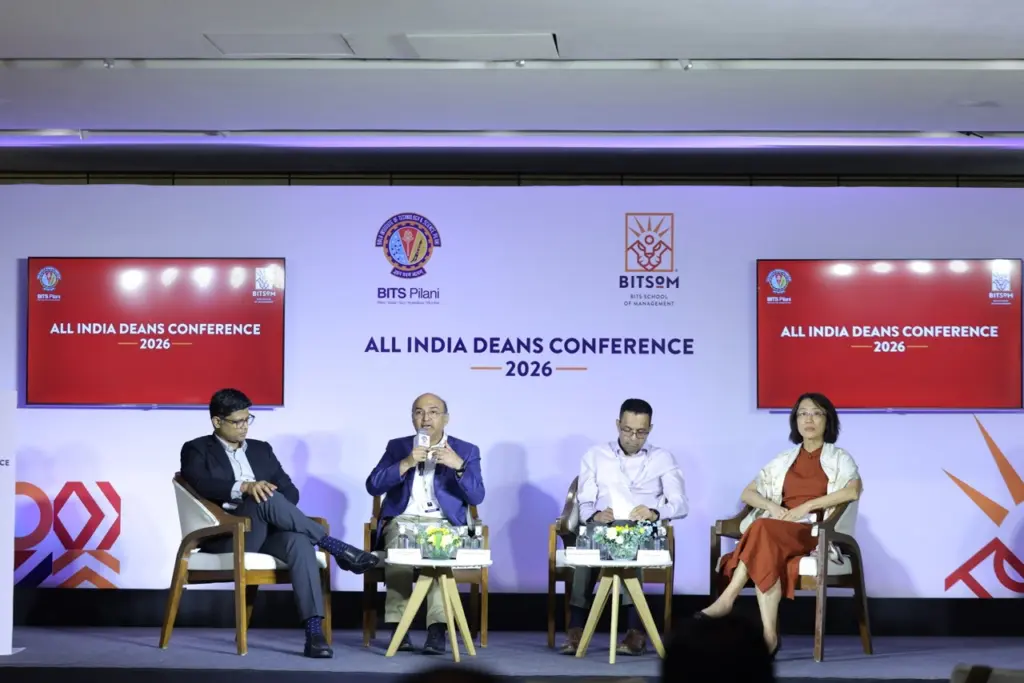
From left, Saravanan Kesavan, dean of BITSoM; Vishal Gaur, dean of Cornell’s Johnson Graduate School of Management; Kieran Fernandes, executive dean of Durham University Business School; and Jun Yang, dean of Nanyang Business School, at BITSoM’s inaugural All-India Deans Conference, held Oct. 8-9 in Mumbai. The gathering focused on AI’s impact on management education and the changing role of business schools.
Indian business school leaders expect artificial intelligence to transform management education. Some of their institutions are still figuring out how to respond, even as executives and employers look to them for guidance.
A recenty survey of 22 Indian business school deans and academic leaders found that 73% expect AI to substantially change what their institutions do or force them to rethink their fundamental purpose. Yet six of those 16 respondents — nearly 38% — said their schools were still watching developments or experimenting.
The survey was conducted by EFMD, a global management education and accreditation organization, and BITS School of Management (BITSoM). Findings were released last week at BITSoM’s inaugural All-India Deans Conference in Mumbai.
At the conference, deans and global academic leaders discussed how AI is reshaping management education, how schools can strengthen critical thinking and other human skills, and how research and partnerships with industry and international institutions should evolve.
Discussions framed a challenge that extends beyond MBA classrooms: How can business schools prepare leaders for an AI-driven workplace while adapting their own teaching, faculty capabilities and programs?
“AI is going to be the next growth engine for MBA career paths,” Vishal Gaur, dean of Cornell University’s Johnson Graduate School of Management, said in a release. “Integrating AI into business education is an opportunity to elevate how we cultivate human reasoning.”
NEARLY HALF OF RESPONDENTS SAY AI WILL CHANGE B-SCHOOL PURPOSE
The survey offers a snapshot of participating leaders’ views, rather than a comprehensive assessment of Indian business education.
Ten of the 22 Indian respondents said AI would require schools to rethink their role or purpose. Six expected it to change what schools do, while five expected it to improve existing activities. One said it was too early to tell.
The barriers extended beyond technology. Governance, privacy and responsible use topped the list of difficult AI challenges, cited by 41%. Curriculum, teaching and assessment followed at 36%, while 32% identified faculty capability and adoption. Respondents could select up to two challenges.
Their requests for help included faculty training, clearer institutional policies and examples of effective AI use at other schools.
AN OPENING IN EXECUTIVE EDUCATION
Conference participants argued that the need for AI education reaches well beyond students entering the workforce. Experienced professionals and senior managers also need support.
Businesses are still working out how to adopt AI and change their operations. Participants identified opportunities for schools to develop executive education and work more closely with industry and government on those needs.
That would require schools to do more than document existing business practices. They would help employers frame problems, develop capabilities and navigate decisions whose consequences remain uncertain.
About 59% of survey respondents identified changing employer expectations and graduate roles among their greatest concerns. Roughly 55% cited changing demand for traditional degrees, including MBAs, and 50% selected shifting faculty roles and workforce expectations. Respondents could choose up to three concerns.
PROTECTING THE ABILITY TO THINK
Indian deans and B-school leaders also concede that AI can lead to “cognitive offloading” — students becoming proficient at prompting AI while losing the ability to question its output or reason independently.
Proposed responses included practical assessments, classroom discussions, whiteboard exercises and analysis of real-world data. Participants also advocated integrating AI across management disciplines while strengthening judgment, ethical reasoning, empathy and original thought.
For schools selling an immersive educational experience, it raises questions about what are students paying for when information and explanations are readily available through AI.
Leaders say B-schools must lean into relationships, peer learning, professional networks and difficult projects grounded in actual business problems. Emphasis on rankings, placement statistics and financial returns, meanwhile, encourages students to treat education as a transaction.
Jun Yang, dean of Nanyang Business School at Singapore’s Nanyang Technological University, argued that schools must look beyond immediate hiring needs.
“Meeting employer demand is essential, but management education must extend beyond transactional skill delivery,” Yang says.
“Our responsibility is to develop leaders with the capability to navigate complex business challenges, the intellectual courage to question status-quo practices, and the determination to lead responsible, long-term transformation with cultural dexterity.”
TAKING INDIAN IDEAS GLOBAL
Participants called on Indian business schools to develop management theories that inform global business practice, drawing on the country’s digital infrastructure, demographic changes and business models. They also urged schools to build international partnerships around joint degrees, shared datasets and research, expanding beyond traditional student exchanges.
“Business education is at an inflection point, shaped by rapid advances in technology, changing expectations from industry, and a growing need for leaders who can navigate complexity with both rigour and responsibility,” said Saravanan Kesavan, dean of BITSoM.
Kesavan described the conference as a starting point for continued collaboration.
“At BITSoM, we see this initiative as the beginning of a sustained conversation—one that will help shape a more relevant, collaborative, and future-focused approach to management education.”
DON’T MISS: THE P&Q INTERVIEW: BITSOM DEAN SARAVANAN KESAVAN ON AI, GROWTH & BUILDING A GLOBAL B-SCHOOL IN INDIA
© Copyright 2026 Poets&Quants. All rights reserved. This article may not be republished, rewritten or otherwise distributed without written permission. To reprint or license this article or any content from Poets&Quants, please submit your request HERE.

