





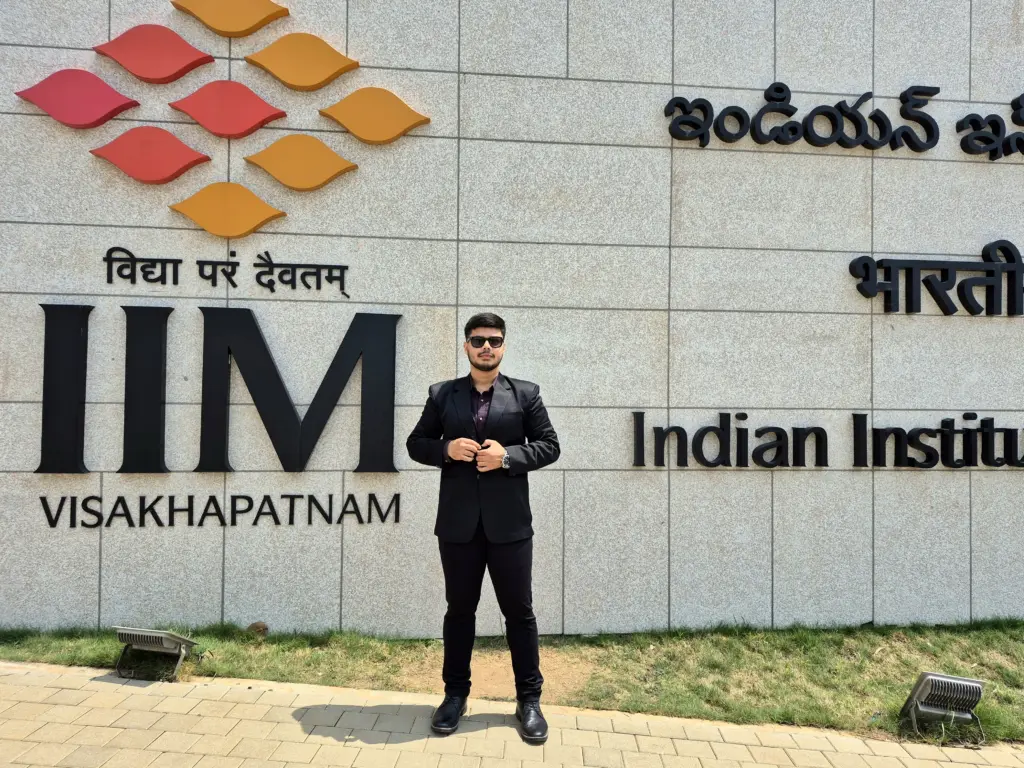
Oishik Das, associate manager at Exotel and a member of IIM Visakhapatnam’s Executive MBA 2024-2026 Winter Intake, stands in front of the entrance sign at the business school.
“The most valuable technology does not simply solve problems. It changes
the way people work, think, and grow.”
Q&A WITH OISHIK DAS
Oishik Das, Associate Manager at Exotel, is a member of the of the 2026 Executive MBA winter intake at Indian Institute of Management Visakhapatnam
Hometown: Bengaluru, Karnataka, India
Fun Fact About Yourself: I have rebuilt my life four times.
I was born in Kolkata, pursued engineering in Bhubaneswar, began my professional journey in Hyderabad, and eventually found my home in Bengaluru. Every move meant leaving behind familiarity, building new relationships from scratch, adapting to a different environment, and discovering another version of myself.
Perhaps that is why I enjoy long motorcycle rides and car road trips so much. I love journeys where the destination matters less than everything you learn along the way. When I am not working or studying, I enjoy driving, singing, writing stories, and exploring places that remind me there is always another perspective waiting to be discovered.
 Education: My academic background includes a Bachelor of Technology in Computer Science and Engineering from the Kalinga Institute of Industrial Technology, followed by a postgraduate diploma from the National Institute of Agricultural Extension Management. I am currently pursuing an Executive MBA at the Indian Institute of Management Visakhapatnam, and I also hold certifications as a Certified ScrumMaster and Lean Six Sigma Black Belt.
Aside from your classmates, what was the key part of IIM Visakhapatnam’s Executive MBA programming that led you to choose this business school and why was it so important to you? I did not want an MBA that paused my career. I wanted one that accelerated it. IIM Visakhapatnam offered something increasingly rare: the opportunity to test every classroom concept against real business problems the very next day.
Over the past two years, I have worked on enterprise implementations, customer transformation initiatives, stakeholder management, and strategic delivery while simultaneously studying finance, strategy, economics, leadership, operations, marketing, and organizational behavior.
The classroom never felt disconnected from reality because every concept immediately became applicable in my professional life.
The diversity of the cohort amplified that experience even further. Every discussion brought together leaders from technology, consulting, banking, manufacturing, healthcare, public administration, and entrepreneurship. It challenged my assumptions and constantly reminded me that complex business problems rarely have one correct answer.
For me, the Executive MBA has not been an academic qualification. It has been a two year leadership laboratory.
What course, club, or activity has been your favorite part of the IIM Visakhapatnam Executive MBA experience? Strategy has fundamentally changed the way I approach leadership.
Earlier in my career, success meant delivering projects on time, within budget, and according to scope. Those metrics still matter, but today I ask different questions.
- Does this decision create long term customer value?
- Does it improve organizational capability?
- Can it scale sustainably?
- Does it strengthen competitive advantage?
The case based pedagogy has been particularly transformative because every discussion mirrors the ambiguity leaders face every day. Working alongside experienced professionals with diverse viewpoints has taught me that leadership is rarely about finding perfect answers. It is about making informed decisions despite imperfect information.
Beyond the classroom, one experience I have particularly enjoyed has been contributing to IIM(V)ibes, IIM Visakhapatnam’s quarterly newsletter. Across multiple editions, I curated and captured photographs featured in the “Impressions” section, documenting campus life, the beauty of nature, and moments that celebrate the vibrant cultural fabric of India while reflecting the spirit of the institute. It gave me the opportunity to contribute to the school’s visual storytelling, preserving experiences that capture not only the memories of our cohort but also the identity and community that define the IIM Visakhapatnam experience.
Together, these experiences have reinforced an important lesson for me. Leadership is not only about solving business problems. It is also about creating communities, preserving shared experiences, and helping shape the culture that people remember long after the work is done.
What is the most “IIM Visakhapatnam” thing you have done so far as an Executive MBA student? For almost two years, my weekdays belonged to enterprise customers.My weekends belonged to IIM Visakhapatnam.
There were weeks filled with executive steering committee meetings, customer escalations, implementation milestones, examinations, presentations, late night assignments, and
collaborative projects, often all at the same time.
Instead of separating work from learning, I intentionally blended them together. A challenge at work became a classroom discussion. A classroom framework became Monday morning’s implementation strategy.
Looking back, the most valuable lesson was not time management. It was learning how to remain effective when every priority feels important.
IIM Visakhapatnam brings together professionals from across industries. What has been the most interesting interaction you have had so far? One classroom discussion completely reshaped my understanding of leadership. A senior executive in my cohort remarked that organizations rarely fail because they lack intelligence. They fail because intelligent people struggle to align around a common objective.
That observation stayed with me.
Throughout my career, I have worked with engineering teams, product managers, customer success, finance, legal, sales, operations, and executive leadership. Every function naturally optimizes for different outcomes. The real challenge has never been technology. It has always been alignment.
That conversation reinforced my belief that the leaders who create the greatest value are not necessarily the smartest specialists. They are the people who enable diverse teams to move in the same direction.
Describe your biggest accomplishment in your career so far. Across approximately five years in enterprise SaaS, customer experience technology, and fintech, I have led digital transformation initiatives supporting more than USD 5 million in annual recurring revenue, consistently maintained 98 percent on time project delivery, and helped organizations achieve customer satisfaction scores exceeding 95 percent.
But, the accomplishment I value most is earning the confidence of customers during moments of uncertainty.
Enterprise software implementations usually fail because change is difficult. Whether leading global SaaS implementations at Zluri, driving customer experience transformation at Kapture CX, delivering consulting engagements at HighRadius, or now managing strategic programs at Exotel, my role has remained remarkably consistent: Translate complexity into clarity, build trust across stakeholders, and turn adoption into measurable business value.
That philosophy has enabled customers to move beyond successful implementations toward meaningful organizational transformation. It has also shaped the kind of leader I aspire to become.
Describe your biggest accomplishment as an MBA student so far. Pursuing an Executive MBA while advancing through multiple leadership roles has become the most demanding and rewarding commitment of my professional life.
For nearly twenty four months, every week required balancing enterprise customer commitments with examinations, case analyses, group projects, presentations, and academic deadlines.
I now approach business decisions with greater financial discipline, stronger strategic thinking, broader organizational awareness, and increased confidence in executive communication. More importantly, I have learned to move beyond asking whether a project can be delivered.
Today, I ask whether it should be delivered, why it matters, and how it creates lasting business value. That shift in perspective will define my career far more than any qualification ever could.
IIM Visakhapatnam emphasizes responsible leadership. What social issue resonates most with you? How do you plan to use your career to address this issue? One of the greatest challenges facing organizations today is not digital transformation. It is transformation fatigue.
Every year, companies invest billions of dollars in new technologies expecting immediate gains in productivity and innovation. Yet many initiatives underperform because organizations focus on software adoption rather than human adoption.
Throughout my career, I have witnessed exceptionally capable employees struggle not because they resisted change, but because they were never empowered to embrace it. That experience has profoundly influenced my leadership philosophy.
Technology should reduce complexity rather than create it. Leadership should inspire confidence rather than compliance. Innovation should improve people’s lives rather than simply optimize processes.
As I continue progressing toward senior product and business leadership roles, I want to build organizations where technology, strategy, and people evolve together. Because sustainable transformation is never achieved through software alone. It is achieved when people believe in the future they are building.
DON’T MISS: ESSEC LAUNCHES FULLY ONLINE EXECUTIVE MBA FOCUSED ON AI, ESG & GEOPOLITICS AND SHOULD GENAI DO STRATEGY?
© Copyright 2026 Poets & Quants. All rights reserved. This article may not be republished, rewritten or otherwise distributed without written permission. To reprint or license this article or any content from Poets & Quants, please submit your request HERE.

