






EDHEC’s campus in Nice, France. Courtesy photo
EDHEC SELLS RESEARCH VENTURE SIPA TO PEI GROUP
EDHEC Business School and its Endowment Fund have agreed to sell Scientific Infra & Private Assets to PEI Group, marking another step in the school’s strategy to turn academic research into commercial value. The deal follows a similar move in 2020, when EDHEC sold Scientific Beta to the Singapore Exchange.
Scientific Infra & Private Assets, known as SIPA, develops indices, benchmarks, and analytics tools for infrastructure and private equity investors. The platform is built on research from EDHEC’s Infrastructure & Private Assets Research Institute and provides detailed data used by investment and risk teams.
School leaders say the transaction reflects a funding model that connects research with industry needs. As a nonprofit, EDHEC channels proceeds from these deals into its Endowment Fund, which supports research, academic programs, and student opportunities. The goal is to create long-term financial independence while expanding the school’s impact.
The sale is also tied to EDHEC’s broader Generations 2050 strategy, which focuses on scaling research and strengthening programs through 2028. By unlocking new funding, the school plans to invest further in its research centers and academic offerings.
As part of the agreement, PEI Group will maintain a long-term partnership with EDHEC to continue developing the research behind SIPA’s tools. Leaders say the model shows how academic work can move beyond theory and shape real-world decision making in financial markets.

Purdue University has received a $20 million commitment from the Ricks Family Foundation to establish the Purdue Institute for Healthcare Systems Innovation within the Mitch Daniels School of Business. The institute will be based at the university’s Indianapolis location. (Purdue University photo)
PURDUE RECEIVES $20M GIFT TO LAUNCH HEALTHCARE SYSTEMS INNOVATION INSTITUTE
Purdue University has secured a $20 million commitment from the Ricks Family Foundation to establish a new institute focused on healthcare systems innovation. The institute will be housed within the Mitch Daniels School of Business and based at Purdue’s Indianapolis location.
The new Purdue Institute for Healthcare Systems Innovation will focus on improving the efficiency and effectiveness of healthcare delivery. It will examine how treatments, devices, and care pathways are priced, reimbursed, and adopted, with an emphasis on cost-benefit analysis and policy design.
The institute will draw on expertise across disciplines, including engineering and pharmacy, to study healthcare from both economic and clinical perspectives. University leaders say this cross-functional approach is key to addressing complex challenges in the U.S. healthcare system.
Locating the institute in Indianapolis places it close to major hospital systems, insurers, and medical technology firms. The proximity is intended to connect research with real-world practice and policy, allowing findings to inform decisions across the healthcare ecosystem.
The gift also supports broader university priorities, including its One Health initiative and expansion in Indianapolis. Leaders say the institute will serve as a central hub for research and collaboration, with new leadership roles and operations set to be established in the coming phases.
WARWICK LAUNCHES MSC IN DIGITAL STRATEGY & AI
Warwick Business School is rolling out a new MSc Business with Digital Strategy & Artificial Intelligence, with its first cohort set to begin in September. Applications are now open. The program is designed to prepare students for a business environment shaped by automation, machine learning, and data-driven decision making.
The curriculum combines core business fundamentals with focused study in digital strategy and AI. Students will examine how technologies such as generative AI and data science are changing industries, while also building the skills to lead that change inside organizations. The program emphasizes both technical understanding and strategic application.
Leaders at WBS say the course was developed with input from employers, alumni, and industry experts. The goal is to train graduates who can connect technical teams with senior leadership. Students will explore the ethical and operational implications of deploying AI at scale, alongside its business potential.
At the end of the program, students can choose between a traditional dissertation or a hands-on Business in Practice module. The applied option includes a team-based industry simulation followed by a written reflection, giving students a chance to test their skills in a practical setting.
Master’s students at WBS also work with the school’s MSc CareersPlus and Employer Relations team, which brings experience across sectors and connects students with employers while offering advice, guidance, and skills training.
SDA BOCCONI LAUNCHES GEOPOLITICAL LEADERSHIP PROGRAM FOR CHIEFS OF STAFF
SDA Bocconi School of Management and the Chief of Staff Association have launched a new executive education program focused on geopolitical leadership. The course is designed for chiefs of staff, a role that is expanding as organizations navigate trade shifts, regulatory differences, and political uncertainty.
The program is the first of its kind built specifically around the external pressures shaping executive decision making. It joins existing offerings with the University of Oxford and Harvard Business School as part of a broader global education portfolio, but stands apart for its focus on geopolitics rather than internal operations or interpersonal leadership.
Participants will study how global forces influence strategy, drawing on SDA Bocconi research in international management and regulatory systems. The curriculum centers on practical frameworks that help chiefs of staff interpret geopolitical risk and translate it into action for their organizations.
The program includes a capstone project tied to a real strategic challenge within a participant’s organization. Those who complete it will earn the Certified Chief of Staff credential, along with a certificate from SDA Bocconi and access to the association’s global network. The course is delivered as a residential experience in Rome, with built-in opportunities for peer learning.
Leaders behind the program say it reflects how the chief of staff role is changing. Once focused on internal coordination, the position now sits closer to strategy, requiring a clear view of the external environment and its risks. This program aims to build that capability at a time when global uncertainty is shaping decisions at the highest level.
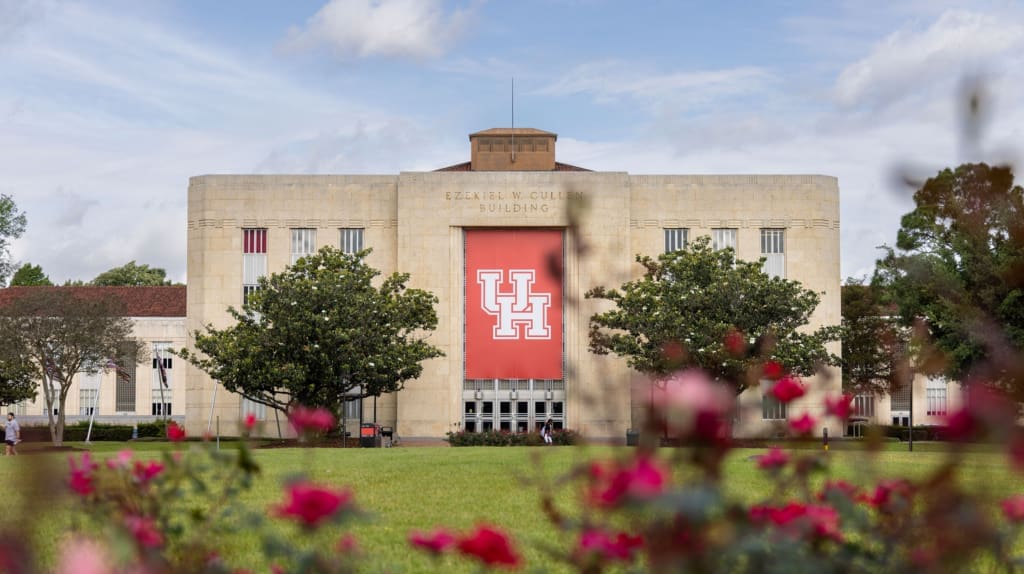
The University of Houston ranked among the top 100 U.S. institutions for utility patents granted in 2025. (University of Houston photo)
UNIVERSITY OF HOUSTON BUILDS INNOVATION PIPELINE THROUGH PATENTS AND STARTUPS
The University of Houston is strengthening its position as an innovation hub, driven by steady gains in patents and startup activity. The university system ranked among the top 100 U.S. institutions for utility patents granted in 2025, highlighting its focus on turning research into real-world applications.
The ranking, compiled by the National Academy of Inventors, placed the University of Houston System No. 64 nationally and No. 3 in Texas, based on 32 utility patents issued last year. These patents give inventors exclusive rights to commercialize new technologies and are often seen as a key measure of innovation output.
Recent inventions span a range of fields, from robotic prosthetics that improve mobility to research aimed at extending battery life. Faculty are also working on materials that could make artificial intelligence devices faster while reducing energy use, reflecting the university’s emphasis on energy and technology research.
Beyond research, the university is focused on commercialization. Its Technology Bridge and Innov8 Hub support students and faculty in launching startups based on their inventions. That effort has led to record-setting years for startup creation, helping drive regional economic development and workforce growth.
University leaders say the goal is to build a cycle where research leads to startups, which in turn fuels more innovation. Recent recognition of seven faculty members as senior members of the National Academy of Inventors further signals the university’s growing influence in research and commercialization.
SURVEY: HALF OF WORKING PROFESSIONALS SACRIFICE SLEEP TO PURSUE AN MBA
A new survey suggests many professionals are pushing themselves to the limit to earn an MBA while working full-time. The study, conducted on behalf of Concordia University, St. Paul, surveyed 122 professionals and found that career concerns are driving more people to pursue graduate business education alongside their jobs.
The results point to a mix of ambition and pressure. About 50% of respondents said they have given up sleep to make time for their MBA studies. More than half, 54%, said they pursued their degree without telling their manager, suggesting many are balancing school and work quietly.
Motivation remains strong despite the strain. The top reasons for pursuing an MBA were personal growth and achievement (84%), increasing earning potential (80%), and building leadership and management skills (74%). The findings reflect continued demand for business education as professionals look to strengthen their position in an uncertain job market.
Most respondents said the effort is worth it. Some 72% rated the value of their MBA at or above expectations, including 26% who said it exceeded expectations. Only 14% said the degree fell short of what they had hoped.
The survey frames what it calls a “quiet ambition boom,” where professionals are investing in themselves even as they stay in their current roles. For many, the tradeoff is clear: longer days, less sleep, and a bet that an MBA will open new doors.
DON’T MISS: REPLACE OR REINVENT? B-SCHOOLS CONFRONT UNCERTAINTY AROUND AI, JOBS, AND THE MBA PIPELINE AND KELLOGG CHRONICLES: BRIDGING BUSINESS & SUSTAINABILITY AT THE ABRAMS CLIMATE ACADEMY
© Copyright 2026 Poets & Quants. All rights reserved. This article may not be republished, rewritten or otherwise distributed without written permission. To reprint or license this article or any content from Poets & Quants, please submit your request HERE.

