





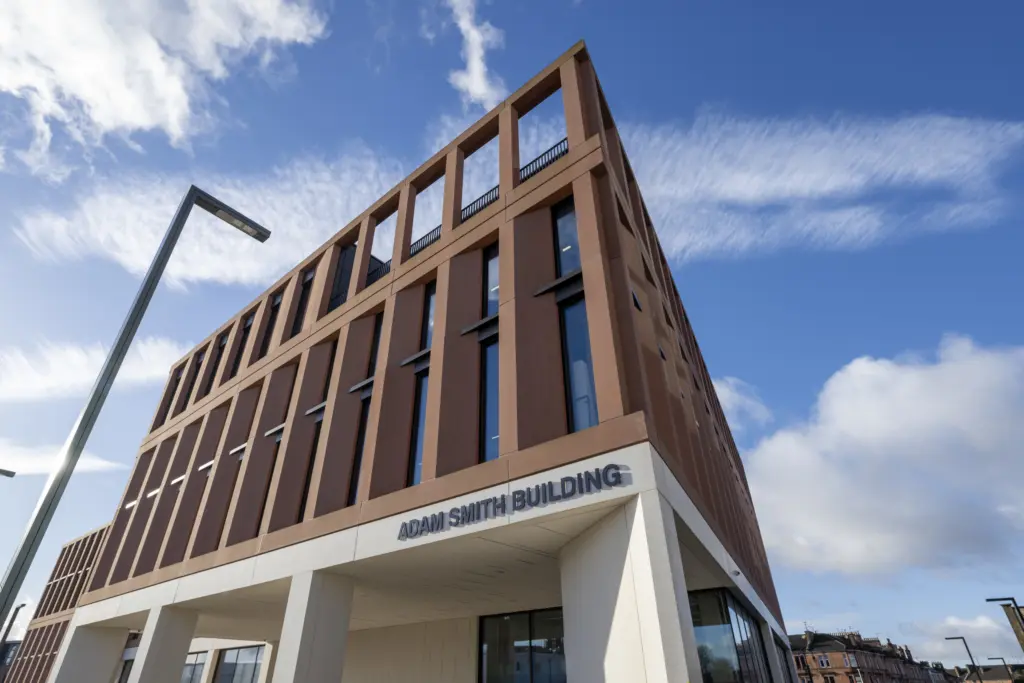
Exterior of the Adam Smith Building
ADAM SMITH BUSINESS SCHOOL LAUNCHES NEW EXECUTIVE EDUCATION PORTFOLIO
The University of Glasgow’s Adam Smith Business School has launched a new executive education portfolio developed with input from employers across Scotland. The programs are designed to address skills gaps identified by businesses, charities, public-sector organizations, and other employers.
The initial portfolio includes four programs focused on leadership, workplace inclusion, artificial intelligence, and organizational performance. Topics include menopause support in the workplace, emotional intelligence and neuroinclusive leadership, AI for productivity and growth, and a leadership retreat for women.
The school spent months consulting employers about the barriers they face in accessing executive education. One of the main concerns was cost, so Adam Smith Business School introduced a tiered pricing model. Fees start at £295 for charities, NGOs, and nonprofit organizations, with discounted rates for SMEs and University of Glasgow alumni.
Organizations can also work with faculty to build custom executive education programs around specific workforce and strategic needs. The school says the goal is to connect academic research with practical challenges that participants can address in their organizations.
The new portfolio forms part of a broader partnership model that also connects employers with student talent, research, and innovation at the business school.
SYRACUSE WHITMAN REDESIGNS ONLINE MBA, CUTS CREDITS AND TIME TO COMPLETION
Syracuse University’s Whitman School of Management is overhauling its Online MBA, reducing the degree from 54 credits to 45 and giving students a faster path to completion. The changes begin with the fall 2026 session and will continue into spring 2027.
Students who move through the program at a moderate pace will be able to finish in as little as 15 months. Beginning this fall, Whitman will also allow up to six prior learning credits for eligible students with military leadership, advanced professional experience, or other qualifying backgrounds. That could reduce the degree to as few as 39 credits.
Whitman is also removing the residency requirement. Students can now complete the MBA entirely online, although optional in-person residency weekends will remain available on campus, elsewhere in the United States, and internationally.
In spring 2027, the program will move from a quarter-based calendar to a semester model with fall, spring, and summer cohorts. Courses will run in eight-week sessions, and Whitman plans to refresh all 39 courses in its online portfolio with updated content tied to changes in business and technology.
The Online MBA offers six specializations, including accounting, business analytics, entrepreneurship, finance, marketing management, and supply chain management. Live online classes are taught in sections of about 20 students by Whitman faculty, with access to academic advising, executive coaching, and career services. Applications for the fall 2026 session are due Aug. 13.

University of Maryland’s Robert H. Smith School of Business
UNIVERSITY OF MARYLAND SMITH REDESIGNS MBA PROGRAMS, CUTS CREDIT REQUIREMENTS
The University of Maryland’s Robert H. Smith School of Business has redesigned its Full-Time, Flex, and Online MBA programs. Beginning with the Fall 2026 cohort, students will complete 48 credits instead of 54.
Smith says the change is meant to lower the time and cost required to earn the degree while keeping the core academic and leadership components intact. The redesigned curriculum will place more emphasis on AI fluency and decision-making in uncertain and complex environments.
Dean Prabhudev Konana said MBA students are placing more weight on flexibility and long-term return on investment. He said employers also want graduates who can lead through constant change.
The school is also expanding access for working professionals through its new Baltimore Peninsula location at Rye Street Market. The site includes classrooms near major employers and innovation hubs.
Smith’s MBA programs continue to rank nationally, including its Flex MBA, which U.S. News & World Report ranks No. 11 among public universities.
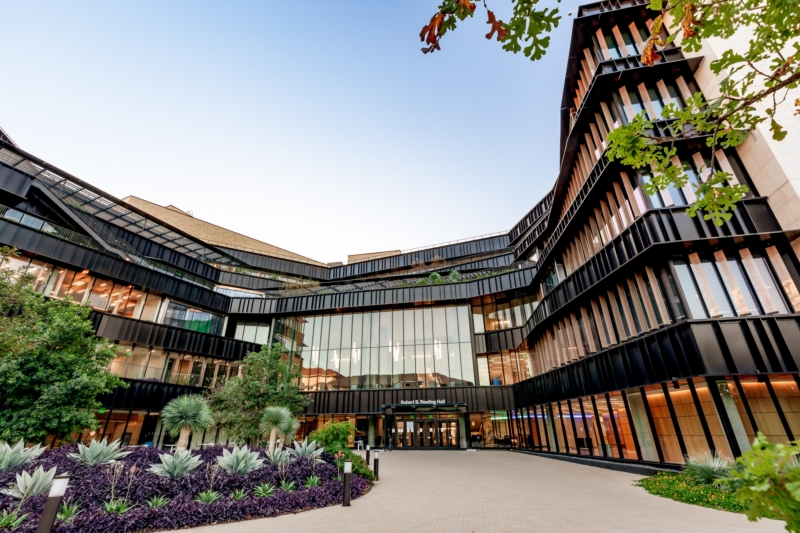
McCombs School of Business at the University of Texas at Austin
MCCOMBS RENAMES TWO MASTER’S PROGRAMS TO HIGHLIGHT AI
The McCombs School of Business at the University of Texas at Austin is renaming two of its 10-month graduate programs to reflect the growing role of artificial intelligence in their curricula. The Master of Science in Business Analytics will become the Master of Science in Business Analytics and Artificial Intelligence, while the Master of Science in Information Technology and Management will become the Master of Science in Business Technology and Artificial Intelligence.
The new names will appear on diplomas for the Class of 2028. Applications for both programs open Aug. 26. McCombs says the changes are meant to better describe what students are already learning rather than signal a major curriculum overhaul.
The M.S. in Business Technology and AI prepares students to integrate and implement technologies that support AI across an organization. Graduates commonly move into technology consulting, product management, and AI implementation roles.
The M.S. in Business Analytics and AI focuses more directly on building AI models and advanced analytics to support business decisions. Alumni often work as analysts, consultants, and data scientists.
DON’T MISS: ESSEC LAUNCHES FULLY ONLINE EXECUTIVE MBA FOCUSED ON AI, ESG & GEOPOLITICS AND TO TURN MANAGERS INTO BUILDERS, YALE SOM MAKES OVER ITS MBA CORE
© Copyright 2026 Poets & Quants. All rights reserved. This article may not be republished, rewritten or otherwise distributed without written permission. To reprint or license this article or any content from Poets & Quants, please submit your request HERE.

