






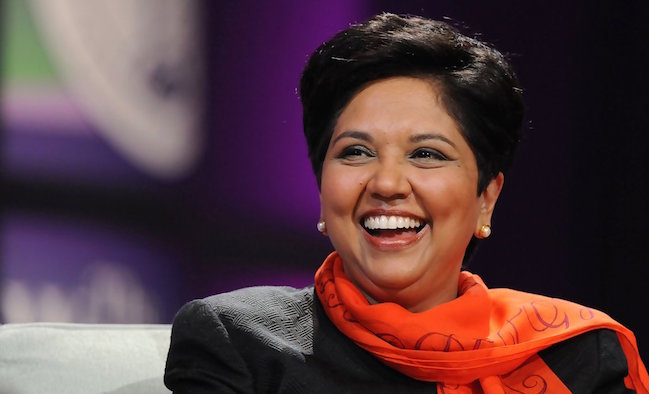
PepsiCo Chairman & CEO Indra Nooyi
Who do you want to be when you grow up?
We’re asked that question in our formative years. As 2rd graders, we’d answer that question with the usual tropes: a celebrity, an athlete – or an Avenger. A decade later, we grew more specific: a judge, a teacher – or a podcaster. As we started our careers, we began picturing a life beyond our role. We wanted careers had made us secure, respected and influential – but also personal lives where we were healthy, happy, and loved.
In a word, we wanted to be free.
THE BIG QUESTION OF A LEADER
Over time, we learned that freedom wouldn’t come cheap. We endured feckless managers, finicky clients, and cutthroat co-workers. As we entered business school, we understood that money, title – or even purpose – weren’t enough. To be truly successful, who we are mattered as much as what we knew. Knowing that, we worked through the question underlying all business education:
Who do I want to be as a leader?
Outside the bubble, leaders are judged by P&L – stock price and market cap. Inside their organizations, leaders hit those numbers from the quality of life they foster as much as the strategic ingenuity they execute. From the boardroom to the cube farms, leaders set the bar, tone, and pace. More than that, their example – what they value and how they act – set their organization’s boundaries as much as their possibilities.
That example is what business students come to absorb, be it through reflections, cases, simulations, or interactions.
THE ‘GENUINE HUMANITY’ OF INDRA NOOYI
Among the MBA Class of 2026, Indra Nooyi, the former Chairman and CEO of PepsiCo, is a leader whose example resonates deeply. Though she stepped down as Chairman in 2019, Nooyi has been hardly forgotten by tomorrow’s business leaders. Between her roles as chief strategist and CEO, Nooyi turned PepsiCo into the largest food and beverage company in the world. In acquiring brands like Gatorade and Tropicana, she pivoted PepsiCo’s portfolio towards healthier products – all while deepening its branding as the fun and bold choice. When it came to practice, she emphasized ‘radical honestly’, personifying the 5 C’s of leadership – Competence, Courage, Communication, Consistency, and Compass – for the PepsiCo team to follow from top-to-bottom.
Lola Fadiran, a 2026 graduate of the University of Texas at Dallas’s Jindal School, is one admirer of Nooyi. From a business standpoint, Fadiran cites her willingness to eschew short-term pressures in favor of long-term goals. She also touts Nooyi’s use of “two-page narrative memos” that emphasized both rationale and implications – further reinforcing her future-driven vision. Beyond strategy, Fadiran admires Nooyi’s “people-centric” management style.
“I am especially inspired by how she combined strategic foresight with a people-centered approach. She championed diversity and inclusion, led with empathy, and maintained high performance. Her example demonstrates that organizations can achieve both growth and integrity. This balance aligns with my own leadership philosophy: delivering results while upholding values, accountability, and inclusive decision-making.”
Nooyi has another fan in May El Damatty, who earned her MBA from the Ivey Business School this summer. She lists Nooyi’s “genuine humanity” as the attribute that sets her apart.
“She often spoke about the importance of remembering that employees are not just workers, but people with families, aspirations, and lives beyond the office,” El Damatty continues. “One example that always stayed with me was her habit of writing letters to the parents of senior executives thanking them for the role they played in raising such talented leaders. It’s a small gesture, but it reflects a leadership philosophy rooted in respect and empathy. I admire leaders who understand that strong organizations are built not just through strategy and performance, but through trust, care, and human connection.”
What makes a great leader in the eyes of MBAs? Who best represents these qualities? Poets&Quants posed these questions to this year’s Best & Brightest MBAs and MBAs To Watch. From Anthropic’s Dario Amodei to the Tata Group’s Ratan Tata, here are 25 business leaders who have provided a template for great leadership to the next generation of MBA difference-makers.
Dario Amodei, CEO and co-founder of Anthropic. Building an AI company is hard. Building one that puts safety and responsible development at its core – when the competitive incentives pull in every other direction – is extraordinary. Dario left OpenAI to co-found Anthropic because he believed AI development needed a different approach, one grounded in making AI systems safe and aligned with human values. What impresses me most is that he has held to that vision even as competitive pressure has intensified. Anthropic is one of the youngest major AI labs, yet it has built a world-class product, attracted exceptional talent, and remarkably, every co-founder is still at the company. That kind of retention says everything about the culture he has built.”
Harshwardhan Singh, Wharton School
“The business leader I admire the most is Ajay Banga, former CEO of Mastercard and currently the president of World Bank Group. What I find most inspiring about him is his ability to combine strong business leadership with a deep commitment to global impact.
During his time at Mastercard, he helped transform the company into a leader in digital payments while also advancing financial inclusion initiatives that brought millions of people into the formal financial system. His leadership demonstrated that profitability and social progress do not have to be mutually exclusive. I also admire his global perspective—having worked across different countries and cultures, he consistently emphasizes collaboration and inclusive growth. His transition from leading a major multinational corporation to heading the World Bank further reflects his commitment to using business expertise to address some of the world’s most pressing development challenges. Ajay Banga represents the kind of leader I aspire to be.”
Soham Mukherjee, University of Texas (McCombs)
“I admire Sara Blakely (founder of Spanx) because she exemplifies the kind of leadership I hope to bring into my career. She built Spanx from the ground up with her personal savings. What stands out to me isn’t just her high-quality product, but also the mindset and culture she created around it. Sara has consistently emphasized resilience, ownership, and empowering her team, fostering an environment where creativity and risk-taking are encouraged. She understands that a strong brand is built not only by a good idea, but on clear goals, motivated people, and execution. As I begin my career in Human Capital consulting at Deloitte, I’m inspired by leaders like Sara who recognize that sustainable success starts with investing in people, supporting team and individual growth.”
Sarah Wales, Indiana University (Kelley)
“The business leader I admire most is Arthur Blank (co-founder of Home Depot). What I admire most about him is his belief that strong organizations are built by empowering people at every level. At The Home Depot, that philosophy translated into a culture where frontline associates were trusted to serve customers and make decisions, turning culture itself into a competitive advantage. Blank’s leadership shows that long-term value is created not only through strategy and execution, but through organizations where people feel ownership and responsibility. That perspective resonates deeply with my own view of entrepreneurial leadership: creating environments where individuals feel empowered to innovate, grow, and create value together.”
Drin Govori, Babson College (Olin)
“The business leader I admire most is James Burke, former CEO of Johnson & Johnson, for his leadership during the 1982 Tylenol cyanide poisonings. Faced with a terrifying and uncertain crisis in which consumers were dying from product tampering, Burke made the extraordinary decision to recall 31 million bottles of Tylenol nationwide, prioritizing public safety over hundreds of millions of dollars in revenue. What distinguishes Burke’s leadership was not just the scale of the recall, but the values-driven clarity behind it. Rather than waiting for complete information or minimizing the company’s exposure, he anchored his decisions in Johnson & Johnson’s Credo, which places responsibility to patients and consumers first. In doing so, he demonstrated that ethical principles are not separate from business strategy; they are its foundation. Burke’s response ultimately restored public trust and set new industry standards for product safety and tamper-resistant packaging. I admire his example because it shows that in moments of profound uncertainty, leadership is defined by moral courage and decisive action. As I pursue strategy in the life sciences, I hope to bring the same conviction that protecting people must outweigh protecting profit.”
Dan Crair, Duke University (Fuqua)
“One of the most defining moments of my undergraduate experience was having the privilege of hearing Ursula Burns, former CEO of Xerox, speak. I remember walking out of that room feeling something shift inside of me, a quiet but powerful realization that I could be completely, unapologetically myself and still reach the highest levels of leadership. That moment planted a seed that I have carried with me ever since.
What I admire most about Ursula Burns is not just the historic nature of her achievement as the first Black woman to serve as CEO of a Fortune 500 company, but it is the way she carried herself through it all. She never shrank to fit the room. She never traded her authenticity for acceptance or softened her edges to make others more comfortable. In a corporate world that too often demands conformity as the price of admission, she refused to pay that toll, and she won anyway. Her story gave me permission to stop seeing my individuality as something to manage and start seeing it as one of my greatest strengths. She showed me that you do not have to become someone else to succeed. You just have to be relentlessly committed to becoming the best version of who you already are. Ursula Burns redefined what leadership looks like, and her example continues to inspire and challenge me to show up fully and fearlessly in every room I enter.”
Gabrielle Sims, Duke University (Fuqua)
“Yvon Chouinard, the founder of Patagonia. His book Let My People Go Surfing is what got me interested in business school. It proved to me that you can build a great business and a better world at the same time. He really is a maverick – Patagonia breaks every conventional rule and thrives anyway. Consumers “don’t care” about sustainability? Make it your number one priority, market causes instead of products, and watch the brand carry you past $1 billion in sales. Can’t survive without rewarding shareholders? Spend on films, activism and supply chain transparency, while remaining profitable for decades. Can’t grow without going public? Give yourself one shareholder – the Earth – and answer to no one else. Enjoy the spoils of your fortune? Give it all away to show the world there’s a better way.
But at the end of the day, I think what inspires me most is that he built a community around shared values, where customers, employees and the brand all believe in the same mission. That conviction is what brought me to business school and what I want to carry into my career.”
Timothy Hoffmann, IESE Business School
“There are several business leaders with compelling stories, but the one I admire most is Yvon Chouinard, founder of Patagonia. He built the company as a high-performance outdoor brand while embedding environmental responsibility at its core. This choice shaped product design, sourcing, pricing, and even decisions aimed at discouraging overconsumption.
Having worked with the fashion/retail industry, I understand how counterintuitive it is to ask customers to buy less. Yet Chouinard did exactly that. He stayed true to his vision and demonstrated the power of a clear and consistent brand identity. At the end, the most radical step was transferring ownership of the company to a trust and a nonprofit so that future profits would be used to fight climate change. Besides the ESG dimension, what I find most incredible is Chouinard’s consistency over time and willingness to challenge existing business assumptions.”
Riccardo Branchi, ESADE Business School
“The business leader I admire most is Tim Cook (former CEO of Apple). What stands out to me is how he took his background in operations and supply chain and used that expertise to build on what Steve Jobs started without trying to be Steve Jobs. He made Apple more operationally efficient, expanded its global reach, and grew it into the most valuable company in the world, all while staying true to the brand. Having worked at Apple myself, I saw firsthand how that operational discipline shows up in everything from the customer experience to how stores run day-to-day. He’s proof that you don’t have to be the loudest voice in the room to be a transformational leader.”
Daniel Martinez, Michigan State (Broad)
“Jamie Dimon, CEO of JPMorgan Chase. Under his leadership, JPMorgan has grown into arguably the most important financial institution in the United States, one that seems to successfully balance multiple facets of finance (consumer banking, SME banking, M&A, trading) within a single entity. Spearheading an organization that accomplishes this balancing act requires the ability to understand the many facets of the market at large while also keeping dozens of balls in the air at once. Additionally, as someone who tries to be direct but respectful, I really admire his candor. He’s not perfect – and there are certainly times when he can be a bit brash – but generally, I think his ability to get to the point is a breath of fresh air in the jargon and fluff-riddled world of business.”
Alexander Porte, Wisconsin School of Business
“The business leader I admire most is Scott Galloway. While he is best known as an NYU Stern professor and public commentator, Galloway is also a serial entrepreneur who has founded multiple companies, served on corporate boards, and built a media brand around making business strategy accessible and honest. What I admire most is his refusal to separate intellectual rigor from real-world accountability. He challenges conventional thinking on big tech, higher education, and economic opportunity with a directness that most people in his position avoid. He does not shy away from being wrong, he does not hide behind jargon, and he consistently uses his platform to advocate for young people and those who lack access to the same opportunities he had.
What resonates with me personally is his belief that business leaders have an obligation to be honest about the systems they operate in, not just be successful within them. He has been vocal about the responsibility that comes with influence, and he models that by being transparent about his own failures alongside his successes. That combination of entrepreneurial experience, intellectual honesty, and willingness to speak up is the kind of leadership I aspire to follow.”
Doğukan Günaydın, University of Minnesota (Carlson)
“Bill Gates (Microsoft co-founder). I admire Bill Gates for his awareness, dedication, and values. He recognized he was in the right time and environment to develop the source code for the first PC and matched that with relentless dedication to coding. His impact extends beyond Microsoft—through the Bill & Melinda Gates Foundation, he has addressed critical global health and social challenges, showing how business success can be leveraged to create meaningful societal impact.”
Gabrielle Simmons, Boston University (Questrom)
“The business leader I admire most is Lori Greiner (entrepreneur and TV personality). I’ve always loved watching Shark Tank, and what really stands out to me about Lori is how passionate she is about supporting entrepreneurs. She doesn’t just invest in products; she invests in her people. I love how she can take a simple consumer idea and turn it into something huge through smart branding, creativity, and strategy. She’s so focused on helping others grow and succeed, and you can tell she genuinely cares about developing their potential. I really connect with that because I’m inspired by the idea of building innovative products while also empowering others to chase their ideas and make them real!”
April Gibbs, Duke University (Fuqua)
“The business leader I admire most is Reed Hastings for his willingness to challenge industry norms and reinvent his company before the market forces it to change. As the co-founder and longtime leader of Netflix, Hastings made bold strategic decisions that reshaped the entertainment industry—most notably shifting the company from a DVD-by-mail service to a streaming platform while the technology was still developing and later investing heavily in original content production. What stands out most about his leadership is his long-term mindset and willingness to disrupt his own business model. Rather than protecting short-term success, he anticipated how technology and consumer behavior would evolve, showing that sustained innovation often requires the courage to question existing strategies and embrace change before it becomes unavoidable.”
Alexander Tager, Rutgers Business School
“One business leader I admire is Elliott Hill, CEO of Nike. What stands out to me most is his long-term commitment to the company. In a time when people often move quickly from one opportunity to the next, his loyalty and willingness to return to Nike reflect a deep sense of belief in the brand and its potential. I also admire his focus on returning to what Nike does best: storytelling. That resonates with me because I believe strong brands and strong leaders know how to create meaning, not just visibility and is something that drives me to work for Nike one day. His example reinforces the importance of long-term commitment, clear positioning, and staying grounded in the core strengths that make an organization distinctive.”
Ronald Manning, University of Miami (Herbert)
“Bob Iger (former CEO of the Walt Disney Company). Most people point to his massive deals at Disney, but I admire the human truth behind his leadership. He is a master at bridging the gap between cold business logic and the creative heart of a company. I am drawn to how he united different cultures, like Pixar and Marvel, by making everyone feel they belonged to a shared mission. In my own journey from engineering to the MBA, I have learned that the best results come from rooms where people feel safe enough to be themselves. Iger proves that you can run a global giant with immense rigor while never losing the empathy that makes a community move.”
Carlos Pardal, University of Virginia (Darden)
Next Page: Bill Gates, Michelle Obama, Colonel Sanders, and More!
© Copyright 2026 Poets & Quants. All rights reserved. This article may not be republished, rewritten or otherwise distributed without written permission. To reprint or license this article or any content from Poets & Quants, please submit your request HERE.

