





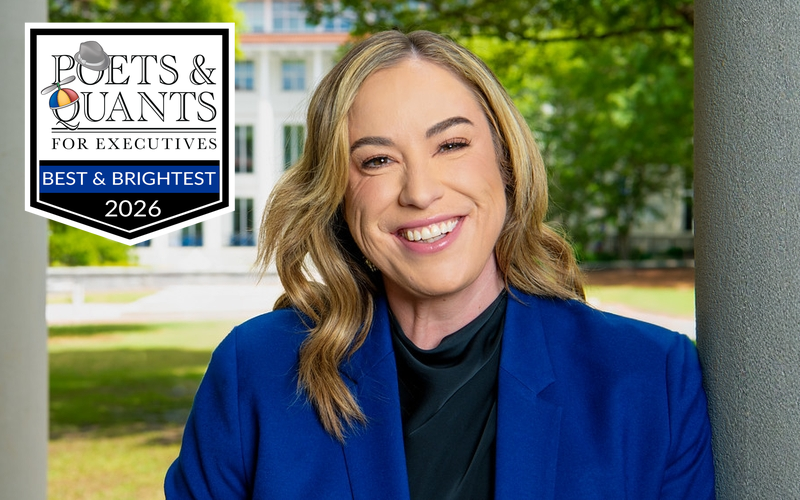
Alexis D. Smith, M.D.
Emory University, Goizueta Business School
Age: 45
“Versatile pediatric and adult trauma surgeon grounded in precision and compassion, driven by blue-sky thinking and magnetic energy.”
Hometown: Atlanta, GA
Family Members: My loving family consists of my parents – Stella and Gary; sister and best friend – Nikki and brother-in-law – Mike Steverson; my best boy and nephew – David; my partner and best friend – Max Gray; and the pups – Miley Cyrus the beagle and Nelson Gray, the maltipoo.
Fun fact about yourself: I lived in Thailand teaching English and I traveled all over the world as a wandering nomad prior to starting medical school
Undergraduate School and Degree:
Emory University, BS Neuroscience and Behavioral Biology
Wake Forest University School of Medicine, MD
University of Maryland School of Medicine- General Surgery
Brown University Alpert School of Medicine- Pediatric Surgery
Where are you currently working?
University of Arizona-Phoenix, Pediatric Surgeon
Emory University, Emergency General Surgeon
Northeast Georgia Medical Center- Trauma Surgeon
Extracurricular Activities, Community Work and Leadership Roles:
Trauma Medical Director, GQIP Georgia Trauma Commission (2025-2026)
Chair of Atlanta’s Regional Trauma Advisory Committee (2022-2026)
Trauma Medical Director, Children’s Healthcare of Atlanta (2017-2024)
Appointed Council Member to Atlanta’s Regional EMS Advisory Council (2024-2027)
Residency Education Site Director and Medical Student Surgery Clerkship Site Director, Children’s Healthcare of Atlanta, Morehouse University School of Medicine
Honorary Leadership Scholarship – Executive Women of Goizueta, Emory University Goizueta Business School (2025)
General Surgery Resident Teaching Award, University of Maryland School of Medicine
Alpha Omega Alpha (AOA) Honor Medical Society Inductee, University of Maryland School of Medicine
Excellence in Surgical Research Award, University of Maryland Department of Surgery
Which academic or extracurricular achievement are you most proud of during business school? My professional answer is that I had the opportunity to serve as the trauma medical director for the state of Georgia during my time in business school. I went into my Goizueta Executive MBA wanting to better marry financial strategy in healthcare to advocacy for improved access to trauma care, particularly for rural and underserved populations. This role gave me the chance to serve my home state while contributing to quality improvement and value-based care efforts.
But honestly, what I’m most proud of is serving as the social chair for my MBA class. That might sound less significant compared to an afternoon in the trauma bay, but I really loved bringing my talented group of classmates together. For our cohort, that meant creating opportunities for people to connect outside of the classroom: sharing ideas, introducing families, and building relationships that will last well beyond the program. My defining moment was organizing a yacht cruise around the Côte d’Azur for 150 classmates and their significant others. It was a lot to pull off, but it captured what made the experience so special for me: building a new family and community, not just a network.
What achievements are you most proud of in your professional career? I’m most proud of becoming one of the few pediatric surgeons in the country who also practices adult trauma and emergency surgery. I initially trained as an adult surgeon before specializing in pediatric surgery, and for nearly a decade I didn’t operate on adult patients. Over time, I realized I missed caring for that population in my community. Making the decision to return to adult surgery wasn’t easy – I ultimately left a full-time pediatric surgery position to bridge both worlds. There was no award or clear path for doing this. It was technically demanding, professionally unconventional, and required rebuilding a skill set I hadn’t used in years. Still, it has been the most rewarding decision of my career. Being able to care for patients across the full spectrum, from a premature infant weighing 800 grams to a 68-year-old trauma patient needing an emergent splenectomy, has reshaped how I think about surgery, responsibility, and impact.
Who was your favorite MBA professor? Charlie Goetz, my entrepreneurship professor. He reminded me that there is more to a career than simply climbing the ladder in healthcare or corporate America. Beyond my medical training and my MBA, he challenged me to see that I could use creativity to build something of my own. He pushed me to think beyond the expected and question the default path. This is something that has stayed with me well beyond the classroom.
Why did you choose this school’s executive MBA program? I graduated with my undergrad degree from Emory University in 2003. Thus, I had firsthand experience with the standard of educational excellence the institution holds itself to meeting. My undergrad education is credited for building a strong foundation for my career in pediatric and trauma surgery. More than twenty years later, returning felt less like a new decision and more like a continuation of something I deeply trusted. I considered other programs, but ultimately only applied to Goizueta Business School. What drew me back wasn’t just the academic rigor; it was the educational environment that Emory created and nourishes. As a neuroscience major during my first Emory degree, some of my most vivid memories weren’t in a business classroom. Instead, they were on the Goizueta lawn for Friday happy hour with my best friend, Andy, surrounded by students exchanging ideas about ventures, markets, and the future. Even then, I was struck by the energy of the Goizueta community: the sense that people there weren’t just there to study business, but they were actively thinking about how to build something meaningful.
What is the biggest lesson you gained during your MBA and how did you apply it at work? The biggest lesson I gained during my MBA was recognizing healthcare as an imperfect system – shaped as much by misaligned incentives and inefficient operations as by variation in clinical decision-making and unpredictable human behavior. As a surgeon, I was trained to focus on the patient on the operating table, but my Goizueta MBA forced me to zoom out and ask: why does the system produce the outcomes we see and how can we improve them?
I’ve applied this most directly in my work in trauma care and quality improvement. Instead of viewing delays, inefficiencies, or variation in care as isolated issues, I now approach them as process problems that can be measured, analyzed, and redesigned. I recently managed a challenging trauma case involving a young patient with a devastating pelvic injury and hemorrhagic shock, requiring four surgical teams to coordinate care across the trauma bay and operating rooms while transfusing over 60 units of blood products to save his life. The clinical care was complex, but the orchestration of people, resources, and timing was just as critical. Whether it’s improving time to intervention, coordinating multidisciplinary teams, or aligning incentives across departments, I’ve become much more intentional about building systems that support better outcomes per healthcare dollar spent. The shift has been from being a high-performing individual contributor to thinking like an operator – someone responsible not just for delivering care, but for designing the environment in which that care happens.
Give us a story during your time as an executive MBA on how you were able to juggle work, family and education? There was one weekend shortly after New Year’s that perfectly captured the balancing act. I couldn’t find coverage for pediatric surgery call, so I was simultaneously on service and attending class through one of my limited virtual passes. At the time, I was doing locums pediatric surgery, often bringing my family with me so I could stay connected to them while also taking on additional calls to help fund my executive MBA. That weekend in Arizona, I sent my family off on a group hike while I logged into class, knowing full well the day would be unpredictable. Between OR cases, an appendectomy and repairing traumatic injuries, I would scrub out, still in full surgical gear, and jump back into lectures. At one point, I logged in wearing a surgical cap, mask, and my operating glasses, which sparked a wave of reactions in the class chat.
It was chaotic, exhausting, and completely unsustainable in the long term, but also deeply clarifying. That night, I was able to get out of the hospital to meet my family for dinner after that relentless day, and I was reminded exactly why I had chosen this difficult path. The MBA wasn’t just about career advancement; it was about building a life where I could be present for both the patients I serve and the people I love.
What advice would you give to a student looking to enter an executive MBA program? For physicians and other healthcare providers considering it – do it! An executive MBA is one of the most powerful ways to step outside the clinical lane and reimagine your role in healthcare. It forced me to think beyond the bedside and OR and into systems, incentives, and leadership. I truly believe that if we want meaningful change in healthcare delivery, we need more physicians at the decision-making table, not just participating in the system but helping design it.
For everyone else: be intentional about how you experience the program. Choose an in-person or hybrid format if you can. The real value of an executive MBA isn’t solely the curriculum, it’s the people. The relationships you build become your sounding board, your future collaborators, and often your co-founders. Sitting in a room every other weekend with leaders from completely different industries challenged how I now think, expanded how I problem-solve, and ultimately made the experience far more transformative than I expected.
What was your biggest regret in business school? The easy answer would be that I should have taken more accounting and finance classes. I still want a deeper understanding of cost accounting in healthcare. However, my real regret is not launching a healthcare startup earlier in the program. Looking back, I wish I had taken full advantage of the founder-focused classes and used them to actively build something in real time. While I do think we will get there eventually, my future partners and I may have gotten more out of the experience had we had started sooner. More to come!
What is one way that your business school has integrated AI into your programming? What insights did you gain from using AI? AI was integrated into our coursework as a tool for problem-solving and decision-making, not just a topic of discussion. We used it to analyze data, pressure-test ideas, and streamline workflows across multiple classes. One of my favorite professors, Jill Perry-Smith, even started her course with an open dialogue on AI, where we collectively defined what acceptable use looked like in her class.
What I learned is that AI is powerful, but only as good as the questions you ask. It doesn’t replace critical thinking, it sharpens it. I’ve carried that mindset back into healthcare, encouraging my surgical residents to use AI to guide research projects, prepare M&M presentations, and tailor how they educate their patients.
Which MBA classmates do you most admire? I had the opportunity to be surrounded by high-performing, thoughtful, and driven classmates in the Goizueta MBA program. From former special operators transitioning to civilian life to operations experts who could dissect the healthcare system better than most physicians, I felt incredibly fortunate to learn alongside them. But the two classmates I admire most were my anchors during the program. Juliette Joseph brought a fearless nature, magnetic personality, and unwavering support. Drew Davis balanced humor with clinical integrity and hard work with a unique ability to love being equal parts surgeon and MBA mathlete.
What was the main reason you chose an executive MBA program over part-time or online alternatives? At a certain point in your career, it’s less about what you study and more about who you meet along the way. For me, the value of an executive MBA was the opportunity to be part of the Emory Goizueta community. I wanted to be in the room with people from different industries, learning from their experiences and building relationships in real time. That level of connection and shared experience is hard to replicate in a part-time or fully online format.
How did you finance your EMBA and what did you do to make tuition and associated costs more affordable? I financed my EMBA myself without taking on additional loans. After graduating from medical school with $275,000 in student debt, I made a deliberate decision not to go down that path again. To make it work, I took on additional call through locums pediatric surgery, often traveling to pick up extra shifts. It wasn’t always easy, but it allowed me to fund my education while maintaining financial discipline.
What is your ultimate long-term professional goal? Build a successful healthcare venture grounded in blue-sky thinking that redefines quality and value, then give back by donating my time to Doctors Without Borders.
DON’T MISS: BEST & BRIGHTEST EXECUTIVE MBAS: CLASS OF 2026
© Copyright 2026 Poets&Quants. All rights reserved. This article may not be republished, rewritten or otherwise distributed without written permission. To reprint or license this article or any content from Poets&Quants, please submit your request HERE.

