





Alice Liu
NUS Business School
Venture Name: dtcpay (Digital Treasures Center)
Date of Founding: 2019
Program: NUS Executive MBA Chinese
Tell us about your career background: I began my career in finance after earning a Bachelor of Finance degree from Shandong University of Finance and Economics. Before moving to Singapore in 2019, I spent seven years working in Hong Kong. During that time, I helped spearhead the establishment of China Minsheng Bank’s first overseas branch outside mainland China and served as a Managing Director for approximately six years. I subsequently became a Managing Director at a Hong Kong-listed company.
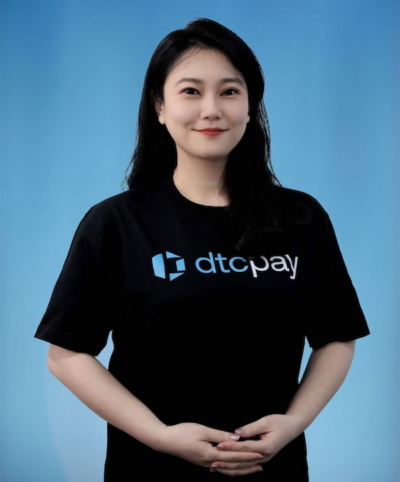 After relocating to Singapore, I enrolled in the NUS Executive MBA Chinese Program. During the program, I recognised a significant opportunity to modernise payments and co-founded dtcpay with my NUS classmate, Band Zhao. I have led the company as CEO since 2020.
What is your business/venture? Dtcpay is a Singapore-headquartered payment company that enables businesses and individuals to make and receive payments using both fiat currencies and stablecoins through a single, seamless platform.
The company was granted a Major Payment Institution licence by the Monetary Authority of Singapore in 2022. Today, dtcpay provides regulated payment services and omnichannel solutions, including online payments, mobile applications and point-of-sale services.
Our goal is to make digital payments more secure, efficient and accessible while bridging the gap between traditional financial infrastructure and the emerging digital-asset economy.
What inspired you to found this business? While studying at NUS, I saw the rapid development of e-money, blockchain technology and Singapore’s fintech ecosystem. At the same time, payment infrastructure remained highly fragmented. Businesses often had to rely on multiple systems, intermediaries and lengthy settlement processes.
I believed blockchain technology could improve the speed, security and cost-efficiency of payments, but any successful solution would also need to be regulated, trusted and practical for everyday business use.
That insight inspired my co-founder and me to create dtcpay: a payment platform that brings fiat currencies and stablecoins together within one compliant and user-friendly ecosystem.
Why did you enrol on the EMBA? After many years in banking and corporate leadership, I wanted to broaden my perspective beyond finance and prepare myself to build and lead a global business.
I chose the NUS Executive MBA because of its strong connection to Singapore and Asia, its international outlook and the diversity of its executive cohort. I wanted to learn alongside experienced leaders from different industries and cultures while gaining a more complete understanding of strategy, entrepreneurship, operations and organisational leadership.
How was the EMBA helped you/your business? The EMBA helped me move from thinking primarily as a financial executive to thinking as an entrepreneur and business builder.
It gave me a more structured way to evaluate opportunities, communicate a vision and make decisions involving strategy, people, operations and international growth. The diversity of the cohort also taught me to examine problems from perspectives beyond my own industry.
Most importantly, the programme connected me with people who shared the ambition to build something meaningful. I met my co-founder, Band Zhao, through NUS, and the ideas and relationships formed during the programme became an important part of Dtcpay’s foundation.
What’s the one thing about the EMBA that you think is undervalued? The most undervalued part of an EMBA is peer learning.
The academic content is important, but the experience and perspectives brought into the classroom by fellow participants are equally valuable. Each person approaches a problem through the lens of a different industry, market or culture.
For an entrepreneur, this becomes a trusted environment in which to challenge assumptions, test ideas and see the business through the eyes of customers, investors, regulators and employees. These relationships also continue long after graduation.
What’s next for your business? Our next chapter is about scaling Dtcpay internationally while keeping Singapore as our global headquarters and centre for technology, compliance, finance and strategic leadership.
Following our Electronic Money Institution licence in Luxembourg, we are expanding our European capabilities and building infrastructure to serve customers across the European Economic Area. We will also continue developing compliant payment solutions across Asia and other international markets.
At the same time, we intend to invest further in technology, local talent and partnerships, making stablecoin and fiat payments simpler and more useful for businesses in everyday commerce.
Would you recommend the EMBA to other entrepreneurs? If yes, why? Yes, particularly to entrepreneurs who are ready to question their assumptions and apply what they learn directly to their businesses.
An EMBA does not replace entrepreneurial experience, but it can be a powerful accelerator. It provides structured knowledge, access to experienced peers and a broader understanding of how different markets and organisations operate.
For me, the programme offered more than a qualification. It provided the perspective, relationships and confidence needed to transform an idea into a regulated, internationally growing business.
NEXT PAGE: Sally Lora, ESSEC Business School
© Copyright 2026 Poets & Quants. All rights reserved. This article may not be republished, rewritten or otherwise distributed without written permission. To reprint or license this article or any content from Poets & Quants, please submit your request HERE.

