




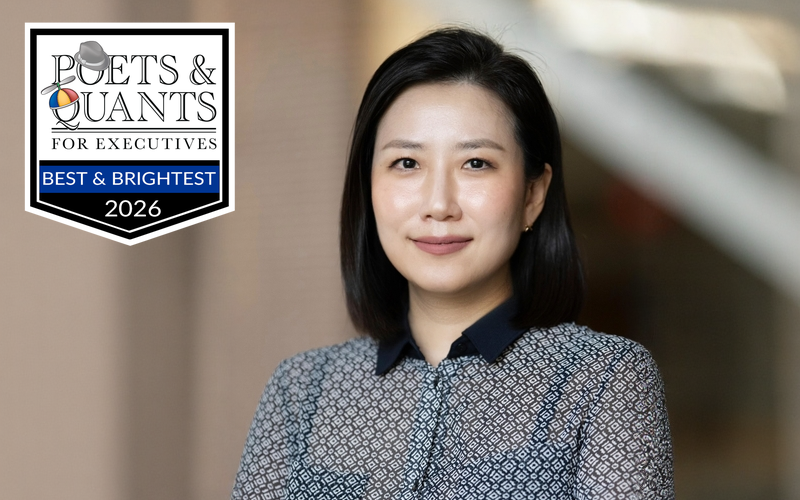
Jay Moon
Southern Methodist University, Cox School of Business (SMU Cox)
Age: 47
“UX designer turned business student, learning to start over with curiosity and courage.”
Hometown: Allen, Texas (originally Seoul, South Korea)
Family Members: Husband, a 16-year-old daughter, and a 12-year-old son
Fun fact about yourself: Three days into orientation, I dropped out of the EMBA program. My English felt nowhere near good enough, and I was sure I would not be able to keep up. I quietly withdrew. But the night before the first class, I could not shake the feeling that I might regret this for the rest of my life. I felt ashamed of myself for walking away before I even tried. So, I made the decision to go back the night before classes started, and I never looked back. Two years later, I received the Beta Gamma Sigma academic honor. Sometimes the best decisions look like bad ones at first.
Undergraduate School and Degree: B.E. in Electrical, Electronics and Communications Engineering, Kyung Hee University, Seoul, South Korea (Mar 1998 to Feb 2002) Executive MBA, SMU Cox School of Business, Class of 2026
Where are you currently working? Currently on a career break. Previously Principal Designer and UX Director at Samsung Electronics (Seoul, South Korea) for over 21 years, leading AI and UX teams across products including Bixby, Samsung Pay, and Samsung Knox. (Note: UX = User Experience)
Extracurricular Activities, Community Work and Leadership Roles:
VC Practicum with Interlock VC, evaluating early-stage startup pitches and investment opportunities
Strategic Consulting Practicum, working with Siemens as a real client on a business strategy engagement
Global Leadership Program (GLP), project with a major insurance client in Argentina
Beta Gamma Sigma Honor Society inductee
Which academic or extracurricular achievement are you most proud of during business school? Being nominated for this Best & Brightest honor still feels a little unreal to me. But the achievement I am most proud of is simply staying in this degree program.
I joined the EMBA program and dropped it three days later. My English was not where I needed it to be, and the thought of keeping up with a room full of experienced executives felt overwhelming. I quietly withdrew.
But the night before the first class, I could not stop thinking about it. The feeling that I might regret this for the rest of my life would not go away. I felt ashamed of myself for giving up before I even started, so I went back. The night before classes began, I re-enrolled, and I never looked back.
What followed were two years that I will never forget. Not just because of the coursework or the projects, but because of the people around me. My classmates knew I was struggling with the language. Instead of making me feel like I did not belong, they made me feel safe. Before presentations, they would tell me, “Just go out there and mess it up. That is the fastest way to learn. And if you do, we have got you.” They meant it every time.
I still find it hard to raise my hand in class the way others do. Jumping into a fast discussion in English is not easy for me. But I showed up every week, I did the work, and I found people who believed in me before I believed in myself. That is something that no amount of money can buy.
I am grateful for having the grades to be inducted into Beta Gamma Sigma. But my decision to walk back in the door of the EMBA program is what I am most proud of.
What achievement are you most proud of in your professional career? I started as a UX designer at Samsung in 2010 and began leading a team as a UX manager in 2013. Over those years, I had the chance to work on projects that were genuinely new territory, leading UX direction across AI, automation, fintech, and e-commerce for Samsung mobile devices.
The project I think about most is Bixby. It was one of the most complex things I have ever been part of. It involved multiple divisions within Samsung, including mobile, appliances, and TV, along with overseas stakeholders and the integration of an AI company Samsung had acquired in the Bay Area. In the early stages, there were a lot of conflicts and disagreements about the direction. People had very different ideas about what this product should be.
What I am proud of is that we got through it. Through a lot of honest conversations and some hard decisions, we eventually landed on a unified concept that everyone could move forward with. That process taught me more about leadership than almost anything else in my career.
One of the hardest parts of UX work is finding the balance between what you wish you could build and what the technology actually allows right now. You are constantly making judgment calls about what to prioritize, what to hold for later, and what the user truly needs today versus what can wait. I learned to make those calls with more confidence over time, and I learned to bring my team along in that thinking rather than just handing down decisions.
Looking back, what I value most is not any single product. It is that my team cared about the people using what we built, and that we kept asking what would actually make their lives better. That is the standard I still hold myself to.
Who was your favorite MBA professor? Honestly, it is hard to pick favorites. Every professor I had left something with me, and I do not think there was a single one I could call forgettable. Each of them gave me something I did not have before.
If I had to name a few, Professor Susan Riffe and Professor Jim Linck both stand out from the very beginning of the program. I came in with almost no background in accounting or finance, and I was behind, and I knew it. Both of them had a way of making me feel like it was okay not to know yet. They believed in me even when I was not sure I deserved it, and they gave me the courage to keep going at a time when I really needed courage. The foundation they built for me made everything else in the program possible.
Professor Harvey Rosenblum is someone I also cannot leave out. He gave genuinely personal feedback on every assignment, and he had this way of encouraging me that felt real, not like something he said to everyone. He once told me something that I know I will carry with me for the rest of my life. I will not try to capture it here because it would not do it justice. But I think about it often.
Why did you choose this school’s executive MBA program? I moved from Seoul to Allen, Texas three years ago when my husband was relocated for work. I had spent over two decades building a career in Korea, and suddenly I was starting over in a new country without a job and without a professional network here.
I already knew SMU Cox had a strong reputation and a network that people talked about. But what drew me most was the chance to be in a room with people who had real work experience and real stories. I wanted to learn from the people sitting next to me just as much as from the faculty.
I also needed to build a new life here in Texas. SMU Cox and the EMBA program gave me a place to start doing that.
What is the biggest lesson you gained during your MBA and how did you apply it at work? The biggest lesson I learned is that being uncomfortable means you are in the right place.
For most of my career at Samsung, I was the one who knew the domain, knew the team, and knew how things worked. The EMBA program changed that. I became the person who needed help understanding basic finance terms, who had to lean on classmates to catch things I missed in a lecture.
That experience reminded me how much real learning requires you to let your guard down. And I realized I had not felt that way at work in a very long time.
Now, as I think about what comes next, I lead with more curiosity and less certainty. I ask more questions before giving answers. I try to create space for others to be the expert. That shift has made me a better collaborator and a better listener.
Give us a story during your time as an executive MBA on how you were able to juggle work, family and education? I was not working during the program, which some people might think made things easier. But being on a career break brought its own kind of weight. Financial pressure, uncertainty about my identity, and the feeling that I had given up my career to be here, so I had better make it worth it.
My husband took on a lot more on weekends so I could focus. My kids helped in ways I did not expect. My daughter would listen to me rehearse presentations and quietly fix my pronunciation. My son would just sit next to me while I worked, keeping me company without saying much.
The night before one of my bigger presentations, I was running through my script at the kitchen table for the fourth time. My daughter looked up and said, “Mom, you have got this. Just say it like you mean it.” I held on to that for the rest of the program.
It was not easy. But it was a team effort, and that made it mean more to all of us.
What advice would you give to a student looking to enter an executive MBA program? Just do it. Do not wait until you feel ready, because that moment may not come.
I dropped out before the first class. I thought I was not ready. My English felt insufficient. The finances were tight. The timing did not feel right. Every one of those concerns was real, and none of them should have stopped me.
The program will be hard. There will be weeks where you feel behind or wonder why you signed up. That is completely normal. Keep going.
The two years I spent in this program were the most valuable of my life. I met people who changed how I think. I learned things that changed how I work. And I found things about myself that I could not have found any other way. If you are on the fence, that is probably a sign you should go.
What was your biggest regret in business school? I did not reach out to enough people.
I know how that sounds from someone in an MBA program, which is partly one long opportunity to build relationships. But my language barrier made me cautious. I worried about being misunderstood or saying something awkward, so I stayed in my comfort zone more than I should have.
There are classmates I respected from a distance and never properly got to know. There were conversations I did not start because I was afraid of stumbling over my words.
I am still working on that. But if I could go back, I would push myself to reach out more, to be okay with imperfect sentences, and to trade a little awkwardness for better relationships.
What is one way that your business school has integrated AI into your programming? What insights did you gain from using AI? SMU Cox was thoughtful about how it brought AI into the program. Rather than banning it or pretending it did not exist, the school encouraged us to use AI for things like research, presentation development, and scenario analysis. At the same time, the school asked =us to clearly document how we used it and what role it played. That transparency requirement turned out to be more useful than the tools themselves.
There were also a lot of classes dedicated to understanding AI from a business strategy perspective, looking at how companies are building AI into their core models and what that means for competitive advantage. That side of the curriculum was genuinely eye-opening for me.
The insight I keep coming back to is that AI is not a shortcut. It is a thinking partner. The students who got the most out of it came in with a clear point of view and used AI to sharpen it. The quality of the output really does depend on the quality of the thinking going in.
For me, this hit differently than it might for others, because I spent years building AI products at Samsung. Coming back to it as a user gave me a new appreciation for how much the experience design still matters. Even a very capable AI feels frustrating if it is not designed around how people actually think.
What was the main reason you chose an executive MBA program over part-time or online alternatives? I needed to be in the room.
Online programs are convenient and I understand why they work well for many people. But I came here as someone new to Texas, new to the professional culture in the U.S., and still finding my footing in English. I needed the experience of being physically present with people who had real careers and real perspectives.
The EMBA format gave me that: the weekend residencies, the team projects, the late nights working through a case together. That is where the real learning happened for me. You cannot get that from a screen.
I also needed the accountability. Knowing I had to show up in person every few weeks kept me going during the weeks when staying home felt like the easier option.
How did you finance your EMBA and what did you do to make tuition and associated costs more affordable? My husband supported the program financially. That is the honest answer and I want to say it plainly.
I had no income during this time. My husband covered tuition each semester, which was not easy. There were semesters where we sold investments and pulled from savings to make it work. We did not have a tidy financial plan. We had a commitment and we figured it out as we went.
I carry that with me. Every class I attended and every assignment I finished was also, in some way, a thank you to my family. Graduating is not just my achievement. It belongs to all of us.
What is your ultimate long-term professional goal? I want to build something that matters, and I want to do it here in Texas.
In the near term, I am looking for a senior leadership role where I can bring together my background in AI and product experience with the business strategy skills I built at SMU Cox. I am drawn to roles where technology and business transformation meet, whether in mobile and AI, in private equity or venture capital as an operating partner, or in strategic consulting.
Long term, I want to reach the C-suite. Not for the title, but because I want to be in a position to shape how organizations think about technology and the people who use it.
And someday, when that chapter is done, I would love to teach. I have been given a lot by people who believed in me when I did not believe in myself. I would love to pass that on.
DON’T MISS: BEST & BRIGHTEST EXECUTIVE MBAS: CLASS OF 2026
© Copyright 2026 Poets & Quants. All rights reserved. This article may not be republished, rewritten or otherwise distributed without written permission. To reprint or license this article or any content from Poets & Quants, please submit your request HERE.

