




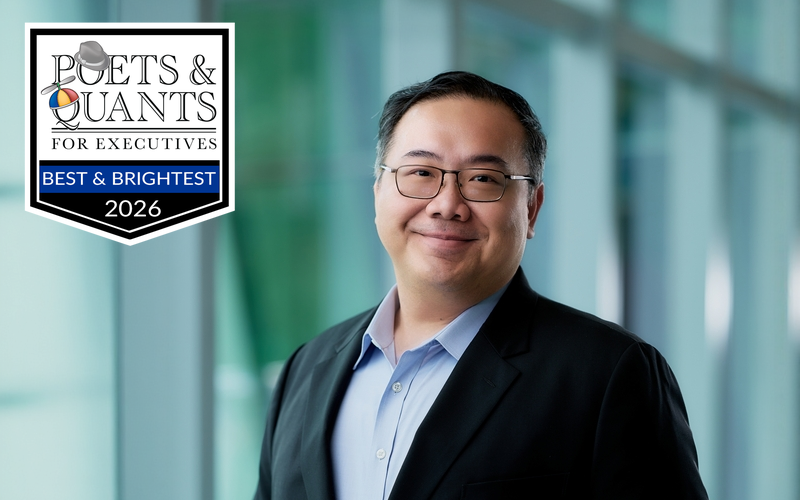
Johan Gozali
National University of Singapore – The NUS Executive MBA
Age: 46
“Coffee-loving systems thinker, adaptive learner, and people-first leader building tech for public good.”
Hometown: Singapore
Family Members: Wife of 20 years and teenage son.
Fun fact about yourself: Originally planned to study medicine, pivoted to computer science which turned into a 25-year career in tech.
Undergraduate School and Degree:
Bachelours of Computing, National University of Singapore
Masters of Science (Computer Science), National University of Singapore
Where are you currently working? Director at GovTech Singapore
Extracurricular Activities, Community Work and Leadership Roles:
During undergraduate studies: 1st Prize in Startup@Singapore Business Plan competition. Made Vice Chancellor’s List and on Dean’s List for four consecutive semesters. Received Outstanding Mentor Award at Republic Polytechnic when I taught there. Mentored at the Centre for Computing for Social good and Philanthropy (CCSGP) at the National University of Singapore.
Which academic or extracurricular achievement are you most proud of during business school?
I’m most proud of contributing with my EMBA classmates to an ESG discovery tour that brought together NUS EMBA students, children from The Hut (a non-profit in Singapore supporting children from vulnerable backgrounds) and HMGICS (Hyundai Motor Group Innovation Center Singapore) to inspire underprivileged children through innovation, sustainability education, and community engagement.
What achievement are you most proud of in your professional career? Throughout my professional career, what I’m most proud of is building teams and capabilities that continue to create impact beyond my direct involvement. Whether at Meta/Facebook, LinkedIn, Linden Lab, and now at GovTech, I take pride in building teams, developing leaders, and creating impact for millions of people and organizations. The common thread is not just delivering technology and scaling operating models, but also nurturing talent and creating teams for the future.
Who was your favorite MBA professor? Dr Prem Shamdasani. He is inspiring and deeply engaging, and he helped me see marketing through a new lens: not simply as branding, communications, or promotion, but as a strategic function that shapes how organizations understand customers, create value, and make better business decisions.
Why did you choose this school’s executive MBA program? It was because of the NUS Executive MBA’s focus on Asia, giving unparalleled access to insights and leaders across Asia.
What is the biggest lesson you gained during your MBA and how did you apply it at work? This is a hard question to answer since I’ve learned and gained much from the EMBA program and have applied it to work in many ways. One practical framework I learned was on how to develop and execute strategy. I find it quite relevant for my work.
Give us a story during your time as an executive MBA on how you were able to juggle work, family and education? I wouldn’t say I was able to juggle work, family, and the demands of the MBA program. There’s only 24 hours in a day and 7 days a week. Often, I had to work through weekends to make up for time that I needed to complete assignments and group projects. I wouldn’t be able to have done all that without the support of my family, colleagues, and management.
What advice would you give to a student looking to enter an executive MBA program? Take time to get to know your peers. I got to learn a lot from my classmates, and they made the journey more enjoyable.
What was your biggest regret in business school? Not taking more time to take classes while I still can.
What is one way that your business school has integrated AI into your programming? What insights did you gain from using AI? I can’t recall a course in the EMBA program that did not use AI in some form as part of the course delivery. A key insight in using AI for learning is that we get out of it what we put in. If we do a lot of upfront thinking and analysis, and engage AI to refine our analysis, we would get more than if we were to use AI to the analysis for us.
What was the main reason you chose an executive MBA program over part-time or online alternatives? It was because the NUS EMBA program includes immersive learning where we travel to countries in Asia to meet businesses and organizations and learn from them directly their challenges and how they overcome them.
How did you finance your EMBA and what did you do to make tuition and associated costs more affordable? I self-financed my EMBA, and what made it possible was careful financial planning and budgeting. The school provided options and recommendations for hotels that helped me manage my costs.
What is your ultimate long-term professional goal? My long-term professional goal is to be of service to the communities around me by using technology for public good. I want to develop leaders, teams, and capabilities that outlast my own role, creating a lasting legacy through people, institutions, and systems that continue to serve society well.
DON’T MISS: BEST & BRIGHTEST EXECUTIVE MBAS: CLASS OF 2026
© Copyright 2026 Poets & Quants. All rights reserved. This article may not be republished, rewritten or otherwise distributed without written permission. To reprint or license this article or any content from Poets & Quants, please submit your request HERE.

