




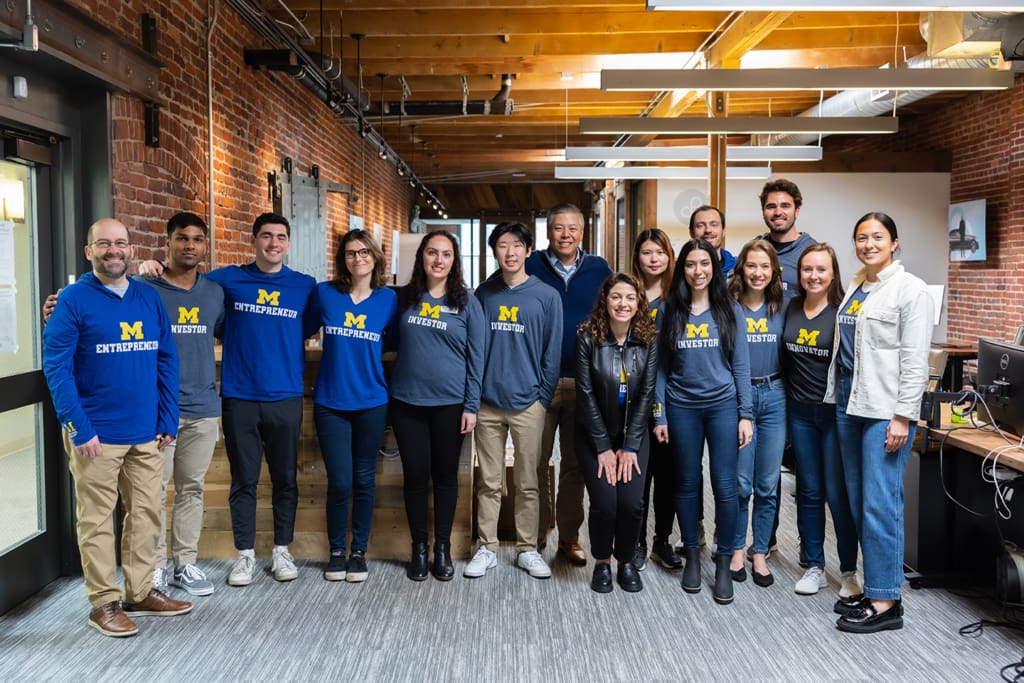
University of Michigan student entrepreneurs and investors gather during the Ross School of Business’s Silicon Valley Experience, which connects aspiring founders with alumni, mentors and venture capital professionals. Contributed photo
MICHIGAN ROSS: A FOUNDER POWERHOUSE REACHES NO. 4
University of Michigan Ross School of Business climbed two spots to No. 4 in this year’s ranking, but its most impressive showing came in the percentage of graduates pursuing entrepreneurial ownership within three months of graduation. It also happens to be the metric weighted the most in our ranking, or 25% of the total score.
Ross reported a five-year average of 25%, the highest among all 28 participating schools.
Ross also reported that 86% of its full-time MBAs had direct involvement with a startup or startup project during the academic year while97% took at least one entrepreneurship elective.
“What sets us apart is the depth of the Michigan ecosystem. Founders gain access to a world-class research university, a global alumni network of more than 710,000 people, and a community invested in helping entrepreneurs succeed,” says Gregg Latterman, executive director of Ross’ Zell Lurie Institute for Entrepreneurship.
“Ultimately, we want students to leave with more than a business plan. We want them to have the relationships, develop an entrepreneurial mindset, and resources to continue their business venture if that is their path.”
FROM IDEA TO OPERATING BUSINESS

Gregg Latterman, executive director of the Zell Lurie Institute for Entrepreneurship
Michigan Ross’ bias toward action permeates through its approach to entrepreneurship. Students are encouraged to move beyond business plans, test their ideas in the market and tap into a broad network of mentors, investors and university resources to turn promising ideas into operating ventures.
Take Ryan McManus, MBA ’25, founder of Sceptre Surgical, a medical device startup to address difficult-to-treat orthopedic implant infections. McManus refined his business model and pitch through the Zell Lurie Institute for Entrepreneurship’s Zell Entrepreneurs program. The institute helped him work through the preclinical development process, secure early grant funding for prototyping, and connected him with professionals who later joined his advisory board.
He has since been accepted into Plug and Play’s Healthtech Accelerator and is working toward FDA approval, with continued mentorship from Zell Lurie.
Jaenelle Lauture, MBA ’26, drew on many of the same resources to develop Krik Krak, an early literacy venture helping parents reinforce classroom reading instruction at home. Through Zell Entrepreneurs, she gained mentorship and access to investors, while the Social Venture Fund and Michigan Business Challenge helped sharpen her business model. She is now testing the venture’s approach through pilots and partnerships.
The founder’s journey for Ryan Lynn, MBA ‘26, started by talking with professors during office hours. The Opportunity Validation Program challenged some of his early assumptions while helping him assess market potential. Mingle ‘n’ Match events helped in his search for potential co-founders, while Startup Studio offered hands-on support in product development, customer discovery and customer acquisition.
Lynn, in fact, took advantage of nearly every stage of Ross’ ecosystem, from Dare to Dream to the three-month Summer Student Accelerator to the seven-month Desai Accelerator.
“The Silicon Valley Experience was probably the experience that impacted me most,” Lynn says. “It introduced me to current students across all of U-M’s programs, and very successful alumni founders and investors. Those interactions gave me practical advice, ongoing mentorship I still rely on, and friendships that have lasted well beyond the program.”
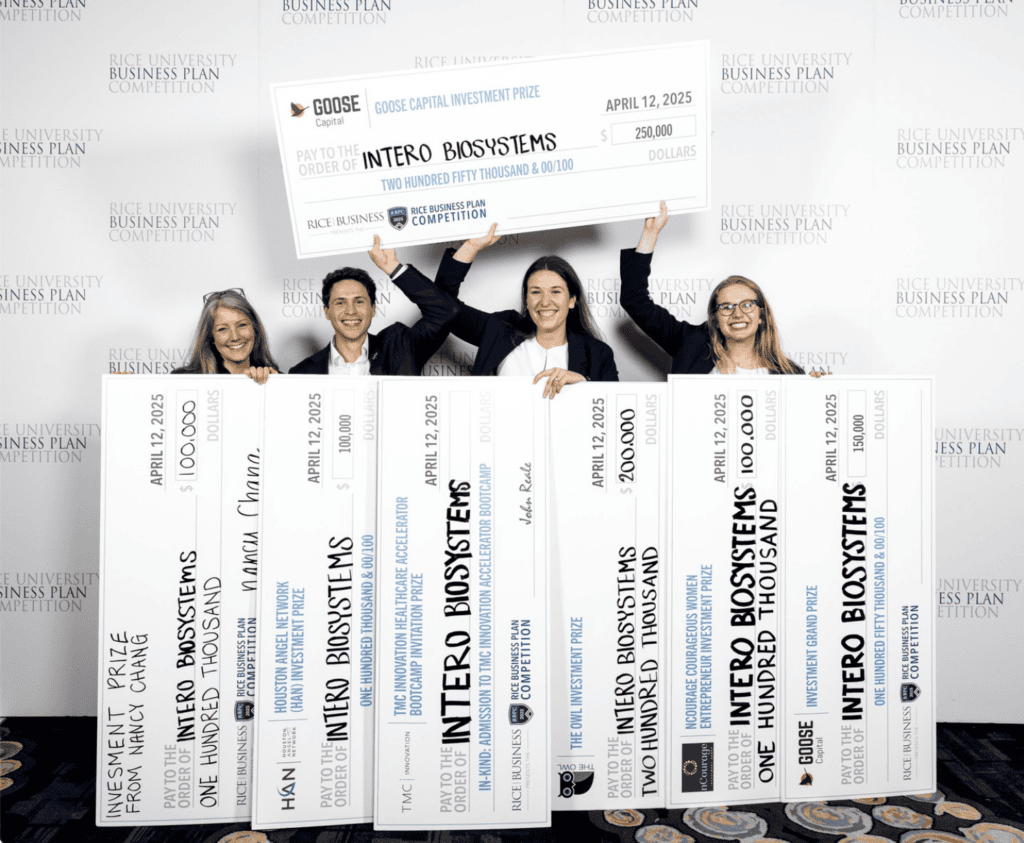
The Intero Biosystems team celebrates its success at the 2025 Rice Business Plan Competition. The University of Michigan startup, which includes Ross MBA Don Sobell, won more than $900,000 in prizes and investments. Contributed photo
WHAT’S NEW & NEXT
Ross is expanding the pathways available to aspiring entrepreneurs while introducing entrepreneurship to students earlier and more broadly, Latterman tells P&Q.
Initiatives such as 10,000 Pitches and the Moonshot Speaker Series aim to reach students who may not yet see themselves as founders. Meanwhile, the Accelerate Blue Foundry connects aspiring entrepreneurs with promising University of Michigan research across more than 100 top-10 disciplines.
Another example Michigan’s interdisciplinary entrepreneurship ecosystem is Intero Biosystems, a venture bringing together talent from the university’s medical, engineering and business schools. The company developed the first the first cell-derived human “mini gut,” replicating the human intestine.
Since last year, the team, which includes Ross MBA Don Sobell, has won more than $1 million in competition awards, including a major prize at the Rice Business Plan Competition. It has raised another $1 million-plus from investors and secured a $600,000 pilot with a major pharmaceutical company.
Ross is also expanding its entrepreneurship through acquisition (ETA) offerings while helping students pursue entrepreneurial roles at established startups and high-growth companies through its Launch&Learn workshop series.
In the AI space, ZellBot, an AI-powered idea-validation tool developed with Google, has helped validate more than 200 ideas, while AI hackathons let students build working prototypes in hours, without coding experience. The school’s Zell Lab for Technologies is also exploring how AI is changing user interfaces and conversational experiences.
“One of our biggest priorities is developing a more robust university-wide mentorship network that connects students with experienced founders, investors, executives, and innovation leaders,” Latterman says.
“We know that some of the most transformative learning happens through relationships with people who have actually built, led, invested in, and grown businesses.”

A mentor advises a student team at Cornell Tech, where the Studio curriculum emphasizes hands-on product development, customer discovery and feedback from experienced entrepreneurs and industry professionals. Contributed photo
CORNELL TECH: AN AI-FIRST MBA FOR ENTREPRENEURS
Cornell’s Johnson Cornell Tech MBA slipped one spot to No. 5 in this year’s ranking, but led all 28 participating schools in the ratio of entrepreneurship mentors to MBA students, with 5.49 per MBA. The school also reported 100% direct startup involvement, 97% participation in entrepreneurship electives and a five-year entrepreneurial ownership average of 13.8%, tied for sixth highest.
Launched in 2014, the one-year MBA puts entrepreneurship and technology at the center of its curriculum. About half of students in recent entering cohorts say they enrolled to start or manage a business, according to Manoj Thomas, associate dean of New York City initiatives.
But the goal extends beyond startup founders. Cornell Tech aims to develop a “builder mindset” that graduates can apply whether they launch ventures, join technology companies or pursue consulting and finance careers.
WHERE MBAs BUILD REAL VENTURES
Cornell Tech’s interdisciplinary Studio curriculum puts MBAs alongside engineers, lawyers and other graduate students to develop products.
All MBAs take Product Studio in the fall, developing and testing new concepts. Aspiring founders can advance to Startup Studio in the spring, assembling teams, building prototypes, testing ideas with customers and pitching investors. Along the way, industry advisers, coaches and New York City entrepreneurs provide feedback through Maker Days and other events.
Students can also take entrepreneurship electives, participate in Big Red Ventures, Cornell’s early-stage venture capital fund, or spend the summer building startups through an accelerator.
At its May 2026 Startup Awards, more than 30 teams competed for funding. Four won investment packages valued at $100,000 each, including three with Johnson Cornell Tech MBA founders.
Among them was Custos, founded by Carlos Guerrero Spota, MBA ’26, and Chloe Wang. The startup develops programmable spending controls that allow businesses to delegate financial transactions to AI agents while maintaining oversight.
But customer discovery revealed that while many companies wanted AI agents, they didn’t know how to build them. Custos began developing the agents itself, turning customer feedback into a new product offering and sales strategy.
Another winner, Aiseptor, led by Akshay Aggarwal, MBA ’26, is developing software to prevent AI-assisted cheating during high-stakes exams by blocking unauthorized tools on candidates’ devices.
Winning teams also receive continued mentorship and workspace through Cornell Tech’s Runway program.
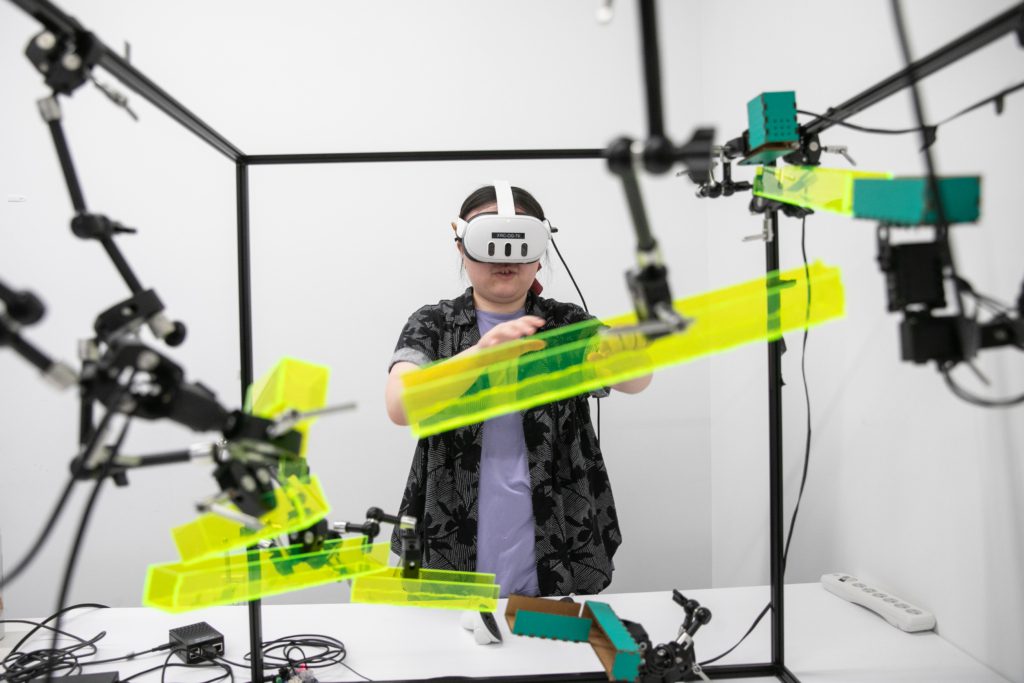
A student presents their VR project in the XR Collaboratory during Cornell Tech’s Startup Awards + Open Studio in 2025.
AI BECOMES THE FOURTH TEAM MEMBER
Cornell Tech has expanded its AI curriculum over the past two years, adding Demystifying AI Technologies, reworking its Data Analytics and Modeling with AI course, and introducing an AI opportunity bootcamp. AI tools are now embedded throughout the Studio curriculum, from research through product launch.
One of the most visible changes is the size of student teams. In Product Studio, teams have shrunk from five students to three, reflecting how much work AI can now help them accomplish.
“AI has made building cheap. What students need now is judgment about what to build, frequent feedback, and teams small enough that everyone builds,” says Josh Hartmann, Cornell Tech’s chief practice officer and an associate teaching professor at the Johnson School.
Thomas sees the same builder mindset becoming increasingly valuable beyond entrepreneurship. Where consultants once relied heavily on recommendations and presentations, they are now expected to demonstrate solutions through working AI agents.
WHAT’S NEW & NEXT
Cornell is also expanding entrepreneurship resources across its campuses.
In July, the university appointed Professor Matt Marx as vice provost for entrepreneurship, innovation and external engagement. He will also establish and lead a new Cornell Center for Entrepreneurship and Innovation, bringing together entrepreneurship programs, venture-development resources and technology commercialization offices across Cornell’s Ithaca, New York City and medical campuses.
At the MBA level, Cornell Tech plans to add a Venture Capital and Private Equity course in 2027–28, helping students understand how ventures are funded and scaled from both founder and investor perspectives. A new course also connects Johnson Executive MBA students with startups in Cornell Tech’s Runway program, pairing experienced executives with emerging ventures.
DON’T MISS OUR FULL 2027 MBA ENTREPRENEURSHIP RANKING PACKAGE:
- Poets&Quants’ 2027 World’s Best MBA Programs For Entrepreneurship
- The Methodology Behind P&Q’s 2027 MBA Entrepreneurship Ranking
- All Of The Data Behind P&Q’s 2027 Top MBA Programs For Entrepreneurship
© Copyright 2026 Poets&Quants. All rights reserved. This article may not be republished, rewritten or otherwise distributed without written permission. To reprint or license this article or any content from Poets&Quants, please submit your request HERE.

