





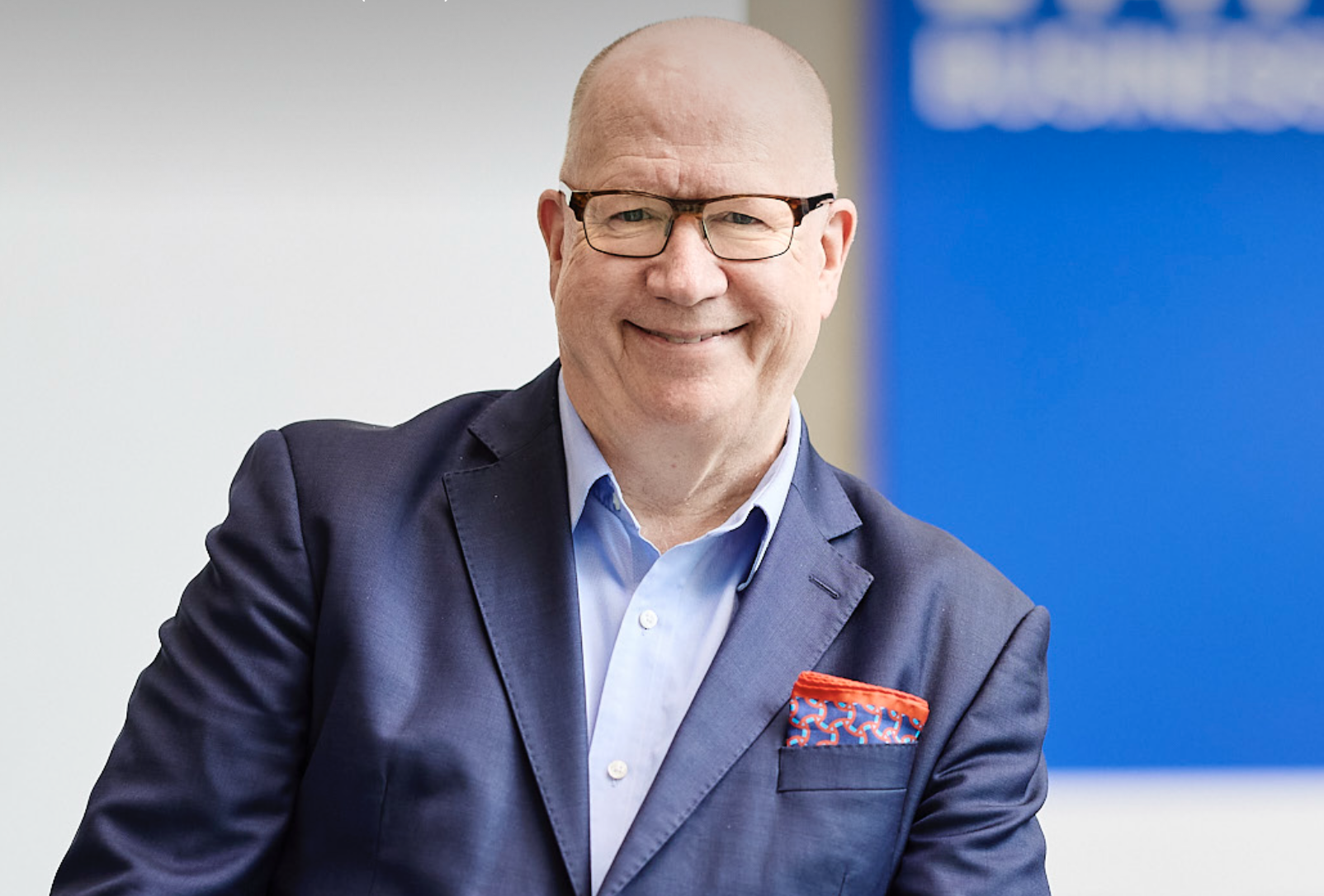
Imperial Business School Dean Peter Todd. Courtesy photo
This article originally appeared in Ambition, the flagship publication of AMBA, a global accreditation body that has been evaluating business schools around the world for almost 60 years. It has 300 members across 57 countries.
Appointed dean of Imperial Business School last September, Peter Todd talks to Ambition editor Colette Doyle about the importance of creating mindful, forward-thinking leaders and why the world will always need “useful” people.
Tell us about your background and how you came to take up the role at Imperial Business School.
“I’m an accidental academic. I’m a first-generation university student – my academic journey began at McGill University in Canada. Before that, I had a few jobs, including one at a cement plant in British Columbia – an experience that, I expect, grounded me in the realities of work. It also helped me pay my way through school.
“I was lucky as a young academic to work at great universities in Canada and the US with excellent mentors and role models. Since then, I’ve had the privilege of holding leadership roles across North America and Europe, including serving as dean at HEC Paris before coming to Imperial.
“What drew me to Imperial was its unique position as a great business school embedded in one of the world’s leading STEMB (ie STEM plus business) universities – and the only school of that type in Europe. That intersection of science, technology and business is incredibly powerful. I saw an opportunity to help bridge those worlds, to bring business thinking into scientific innovation and help Imperial bring science to humanity.
“I’ve found that the culture here, which incorporates a focus on excellence with a desire to be useful, has only deepened my belief that this is a place where we can do something truly distinctive to address global challenges.”
What have been some of the highlights of your career to date?
“I’ve been fortunate to work with some truly remarkable institutions and people. Leading HEC Paris through a period of transformation was certainly a highlight, as was overseeing the launch of a major fundraising campaign while there.
“What I find most rewarding is helping build institutions that matter – places that are academically rigorous but also connected to the world around them. Whether it’s launching new interdisciplinary initiatives, enhancing programme portfolios, or mentoring students and faculty, the greatest reward is to help people make an impact.
“Now, at Imperial, I see the opportunity to take that to another level: it’s an institution that was founded with the explicit mission to “be useful”. With its critical mass of STEM expertise, coupled with the deep and engaged knowledge of its business school, it is poised to provide important answers to grand challenges such as climate and sustainability and the impact of AI, as well as the creation of healthy and resilient societies.
“A great example of this is the work being done through our Centre for Health Economics & Policy Innovation, which brings together world-class research to inform better healthcare policy and delivery. It’s this kind of impact-driven, interdisciplinary work that makes Imperial such a powerful platform for change.”
Do you believe that in the 21st century, with the rise of alternative providers such as LinkedIn and Coursera, the MBA is still able to stand out and distinguish itself in the marketplace?
“Absolutely. The MBA remains a powerful and relevant qualification, but it must continue to evolve. At Imperial, we already offer a distinctive MBA programme that reflects our strengths as a world-leading STEM university. It’s designed to develop mindful, forward-thinking leaders who are equipped to navigate an increasingly digitalised and complex business world. It also adapts to the needs of different learners with full time offerings, a weekend programme and, of course, our world-leading global online MBA.
“What we’re focused on now is enhancing that distinctiveness, deepening the integration of technology, innovation and sustainability into the learning experience. We’re also working to embed the programme more fully across the university, strengthening alignment and collaboration with our STEM faculties. That cross disciplinary ambition allows us to bring even more of Imperial’s scientific and technological expertise into the MBA, enriching the experience and ensuring it reflects the science-dominated context in which businesses themselves are operating.
“We’re not trying to replicate what others are doing, we’re doubling down on what makes us unique: a rigorous, cross-disciplinary education with a strong science, innovation and entrepreneurship edge that prepares students to lead with purpose and impact in a rapidly changing world.”
How has management education evolved since you started teaching at Queen’s University in Canada in the late 1980s?
“Dramatically. When I started, you were in a classroom the whole time – or, at least, it felt like it – you focused on your chosen discipline and you thought about things in terms of traditional business functions.
“Today, half the time, you’re trying to get students out of the classroom, interdisciplinarity is seen as a strength – especially at somewhere like Imperial, for all the reasons I’ve mentioned – and everybody kind of expects that functions will evolve.
“In more practical terms, there’s also been a big shift towards project-based learning by doing; today’s students are digitally native in a way they generally weren’t in the 1980s, plus there’s a much greater emphasis on societal impact. Students are no longer just looking for jobs – far more often than they were, they’re looking to create them. They want to make a difference – they’re seeking purpose. That means we, as educators, need to give them the tools to think critically, collaborate effectively and adapt to uncertainty.”
We hear so much nowadays about diversity and inclusion, as well as the concept of ‘belonging’; how can schools best train the next generation of managers and entrepreneurs to implement DEI practices in a responsible manner?
“Diversity isn’t just a value; it’s a strategic imperative. What I have come to appreciate over time is that every institution I have been a part of has become more diverse and, through that, has become better. Imperial is the UK’s most international university, so we’re an embodiment of the advantages brought about by diverse perspectives. We need to continue to shape environments where people feel they belong, where they’re respected and where they can thrive.
“That starts with culture. Culture isn’t built through grand statements; it’s built through daily actions, through how we treat one another, how we collaborate and how we lead. Our role as educators is to model inclusive leadership and to equip our students with the mindset and skills to build inclusive organisations of their own.”
What has becoming AMBA-accredited meant to your school?
“AMBA accreditation is an important marker of quality and global recognition. It affirms that our programmes meet rigorous international standards and that we’re committed to continuous improvement. But more than that, it aligns with our ambition to be a top-tier, globally relevant business school.
“The process itself is constructive. It’s not just about meeting criteria; it’s an opportunity to benchmark ourselves against other leading institutions, to learn from our peers and to reflect on how we can continue to improve. We find the feedback from accreditation panels extremely valuable, while our faculty who serve as panel members at other schools also gain a great deal from seeing examples of best practice in different contexts. It’s a two-way learning process that strengthens the entire sector.”
The impact of AI and other generative algorithms such as ChatGPT on postgraduate management education has been well documented – what’s your take on it at Imperial?
“AI is already reshaping how we teach and how students learn, as well as how institutions operate; we’re embracing that change even if, like many, we’re still finding our way. The real opportunity lies not just in adopting new tools, but in rethinking how we design learning experiences and integrate AI. If today’s students are digitally native, tomorrow’s must be AI-native. AI challenges us to adapt our teaching and assessment methods to reflect the changing complexities of the world. But, more importantly, we need to help students use the technology to leverage their human advantage.
“We’re building AI into our programmes in ways that enhance, rather than replace, human judgment, creativity and collaboration. It’s about preparing students to lead in a world where AI is part of the toolkit, but where ethical reasoning, critical thinking and the ability to explain our decisions remain essential.
“We’re also exploring how AI can support our own operations: streamlining processes, improving feedback and helping us better understand student needs. But ultimately, our approach is grounded in the belief that technology should serve education, not the other way around.”
The topic of sustainability has been embedded into MBA programmes around the world; how integral is it, do you think, to the concept of leadership?
“Sustainability is no longer a peripheral concern; it’s central to the very idea of leadership in the 21st century. It’s embedded in our research, our teaching and our operations. We offer a dedicated MSc in Climate Change, Management & Finance that continues to evolve; in recent years, we’ve added new modules on shareholder activism and sustainable consumption among others.
“Our MBA global experience weeks regularly include sustainability-focused projects, from working with entrepreneurs in Cape Town to studying climate transformation in the Nordics. Our research centres, including the Centre for Climate Finance & Investment, the Leonardo Centre on Business for Society, the Gandhi Centre for Inclusive Innovation, our Centre for Responsible Leadership and the Centre for Health Economics & Policy Innovation, are helping shape global thinking on climate finance, corporate sustainability and inclusive innovation.
“Importantly, our work aligns with the university’s broader ambitions through the Sustainable Imperial strategy and our new School of Convergence Science for Sustainability. Imperial is committed to becoming a global leader in sustainability, with a roadmap to reach net-zero carbon emissions by 2040 and a focus on embedding sustainability into every aspect of university life – from research and education to campus operations and community engagement. As a business school, we play a key role in that mission, helping to translate scientific discovery into real-world value.”
Your career has spanned positions in North America, continental Europe and now the UK; is management education truly global or have you encountered different issues in each region?
“Management education is increasingly global in its aspirations, but it’s still shaped by local context. Each region brings its own challenges and opportunities: regulatory frameworks, cultural expectations, institutional structures. What works in one place doesn’t always translate directly to another.
“That said, the core mission of any business school is the same: to prepare leaders who can lead with purpose, navigate complexity, drive innovation and create value. My international experience has taught me the importance of adaptability and the value of diverse perspectives. At Imperial, we’re fortunate to have a truly global student body and faculty that enriches everything we do.”
With all the economic and geopolitical upheaval that the world is currently facing, do you believe there is still room for optimism when it comes to the future of the global business school sector?
“Absolutely. In fact, I think this is a moment of great opportunity for business schools if we are willing and able to adapt. The world needs leaders who can navigate uncertainty and bridge disciplines. At Imperial, we’re very well positioned to do just that. Our place within a world-leading STEM university gives us the tools, colleagues and insights needed to tackle big problems – plus the platform to make a difference. That’s what brought me here.
“I’m optimistic because I see students who come to us motivated by the changes you mention. I see how our faculty are engaged with those same considerations – in their research, in their teaching and in how they deliver both. Like I said initially, Imperial was founded with the mission to “be useful” and the world will always need useful people.”
© Copyright 2026 Poets & Quants. All rights reserved. This article may not be republished, rewritten or otherwise distributed without written permission. To reprint or license this article or any content from Poets & Quants, please submit your request HERE.

