





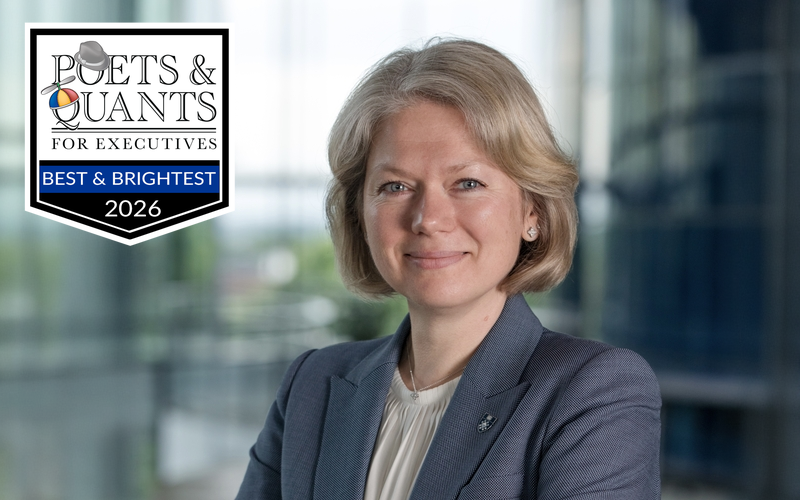
Olesya Afanasyeva
Yale School of Management
Age: 46
“Resilient, thoughtful, values-driven leader committed to growth, building strong teams, and striving for meaningful impact.”
Hometown: Calgary, Alberta, Canada
Family Members: Pavel Afanasyev, husband; Polina Afanasyeva, daughter
Fun fact about yourself: Despite a lifelong career in finance, when I was in college, I was convinced it was the one thing I would never do in my life.
Undergraduate School and Degree: BA in management and economics, International University in Moscow
Where are you currently working? Orion Steel Group, Senior Vice President and Chief Financial Officer
Extracurricular Activities, Community Work and Leadership Roles: Together with two of my classmates, I have been leading the class gift campaign for our class. I have also supported the Yale SOM EMBA program and admissions team through participation in recruitment events, new student webinars, and panel discussions.
Which academic or extracurricular achievement are you most proud of during business school? I am proud of being named a class marshal for the EMBA Class of 2026, an honor tied to strong academic performance in the core curriculum. What makes that recognition especially meaningful to me is that it did not happen in isolation. It was made possible by the support of my family, the trust and flexibility of my team at work, and the friendship and encouragement of my EMBA classmates, all of which made the experience both manageable and deeply rewarding.
At the same time, the best part of the EMBA journey was never the recognition itself. It was the opportunity to learn from extraordinary professors alongside a remarkable group of classmates whose perspectives, experiences, and friendship made the experience far richer than any individual accomplishment. That is what I will carry with me most from my time at Yale.
What achievements are you most proud of in your professional career? The achievement I am most proud of in my professional career is helping lead my company through a period of profound uncertainty, when the future of the business felt genuinely fragile.
It was the kind of moment when the usual assumptions no longer held. The environment around us was shifting quickly; the path forward was unclear, and many of the decisions in front of us carried consequences far beyond the numbers. In times like that, leadership becomes less about polished plans and more about steadiness, judgment, and the ability to keep people moving forward when there are no easy answers.
What I remember most is the weight of responsibility. Our choices affected not only the business, but also the people who depended on it — employees, families, communities, customers, and partners. That made the work deeply personal. We had to stay disciplined, make difficult decisions, and keep building credibility in an environment that offered very little certainty. In doing so, we helped preserve continuity for the business and protect thousands of jobs through one of the most difficult chapters in its history.
I am proud of that period not because it was dramatic, but because it revealed what leadership really asks of you: resilience, sound judgment, and the ability to give others confidence when certainty is hard to find. It also reinforced for me how important it is to have a team you trust unconditionally and can rely on fully. In moments like that, even the most difficult situations become manageable because you are carrying them together. That experience shaped me deeply and remains the professional achievement I value most.
Who was your favorite MBA professor? It is genuinely hard to pick one favorite professor because we had an extraordinary faculty at Yale. But if I were to name one, I would choose Professor Sonia Marciano. Her Competitive Strategy course stayed with me in a particular way and helped me think about strategy from a very different perspective than I had before. It also felt immediately relevant to the kind of questions I deal with in my work.
What I appreciated most was that she did not present strategy as something rigid or purely academic. She made it feel alive: shaped by choices, trade-offs, positioning, and judgment. Her class pushed me to think more carefully about how organizations create real distinction and how strategy is built through a series of connected choices rather than a single plan on paper. That shifted the way I approach strategy work in my own organization.
More broadly, her course reflected something I valued throughout the Yale experience: teaching that was intellectually rigorous, but also deeply practical. I left her class with not only new ideas, but a new way of looking at challenges I face every day.
Why did you choose this school’s executive MBA program? I chose Yale’s executive MBA program because it felt aligned with both who I am and the kind of leader I want to become.
At this stage in my career, I was not looking for an MBA simply to add another credential. I was looking for a program that would challenge me intellectually, broaden the way I think, and help me grow beyond the boundaries of my functional role. Yale’s mission of educating leaders for business and society resonated with me immediately. It reflected something I already believed deeply: business decisions do not happen in isolation, and leadership carries responsibility not only to shareholders, but also to employees, communities, and the broader system in which we operate.
I was also drawn to the structure of the program itself. The stakeholder-based integrated curriculum felt much closer to the real world than a traditional functional approach. In practice, leaders do not deal with finance, strategy, operations, and human behavior as separate categories. They are constantly balancing competing priorities, perspectives, and consequences. Yale’s approach reflected that complexity in a way that felt both practical and energizing to me.
Just as important was the community. I wanted a program with strong in-person engagement, outstanding faculty, and classmates who would bring very different life and professional experiences into the room. That has turned out to be one of the most rewarding parts of the experience. The diversity of perspectives at Yale has expanded not only what I have learned, but also how I think.
In the end, Yale felt like the right place for a new chapter of my personal and professional growth: ambitious, values-driven, and deeply connected to the world beyond the classroom.
What is the biggest lesson you gained during your MBA and how did you apply it at work? The biggest lesson I gained during my MBA was greater clarity about the kind of leader I want to be.
The program certainly deepened my understanding of strategy, economics, decision-making, and the complexity of the business environment. But its most meaningful impact was personal. It reinforced for me that leadership is not only about making sound decisions or delivering results. It is also about creating an environment in which other people can think boldly, act autonomously, and grow beyond what they believed possible.
That idea has become my North Star. I now find myself returning to a simple question: “What environment am I creating for my teams?” It has changed the way I lead – how I communicate, how I delegate, how I create clarity, and how I support the growth of others. I think more carefully not only about the decision itself, but also about the conditions around it: whether people have enough context, whether they feel ownership, and whether the culture encourages both accountability and initiative.
In that sense, the MBA has been as much about personal growth as professional development. It has given me new tools, but also a clearer sense of purpose. I have tried to bring that back to work by shaping my organization with greater intention, trust, and responsibility for the people I lead.
Give us a story during your time as an executive MBA on how you were able to juggle work, family and education? During my time in the EMBA program, balancing work, family, and school came down to discipline, routine, and a great deal of support.
Because I live in Calgary, getting to Yale for every class weekend meant a 13-hour journey each way, every other week. I never missed a class weekend, and over time that travel became part of the structure that held everything together. I built my own routine and knew exactly where I needed to be and when. That gave me a sense of control and stability as I managed the demands of work, school, and family all at once.
What made it possible, though, was not routine alone. It was also support. My husband was fully behind me from the beginning, and that made an enormous difference. Around the same time, our daughter had left for college, which was a major transition for our family, but it also opened the door for me to begin this chapter of my own. At work, I had to plan further ahead, delegate more thoughtfully, and trust my team even more. At home, we all had to be honest about what the program would require and adjust our lives to those demands.
Over time, even the people I met along the way became part of that support system. The Air Canada crews on my Calgary-Newark flights – many of whom I now know by name – and the hospitality staff at the Omni hotel in New Haven became familiar and welcome faces on this journey. I am genuinely grateful to that extended team as well.
The experience taught me that growth is rarely an individual act. It takes discipline, but it also takes the support, generosity, and belief of many people around you.
What advice would you give to a student looking to enter an executive MBA program? My advice would be to go into an executive MBA with intention, humility, and real commitment.
You will get as much out of the program as you put in. It is an extraordinary experience, but it is also a demanding one. The workload is real, the pace is fast, and the program will ask a lot of you over a sustained period of time. Before you begin, make sure you have the support of the people who matter most at home and at work. That support is not just helpful; it becomes part of what makes the experience possible.
I would also encourage anyone considering an EMBA to be willing to step outside of their comfort zone. You will need to learn how to be comfortable with being uncomfortable. There will be moments when you are outside your area of expertise, when the material feels unfamiliar, or when others in the room seem far stronger than you in a particular subject. That is not a weakness; it is part of the value of the experience. Some of the richest learning comes from leaning on your classmates and teammates, who will often be stronger than you in different areas, just as you will bring strengths they can learn from as well.
And finally, be fully present for the experience. Make the time for the conversations outside the classroom, the group work, the dinners, the informal moments, and the relationships that grow over time. Those parts of the journey matter just as much as the coursework, and they often stay with you the longest.
What is one way that your business school has integrated AI into your programming? What insights did you gain from using AI? One of the ways Yale integrated AI into the program was by treating it as a practical tool we were expected to learn to use thoughtfully, rather than as a separate topic to discuss in theory. As the technology evolved, our professors adapted in real time and incorporated AI into different parts of the learning process, from research and writing to presentations and other assignments.
What I found most valuable was learning how to use AI well, not just how to use it. It can be an incredibly powerful tool for research, analysis, and idea generation, but its value depends on the quality of the questions being asked and the judgment of the person using it. I think of AI as a highly capable analyst I can partner with, while I remain responsible for the direction, the interpretation, and the final outcome.
The experience also reinforced the importance of validation. AI can be extremely helpful, but it still needs to be challenged, tested, and used with care. That balance – openness to the tool, combined with discipline and accountability – was probably the most important insight I gained.
What was the main reason you chose an executive MBA program over part-time or online alternatives? I was specifically looking for an executive MBA program with a meaningful on-campus experience, where I could benefit from in-person teaching, active class discussion, and the opportunity to build strong relationships with my classmates. To me, one of the greatest strengths of an executive MBA is the wealth of practical knowledge and lived experience that participants bring into the room. That kind of learning is hard to replicate in a more remote or transactional format, and the Yale SOM EMBA program more than lived up to that hope.
How did you finance your EMBA and what did you do to make tuition and associated costs more affordable? My company sponsored my participation in the EMBA program, for which I am very grateful.
What is your ultimate long-term professional goal? My ultimate long-term professional goal is to become a CEO and lead the kind of successful, values-driven organization I believe in – one that does well by doing good.
DON’T MISS: BEST & BRIGHTEST EXECUTIVE MBAS: CLASS OF 2026
© Copyright 2026 Poets & Quants. All rights reserved. This article may not be republished, rewritten or otherwise distributed without written permission. To reprint or license this article or any content from Poets & Quants, please submit your request HERE.

